How EDP Generated a >50% ROI by Building a Data-Driven CRO Program Using VWO
About EDP
EDP is a global energy company headquartered in Portugal, with a global presence across Europe, the Americas, and Asia. The company produces, manages, and distributes electricity, with a strong focus on renewable energy sources such as wind, solar, and hydropower, as well as electricity supply, energy management, and related services.
With a customer-centric approach, EDP has earned the trust of industry leaders, SMEs, and over 3 million families worldwide, who rely on them to power their success and sustainability. And as more customers began discovering, comparing, and purchasing energy plans online, EDP (edp.pt) website became a critical gateway for lead generation and customer acquisition.
However, in the energy sector, digital changes require significant development effort and investment. Scaling solutions without validation risks rolling out experiences that may not improve business outcomes or meet user needs. This made it essential to test ideas before scaling them, ensuring that only improvements proven to enhance user experience and deliver measurable business value were implemented across the digital ecosystem.
To support this shift, EDP established a structured CRO program that evolved into a mature, cross-functional capability:
- Collaborative team model: The program evolved from a centralized structure into a cross-functional model involving UX, digital, sales, and development teams, enabling experimentation to be embedded across the organization.
- Agile experimentation workflows: Clear workflows were defined based on agile methodologies, integrating experimentation as a natural step within the development cycle.
- Advanced experimentation and personalization: The team progressed from foundational A/B testing to more sophisticated experimentation and personalization strategies tailored to different user typologies.
- Data-driven decision-making culture: Teams increasingly relied on behavioral insights and experimentation to validate hypotheses before implementing permanent changes.
From fragmented tools to a unified experimentation engine
When evaluating platforms to begin its experimentation journey, EDP encountered a familiar obstacle: most solutions operated in silos.
Some tools specialized in testing. Others focused on behavioral insights. Covering both would require stitching together multiple platforms, resulting in higher costs, greater complexity, and additional operational overhead.
VWO differentiated itself by centralizing both testing and behavioral insights within a single ecosystem.
- High customization without heavy development dependency
VWO enabled EDP to create and modify experiences without complex development cycles. This empowered teams to move faster and test more frequently. - Time and cost efficiency
Landing page development and collaboration activations became more efficient, reducing both turnaround time and resource costs. - Advanced, natively integrated A/B Testing
Rather than layering tools, VWO’s built-in testing functionality ensured seamless experimentation workflows and reliable result tracking. - A powerful insights module
With session recordings, heatmaps, and user behavior analytics included natively, EDP gained deep visibility into user journeys, without relying on additional software.
Why VWO
VWO Testing has been key to implementing the methodology, not only from a technological standpoint, but also in transforming the way we work by promoting a culture of continuous experimentation and data-driven decision-making.

José de la Espada
Analytics & CRO Lead
Goals
EDP’s CRO program was established to increase the return on digital investments while reducing the risk of deploying unvalidated experience changes. The program aimed to embed experimentation as a core capability, enabling teams to validate ideas before full implementation and make confident, data-driven decisions.
Key strategic goals included:
- Maximizing ROI from digital development investments
- Increasing lead generation and conversion efficiency across key digital journeys
- Improving the effectiveness of customer acquisition flows, including simulation and sign-up processes
- Establishing a scalable experimentation culture integrated into the development lifecycle
- Enabling data-driven decision-making across UX, digital, product, and business teams
As the program matured, experimentation became not just a validation mechanism, but a strategic enabler of digital growth.
Observations
As part of its CRO program, EDP established a structured process to understand how users interacted with its digital ecosystem and identify opportunities for improvement. Using VWO Insights, the team analyzed real user behavior to understand how users navigated key journeys, where friction occurred, and at which stages users dropped off.
Here are some of the many key discoveries they made:
Observation 1: Friction on the offer page
Behavioral analysis revealed that users were dropping off before progressing to the offer stage. The structure of the page required users to provide multiple pieces of information early in the journey, increasing cognitive load.
Observation 2: High abandonment during form completion in B2C simulator
Analysis of the solar savings simulation flow — where customers estimate potential solar energy savings before requesting installation — revealed that users were required to provide their email address before viewing the results. Although many users shared their contact information, +90% abandoned the flow after seeing the results, suggesting uncertainty about the next step in the journey.
Observation 3: Pricing page traffic not converting into subscription journeys
Although the pricing page attracted high traffic, very few users progressed to the pricing page (start of the subscription process), indicating confusion in selecting the most relevant offer.
Tests run
Based on insights gathered from observations and funnel analysis, EDP developed multiple hypotheses and validated them through A/B tests using VWO Testing.
Test 1: Progressive information capture on the offer page
Hypothesis:
The first hypothesis centered on the idea that distributing required fields progressively throughout the journey, rather than requesting them all upfront, would reduce friction and encourage users to progress toward the offer stage.
What was changed:
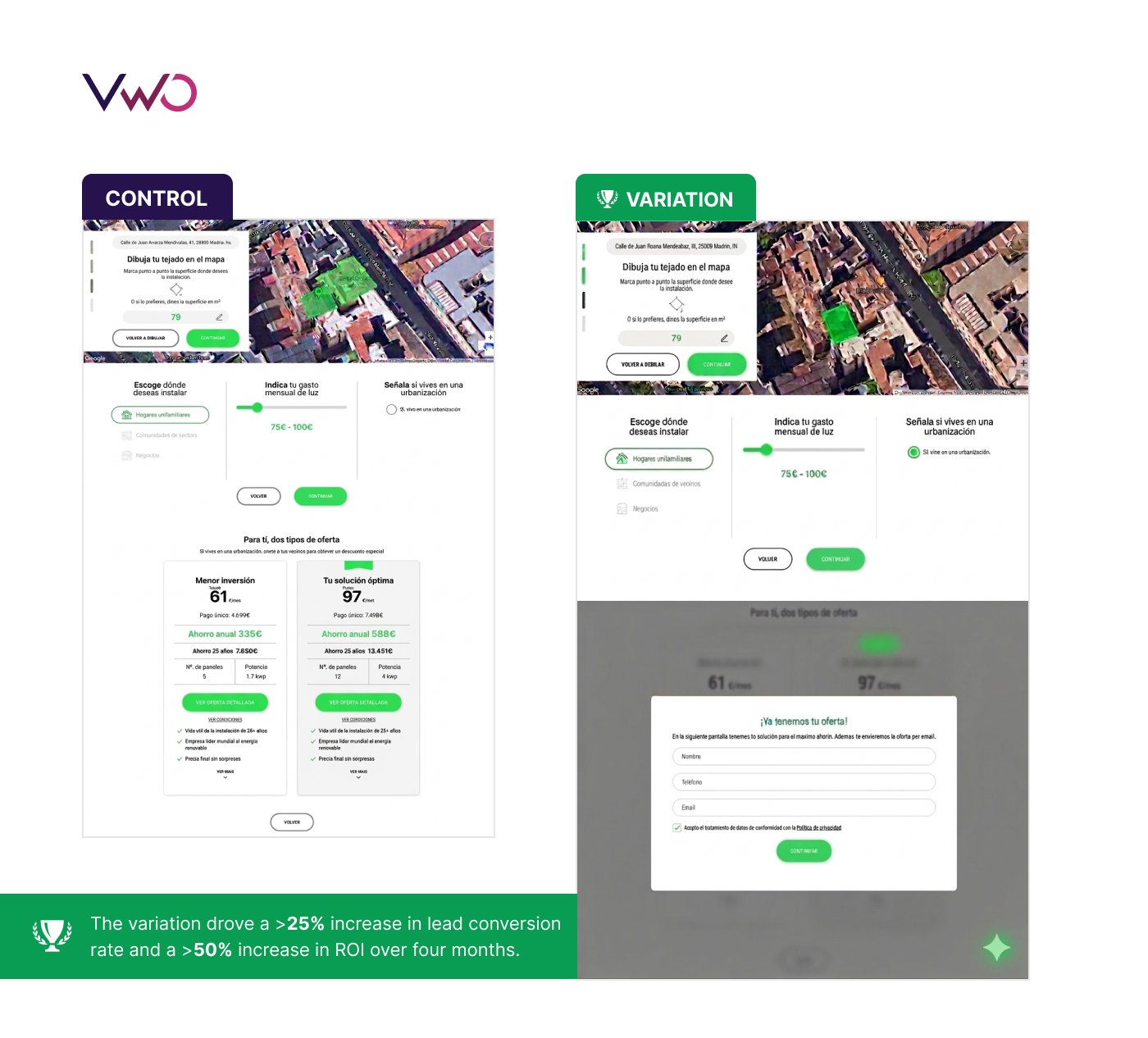
The team ran an A/B test on the offer page within its lead acquisition funnel.
In the control version, required fields such as name, phone number, and email were presented too early in the journey, before users had built enough context or intent to continue.
In the variation, required fields were distributed progressively throughout the funnel, with the most relevant ones requested closer to the offer stage. This made the interaction feel more contextual and aligned with the user’s progression through the journey.
Results
The experiment delivered a >25% increase in lead conversion rate, validating the hypothesis that restructuring how and when data was requested could significantly improve user progression.
Within just four months, the program delivered a >50% return on investment, demonstrating the tangible business value of embedding experimentation into its digital optimization strategy.
Additional benefits included:
- Increased engagement and conversion driven by data-backed experience improvements
- Reduced development time and costs by validating changes before full implementation
- Improved operational efficiency through faster testing and iteration cycles
- Consolidation of behavioral analysis and testing within a unified optimization workflow
Following the successful pilot in Spain, EDP scaled its experimentation model to Portugal, embedding testing into agile workflows and establishing a structured experimentation culture within six months. This ensured that optimization became a scalable and sustainable capability across its digital ecosystem.
Test 2: Form simplification in B2C simulator flow
Hypothesis:
Next, it was hypothesized that reducing drop-offs after the simulation stage. Since users had already shared their contact information to access the solar simulation results, the team believed that enabling earlier lead activation and simplifying the transition to commercial contact could reduce abandonment and recover lost opportunities, as many users were still dropping off after viewing the results.
What was changed:
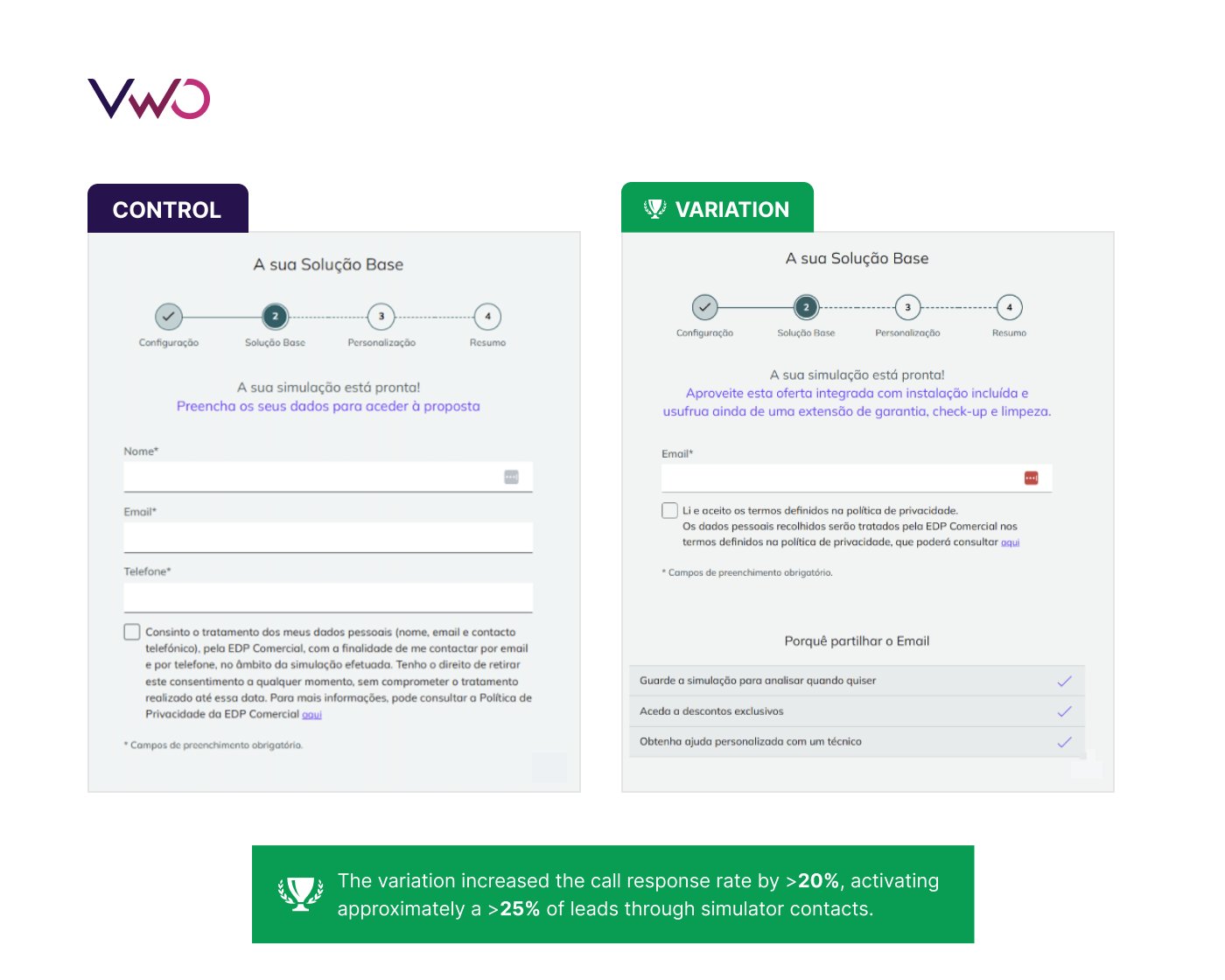
To address this, EDP tested a revised approach to activating leads captured during the simulation flow. In the variation, the team adjusted the lead-nurturing step to enable earlier lead activation. Since users had already shared their contact information during the simulation, these leads could be directly activated by the sales team without requiring users to continue through the rest of the journey.
Results
The experiment helped recover a significant number of opportunities that were previously lost within the simulation journey.
- The call response rate increased >20%.
- Approximately >25% of leads during the period were activated through simulator contacts.
These results demonstrated that engaging users earlier in the journey helped EDP convert high-intent visitors who would otherwise have abandoned the flow.
Test 3: Pricing page redesign to improve subscription progression
Hypothesis:
For the third test, the team believed that improving the visual hierarchy of the pricing page and highlighting the most relevant offer would guide users more effectively toward the subscription process.
What was changed:
EDP tested a redesigned version of the pricing page aimed at guiding users toward the most relevant subscription option.
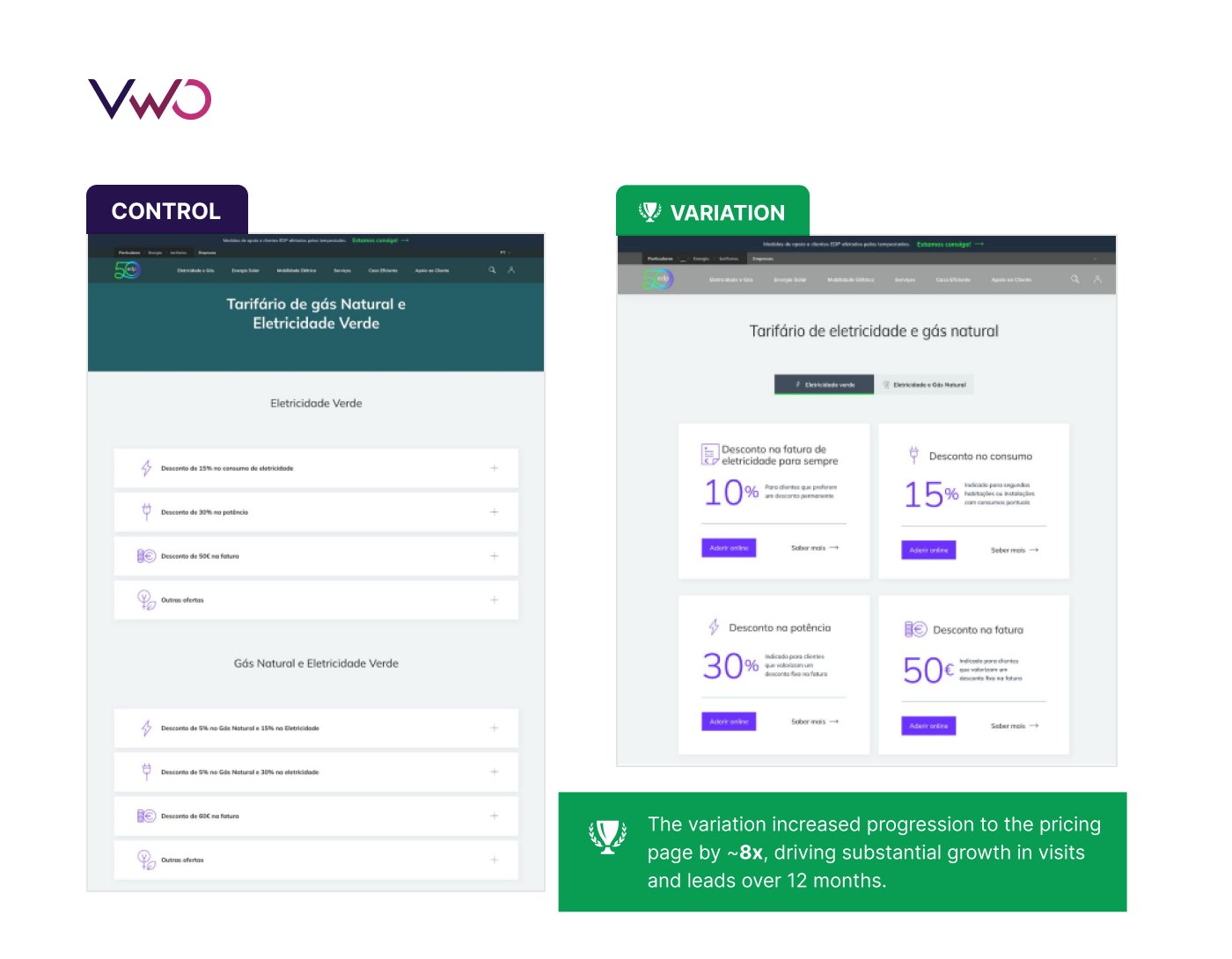
In the control version, pricing options were presented in a list-style accordion layout where users had to expand individual items to view offer details. This made it difficult for users to quickly compare offers or identify the most relevant plan.
In the variation, the pricing page was redesigned using visual offer cards that clearly highlighted the available discounts and benefits. The updated layout improved visual hierarchy, made it easier to compare options, and added clearer calls-to-action guiding users toward the subscription process, allowing them to book directly from the page and increasing the potential for conversions.
Results
The variation multiplied the progression rate to the pricing page by approximately 8 times, driving a substantial increase in visits and leads over 12 months
Implications and opportunities
These experiments were part of EDP’s broader CRO program, where behavioral insights and structured experimentation were used to continuously identify and remove friction across key digital journeys.
Encouraged by the results, EDP is focused on evolving its CRO practice from a tactical optimization effort into a strategic, globally scalable capability.
Key priorities for the next phase include:
- Scaling experimentation across markets and business units: Replicating the proven optimization model across additional regions and digital properties to drive consistent performance improvements at scale.
- Advancing experimentation maturity: Expanding the roadmap to include more sophisticated tests and personalization strategies that optimize performance across the entire customer journey.
- Embedding experimentation into core business processes: Making testing a standard part of product development and decision-making, ensuring that digital changes are validated before implementation.
- Maximizing financial impact through data-driven prioritization: Continuously improving ROI by focusing development resources on initiatives proven to deliver measurable business value.
VWO continues to support this vision by enabling EDP to scale experimentation efficiently across markets, ensuring that insights can be translated into validated improvements across their digital ecosystem.
Conclusion
EDP’s experimentation program demonstrated how validating changes before implementation can significantly improve both business outcomes and operational efficiency. By using behavioral insights to guide experimentation, the team identified high-impact opportunities across the conversion journey, reduced friction at critical stages, and ensured that development efforts delivered measurable results.
For organizations facing similar challenges, the key takeaway is clear: sustainable digital growth comes from understanding user behavior and validating improvements through structured experimentation. Instead of relying on instincts or assumptions, teams can use experimentation to confidently scale changes that deliver real impact.
If you are ready to apply these principles to your own digital ecosystem, you can start a free trial or request a demo of VWO to explore how experimentation and behavioral insights can help you optimize experiences and maximize ROI.

Location
Portugal
Industry
Services
Experiment goals
Optimize ROI & Increase lead conversions
Impact
Generated a >50%+ ROI and a >25% potential increase in lead acquisition conversion rate in 6 months