 DE
DE
 BR
BRHow Meliá Hotels achieved a risk-free funnel rollout from 5% to 100% in one week with VWO Feature Experimentation
About Meliá Hotels: Building a CRO Team in the Hospitality Industry
Meliá Hotels International is one of the world’s most recognized hospitality brands, with a presence in over 40 countries.
With millions of bookings flowing through their digital channels, even small changes to the booking funnel can impact conversion rates, which makes feature experimentation a core capability for their CRO team.
The experimentation program is led by Jorge Arboleya Pérez, CRO & SEO Team Lead.
His focus from day one has been breaking down silos between teams. CRO, data, design, content, and engineering all sit in the same room when an experiment is being planned.
That cross-functional collaboration is what makes the program work.
The team runs on a fail-fast mindset: every experiment, whether it wins or loses, produces insight that feeds the next one.
To make those learnings accessible beyond the squad, Jorge built a CRO knowledge database that anyone in the organization can query through MCP.
Past experiments, results, and hypotheses are all searchable in a conversational format, so data becomes a shared asset instead of sitting in someone’s spreadsheet.
The cross-functional squad behind Meliá’s booking funnel optimization:
- Data / Web Analytics Specialist:
Analyzes user behavior through heatmaps, session recordings, and journey mapping to identify where users drop off and why. Quantifies the business impact of each friction point so the team can prioritize the experiment backlog based on real numbers, not gut feeling.
- UX Designer:
Takes the friction points identified by Data and designs solutions through the lens of user psychology. The goal isn’t just making things look right. It’s understanding how people actually behave, what motivates them, and where cognitive biases shape their decisions in the booking flow.
- Content Specialist:
Owns the copywriting side of experimentation. Some of the biggest wins the team has seen came from changing a handful of words, not from redesigning a page. This role makes sure the narrative across the funnel is persuasive and aligned with what guests expect at each step.
- CRO Lead & Specialist:
The Lead defines the experimentation strategy, decides which problems to tackle first, and makes the final call on scaling or killing a test. The Specialist runs the day-to-day operations: heuristic audits, hypothesis formulation, test configuration, QA with the developer, and results documentation. Together, they keep the pipeline moving from business case to validated learning.
- IT Developer:
Implements the experiments that go beyond simple code injection, configures the feature flags in VWO, and ensures that each test runs cleanly without breaking page load, analytics tracking, or SEO.
Why Meliá chose VWO as their feature experimentation platform
Meliá needed a feature experimentation platform that plugged into their existing architecture while allowing stakeholders outside of engineering to see experiment progress without asking for a custom report.
We chose VWO as a long-term strategic engine to help us democratize experimentation across the organization. It acts as a meeting point for all Growth profiles, balancing statistical robustness with operational agility. This allows us to scale a true data-driven culture where even failures become valuable business learnings.

Jorge Arboleya Pérez
CRO & SEO Team Lead
Goals
Meliá’s product team faced a challenge familiar to any hospitality brand focused on optimizing the booking funnel:
How to increase visibility and drive adoption of add-on services (pet care, early check-in, parking) without introducing significant friction in an already optimized booking flow?
Pet care services, early check-in, and parking options were common add-ons that customers could choose from during the booking process.
Meliá’s previous user research and behavior analysis also revealed some crucial insights:
- For users to choose add-on services, they first had to be made aware of the availability of these extra offerings.
- Visual elements had a positive impact on users, enabling them to better understand the value proposition and facilitating faster decision-making.
- Showing the services too early or too late in the journey could reduce their effectiveness.
The challenge: Adding an extra step without increasing drop-offs
While these add-on services generated clear value for Meliá, they appeared much later in the booking funnel.
At the same time, any structural change to the already optimized booking process could have a ripple effect on critical business outcomes such as revenue and final bookings.
This concern was further reinforced by a broader industry pattern in hospitality:
As a rule of thumb, every additional click in the booking funnel tends to introduce friction and increase the likelihood of drop-off.
This is why feature experimentation with progressive rollouts is the right approach for testing structural changes to booking funnels.
It lets teams expose changes to a controlled subset of users and roll back instantly if key metrics take a hit.
Against this backdrop, Meliá’s core question became
Can we introduce a new step to surface extra services earlier to drive up average booking value without increasing drop-offs in the funnel?
The team needed a way to introduce this change safely, learn from real user behavior, and retain the ability to pause or adjust before a full rollout.
Meliá's progressive rollout: From 5% to 100% of traffic in one week
Based on learnings from past research and the need to increase the visibility of these add-on services, the team defined a clear set of validation criteria to manage the rollout:
The goal was to introduce an additional, well-timed step that surfaced extra services at a relevant moment in the booking journey. This approach aimed to increase awareness and consideration of add-ons while ensuring users could move from the room selection stage to Rate Selection (Step 2) without increasing drop-offs or negatively affecting final confirmations.
The criteria also aligned with learnings from previous Meliá experiments, where additional information had been introduced in a controlled manner (for example, daily price calendars for a subset of hotels).
In those cases, incremental exposure enabled the team to observe real user behavior before committing to a full rollout rather than assuming a positive outcome upfront.
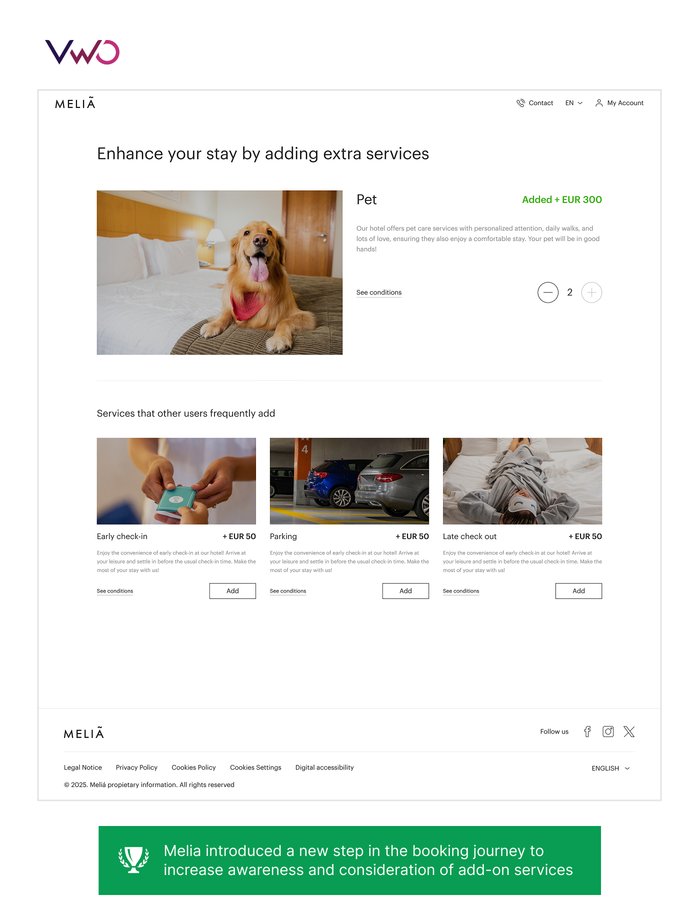
Feature flags in action: How the rollout was configured in VWO
The release of this extra step was managed with VWO Feature Experimentation through:
- Progressive rollout: Gradually release the new step to more users while monitoring its impact, analyzing the results, and choosing whether or not to pause it, without blocking key business decisions.
- Impact analysis: Track and measure how the next step impacts key metrics to see what’s working and what needs improvement before committing to a full rollout.
- A/B Testing (feature on vs feature off): Test the introduction of the new step through limited exposure, rather than releasing it to all users at once.
The team deliberately designed a risk-aware metric framework in VWO to judge the impact of the change in a balanced way:
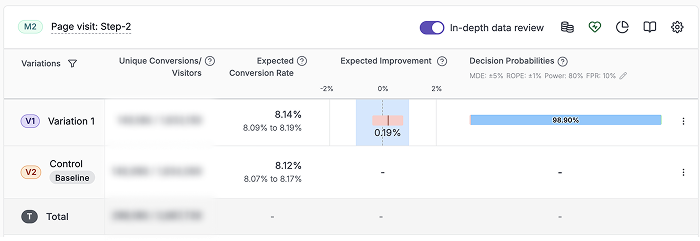
- Primary decision metric – Page Visit to Rate Selection (Step 2):
This measured movement from the room selection/checkout entry step to the Rate Selection page. It served as the most sensitive behavioral signal of friction, helping the team understand whether the new “Extra Services” step led to users dropping off or improved the revenue per visitor. - Guardrail metric – Final confirmation:
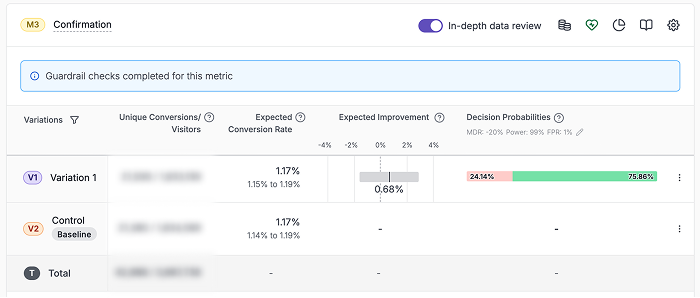
Final conversion was treated as a protective guardrail to ensure that introducing the new step did not harm the core booking outcome. Any meaningful deterioration here would have triggered a pause or redesign. - Supporting value metric – Revenue per visitor:
Revenue was tracked as a complementary signal to understand potential business value, while acknowledging its natural variability and higher noise compared to behavioral metrics. - Statistical rigor: The experiment was designed with statistical rigor. The team defined a Minimum Detectable Effect (MDE) of ±5% and set the false positive rate (Type I error) at 10%, with 80% statistical power. This ensured that observed changes reflected real user behavior rather than random noise. Revenue per visitor, being inherently more variable, was treated as a supporting signal rather than the primary decision metric, a practice that reduces the risk of Type II errors when working with high-variance metrics.
Why feature experimentation, not web testing, was the right approach
Feature experimentation allows product teams to test structural changes (like adding an entirely new step to a booking funnel) by controlling exposure at the code level through feature flags.
Unlike client-side web testing, it works server-side, meaning changes are built on existing backend modules rather than overlaid on the frontend.
A direct production launch, without prior validation, would have exposed the entire booking funnel to a structural change with no immediate rollback capability.
VWO Feature Experimentation (FE) eliminated that scenario entirely, allowing Meliá to contain risk while still moving at business speed.
Also, since the goal was to isolate the structural impact of introducing a new step, the team felt VWO Feature Experimentation would be far more effective than personalization or complex multi-variant steps.
It enabled the team to introduce the new step in a phased manner, building the change on top of existing backend modules rather than reconstructing them on the frontend.
Also, opting for VWO FE meant the entire process would stay aligned with the site’s native architecture, reducing unnecessary engineering effort.
The team could then safely introduce the extra step to specific user segments first and monitor its impact, rather than releasing it to all users and risking irreparable damage to the funnel.
Additionally, VWO FE helped decouple risk from the release while maintaining zero latency, which is a critical factor for highly sensitive conversion journeys like the booking funnel.
Jorge Arboleya Pérez, CRO & SEO Team Lead at Meliá, describes how VWO’s feature experimentation platform fits into their broader optimization stack:
The greatest value VWO offers comes from the infrastructure that enables Research and Testing to be integrated, breaking down departmental silos. VWO allows us to move seamlessly from qualitative data (Insights) to experimentation (Testing): while analytics tells us the ‘what,’ VWO Insights explains the ‘why’ behind user behavior, which is critical for formulating winning hypotheses. Its versatility is comprehensive—it enables us to scale the experimentation program by balancing execution speed with technical complexity, unifying Client-Side, Server-Side, and mobile app experimentation through VWO Feature Experimentation, ensuring that learning is at the center of every technical decision.
Jorge Arboleya Pérez
CRO & SEO Team Lead
Results: 1.85% uplift in average revenue per visitor with zero funnel friction
The extra step was successfully introduced in Meliá’s booking funnel through VWO Feature Experimentation.
Due to confidentiality policy, Meliá is unable to publish the complete statistical outputs of this experiment, including confidence intervals, p-values, and full sample size breakdowns.
The results reported below reflect the business metrics internally validated and used as the basis for decision-making. The extra step was successfully introduced in Meliá’s booking funnel through VWO FE.
While the initial rollout was limited to 5% of visitors, the team gradually rolled it out to 15%, 50%, and finally 100% of visitors within the span of one week.
Adding an extra step to a booking flow typically raises concerns about increased drop-offs or reduced conversions.
However, the results showed no negative impact on the funnel, i.e., there was no increase in users dropping off during this step.
Instead, the data showed an estimated uplift of 0.68% in final booking confirmations, indicating that the new step actually encouraged booking conversion.
Most importantly, the data indicated a 1.85% uplift in average revenue per visitor, leading to tangible business outcomes for Meliá.
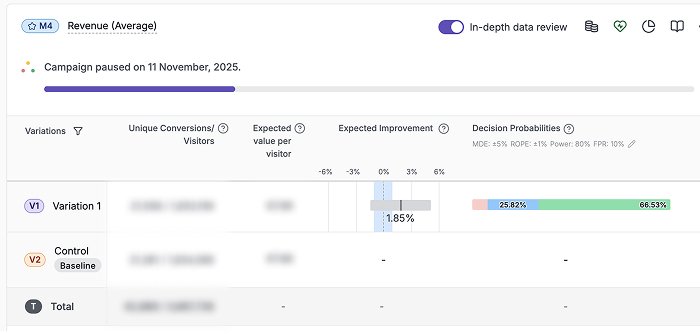
Despite introducing a new interaction point, here’s what happened:
- The booking funnel remained 100% stable, with no measurable increase in drop-offs despite adding an extra step.
- More users progressed through the funnel, indicating the new step added value rather than friction.
- Final booking confirmations showed an estimated 0.68% uplift.
- Revenue per visitor increased by 1.85%, confirming tangible business impact from the progressive rollout.
Key insight: Timing matters more than clicks in booking funnel optimization
Despite introducing such a big change, the extra step caused no measurable increase in friction in the booking process. In fact, the team registered a slight uplift in revenue after the addition of an extra step.
This proved that early exposure to extra services can be integrated into the journey without generating evident friction, provided that its impact on user progression is carefully monitored.
Also, adding an extra step does introduce cognitive load, even when behavioral metrics remain stable. This is why teams must evaluate not only what is shown, but when it is shown.
They also learnt that value metrics like revenue can provide useful signals, but they should always be interpreted in combination with more stable behavioral metrics.
Opportunities and next steps
Building on these insights and learnings, the team is now planning its next experiment to further refine how and where additional services fit into the booking journey.
While the current change did not harm the funnel and even led to a modest revenue uplift and even booking conversions, the team at Meliá wants to continue challenging their learnings and improve the overall user experience.
One idea is to reposition the selection of extra services after the room booking is completed.
Since many of these add-on services are paid for directly at the hotel, moving this step post-confirmation could reduce cognitive load during the reservation process.
Meliá will test this change against the current flow, and they are also exploring new experiment ideas to better isolate the value impact while keeping the booking funnel as a stable baseline.
Apart from this, the team also plans to continue tracking key metrics and gathering behavioral insights as part of the post-rollout validation process.
This is to confirm whether behaviors observed during experimentation hold at a greater scale.
Conclusion
This feature rollout reflects Meliá’s strong belief in validating decisions and mitigating risk through guardrail metrics before any critical release.
By relying on gradual rollouts and data-backed validation, the team can confidently optimize high-impact journeys like the booking flow.
Given the volume of traffic in these funnels, even small performance improvements can drive meaningful impact at scale.
What can hospitality brands learn from this feature experimentation approach?
With this experiment-driven approach, the team is able to navigate uncertainties regarding key product decisions and manage feature releases without compromising on speed or safety.
One of the most significant learnings from this project goes beyond the results themselves: it lies in the process that made them possible.
In any large-scale organization, internal pressure to ship changes directly to production is a constant reality, regardless of the potential risk involved.
Feature experimentation served as the mechanism that allowed Meliá’s team to defend data-backed decisions against that pressure, decoupling the moment of release from the moment of validation.
No change goes live at full scale without evidence first. That principle, now embedded in how the team operates, is arguably the most durable outcome of this experiment.
If you’re looking to implement feature experimentation, VWO supports progressive rollouts, guardrail metrics, and server-side testing.
This is the exact setup Meliá used to safely introduce an extra step in its booking funnel.
Schedule a demo to explore the endless possibilities that VWO opens up for your team.

Location
Spain
Industry
Travel
Experiment goals
Increase adoption of add-on services without creating friction
Impact
Booking flow remained stable & expected uplift of 1.85% in revenue per visitor