
 DE
DE
 BR
BRAURUM drives 4× trial activation through experiment-led onboarding with VWO
About Aurum
AURUM is a leading legal technology company focused on helping law firms and legal professionals operate more efficiently through Astrea, its practice management platform.
For AURUM, product experience plays a decisive role in commercial success. The trial period is not simply a lead qualification phase, it is where users must quickly perceive value, build confidence, and adopt the product as part of their daily workflow.
To support this, AURUM’s growth team operates with a strong experimentation mindset, embedding discovery, testing, and learning directly into product development cycles. Using VWO as its experimentation platform, the team runs a continuous pipeline where each test validates a specific user story and learning objective, allowing the Astrea trial experience to evolve based on real user behavior.
Why VWO
VWO has been an essential tool for enabling a culture of continuous experimentation within the Growth team. It allows us to test hypotheses quickly, safely, and autonomously, even in a complex product context with multiple dependencies. The flexibility to create A/B tests, combined with data reliability and ease of tracking results, makes VWO a strategic partner in decision-making—not only to validate ideas, but to generate actionable insights that guide product evolution. In addition, VWO adapts very well to our experimentation pipeline, where each experiment is treated as an investment in learning, not just an attempt at immediate gain. Another highlight is the support from the VWO team, which has been extremely close and efficient. We have monthly follow-up meetings, as well as quick email responses and a great willingness to support problem solving, which increases our confidence to experiment more quickly and safely.

Sarah Benicio
Growth Product Manager
Goals
Astrea offers users a 10-day free trial, designed to help them quickly experience the core value of the product. However, before the improvements were implemented, legal clippings, the main input required to use Astrea, could take up to 48 hours to become available. In practice, this meant users often took up to three days to reach the “Aha” Moment: processing of the first clipping.
This delay weakened early value perception, increased the risk of abandonment, and slowed activation momentum.
While this challenge triggered the experimentation journey, the broader objective was larger than solving a single delay. The growth team set out to build a structured, gradual progression toward activation across the entire early trial journey.
Program North Star: Activation during the trial period
Beyond focusing on the activation moment (a single event), the goal was to guide users step by step through the entire growth flow levers—from first access, through first experience, into early engagement, and finally into meaningful product usage.
All initiatives were designed to run within the first 10 days of the trial, with a shared focus on accelerating initial activation and engagement with key features. Each experiment and rollout contributed to this goal, with a specific primary success metric aligned to its role in the journey.
Hypothesis
Analysis of user behavior during the Astrea trial revealed a consistent pattern: users who engaged in early activation behaviors—reducing their time to value—were significantly more likely to convert into paying customers. These behaviors included:
- Processing their first clipping (core value moment)
- Adding an initial task (core workflow engagement)
- Adding a fee to a case (key habit-forming intent)
- Progressing successfully through the first experience journey into real product usage
The team hypothesized that redesigning onboarding and trial experiences to systematically guide users through these activation and engagement behaviors, reducing friction, reinforcing progress, and prioritizing initiatives through a structured experimentation pipeline focused on key growth levers, would accelerate value perception and increase activation rates.
Experiments run
Experiment 1 — First experience compound test
Stage: First access → Initial activation
Purpose
Early user journeys lacked clarity and direction. Actions were not obvious, progression was unclear, and setup steps did not clearly connect to real product value.
The objective was to reduce friction, create visible progression, and build early momentum.
What was changed
Instead of testing isolated UI elements, the growth team redesigned the entire first experience as a single composite journey:
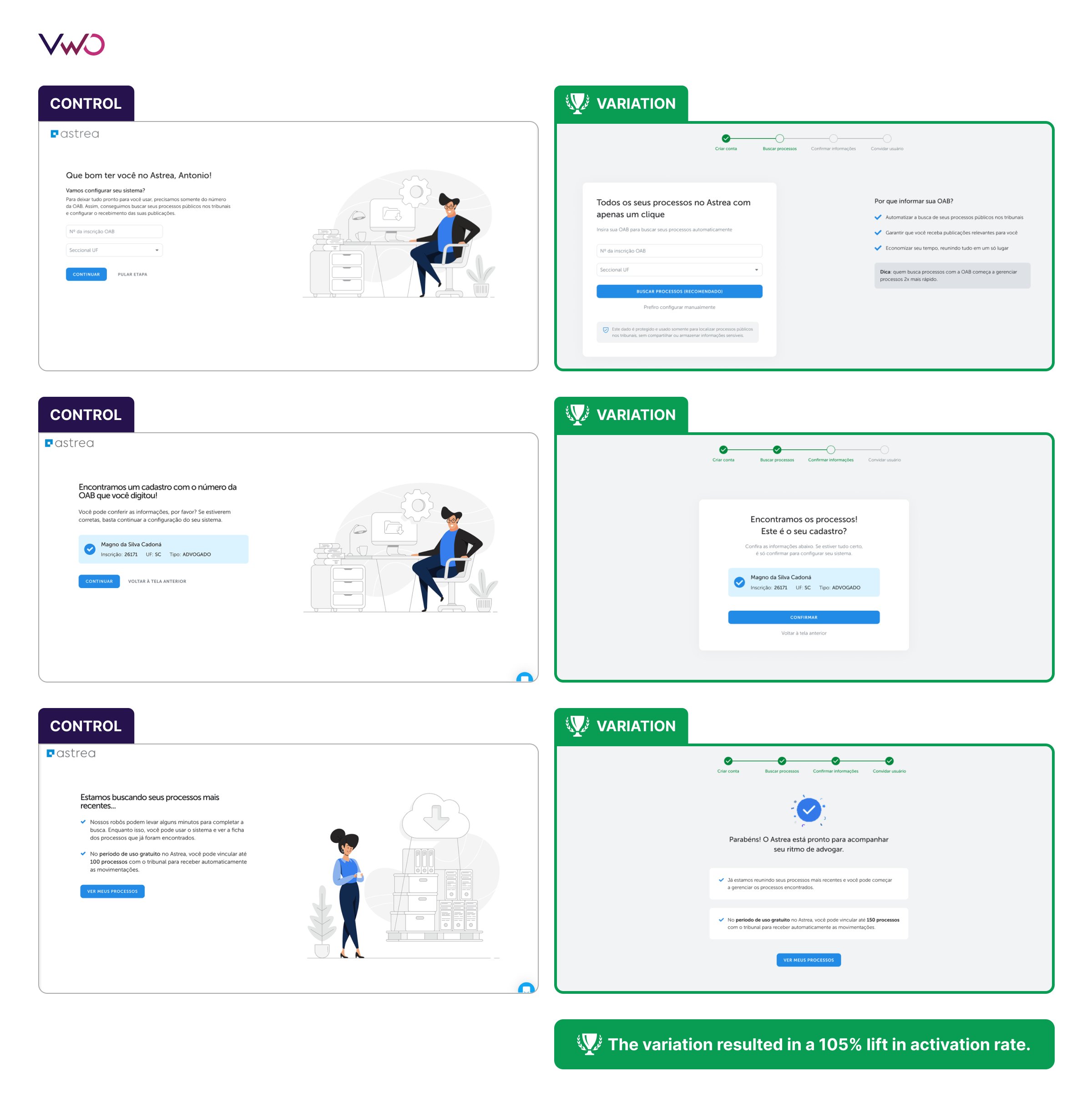
- In the control, large decorative illustrations dominated the screens, pulling attention away from the core setup action and creating visual distraction. In the variation, the carousel was restructured to remove the oversized illustration and refocus attention on the core setup action.
- The control lacked clear journey structure and step sequencing, offering users little sense of flow position or progress toward completion. In the variation, a progress bar was introduced clearly showing: which steps are part of the flow, which step the user is currently on, and which steps have already been completed.
- The first experience felt like isolated screens rather than a connected journey, with no continuity or momentum. The growth team redesigned the entire first experience as a single composite journey, treating setup as one continuous activation flow.
- In the control, OAB registration appeared as a mandatory compliance step with no explanation of user value. OAB registration was reframed to highlight its value, showing that informing the Brazilian Bar Association directly enables better use of Astrea’s features.
*OAB is the Brazilian Bar Association, which is the entity that regulates lawyers in Brazil.
Metrics tracked & impact
Primary metric:
Activation rate during the 10-day trial: Users performing meaningful value actions such as adding tasks, adding fees, or processing a clipping.
Secondary metrics:
- Completion rate of the first experience flow: Users who successfully progressed through the guided setup journey and enter the product workspace, i.e., complete the flow by clicking “Ver meus processes” or “View my cases”, marking the transition from onboarding into product usage.
- Rate of users who return and perform meaningful activation actions: Tracked whether users moved from setup into real value behavior, such as adding tasks, adding fees, and engaging with core workflows, validating that early experience improvements translate into genuine product adoption.
Guardrail metric:
Drop-off during the onboarding was set as the guardrail metric to ensure structural changes did not introduce confusion, friction, or abandonment at the most sensitive stage of the journey. This protects experience quality and trust while optimizing for activation.
Impact:
The experiment delivered a 105% lift in activation rate, representing a 7-percentage-point increase. This confirmed that restructuring the first experience around clarity, progression, and trust directly accelerates early activation and strengthens trial momentum.
Experiment 2 — Onboarding checklist
Stage: First experience integration and configuration → Engagement and completion
Purpose
After improving the first experience, the next challenge was maintaining momentum. The goal was to convert early trial usage into structured progression, ensuring users moved directly from first experience completion into activation behavior.
What was changed
A next-steps onboarding checklist was introduced into the first experience, designed specifically to guide users toward activation-driving behaviors in Astrea:
- Add a task
- Process a clipping
- Add a fee
To reinforce momentum and reduce uncertainty, the existing “First Steps” progress indicator was iterated to reflect user progression through these activation actions. This provided clear feedback, reinforced completion behavior, and created continuity between first experience completion and early activation.

The dashboard served as the starting point for user onboarding

A floating checklist in the bottom-left corner guided users through onboarding steps

Completion confirmation reinforced successful onboarding activation
Metrics tracked & impact
Primary metric:
Activation rate during the trial, defined as the percentage of users who completed all setup steps and reached the clipping stage.
Secondary metrics:
- Rate of users who successfully complete the first step: Driven by clearer journey structure and visible progress feedback through the “First Steps” indicator
- Activation setup usage: Driven by checklist-guided actions across key activation steps (Add a task, Process a clipping, Add a fee)
Guardrail metrics:
- Checklist trigger timing had to remain stable because it sat at a critical handoff point in the journey. It displayed three key activation actions: adding a task, processing a clipping, and adding a fee. This metric had to be monitored so that it didn’t appear too early (before context was established) or too late (after users had already disengaged). The goal was to maintain a balance between guidance and friction.
- First-session error rate was monitored as the first session is the most sensitive moment in a trial, where early friction has a disproportionate impact on drop-off. If the checklist increased cognitive load or caused users to take incorrect actions, it would surface immediately during this initial interaction. Later sessions are influenced by multiple external factors, making them less reliable for isolating the checklist’s impact. Therefore, the primary concern was to ensure the checklist did not negatively affect the user’s very first product experience.
Impact:
When users were exposed to the new feature, activation rate increased by 187%, with conversion rates across key activation setup events rising by 21% and 25%. This confirmed that guided progression outperforms unguided discovery, turning early trial usage into structured activation rather than passive exploration.
Experiment 3 —Retroactive legal clippings on first access
Stage: First access → Aha Moment / Activation moment (Single event)
Purpose
This experiment addressed the most fundamental barrier in the Astrea trial journey: delayed value realization.
As highlighted earlier, the delayed availability of legal clippings, the core input required to use Astrea, extended the time-to-first-value. This weakened early value perception, increased abandonment risk, and slowed activation momentum.
The focus was on optimizing the single event that drives activation, legal clipping processing, rather than the multi-step onboarding experience.
What was changed
Previously, clippings were only captured after account creation, which could delay access by up to 48 hours. With this experiment, recent clippings from moments before account creation were made available immediately, enabling users to engage with real data from their very first access.
By integrating an external API, clippings were made available as soon as users entered the product for the first time. This allowed users to:
- View real clipping content instantly
- Process clippings from day one
- Engage with Astrea’s core workflow without waiting periods
This change was introduced through a controlled rollout, continuously monitored, and is now part of the standard trial flow. It reshaped the trial journey by building immediate value into the very first user experience, helping users reach the “Aha” moment faster.
Metrics tracked & impact
Primary metric:
Rate of users who engaged with a clipping during the trial: This measures whether users experienced Astrea’s core value at least once.
Secondary metric:
Activation rate: Rate of users who completed key onboarding actions and reached full activation during the trial. This milestone was achieved when users processed their first clipping and completed the onboarding checklist, after which a confirmation and reward reinforced their successful activation.
Guardrail metrics:
Error rate when sending clippings & delivery time: These were monitored as safety controls to ensure that introducing immediate clipping access did not compromise system stability or data reliability. Any increase in errors or delivery delays would undermine trust in the product and disrupt the first-access experience, even if activation improved.
Impact:
This variant delivered a 16 percentage-point absolute increase in engagement compared to the control, representing a 125% relative uplift in retroactive legal clippings.
Why feature experimentation
VWO Feature Experimentation provided the flexibility AURUM needed to test different layers of the product journey, from frontend experience design to backend value delivery, within a single experimentation framework. This allowed the team to apply the right feature to each change, based on its complexity and level of risk.
A/B testing played a critical role in the composite test by enabling the growth team to validate the redesigned first experience as a complete activation journey rather than a set of isolated interface changes. As the experiments moved deeper into the journey, controlled rollouts offered better solutions. The onboarding checklist and guided progression logic were introduced gradually, allowing the team to observe user engagement, monitor early-session stability, and ensure that structured guidance improved activation without creating friction in the experience.
Again, a controlled rollout was essential for retroactive clipping access acceleration due to backend complexity and external API dependencies. Although the initiative involved integration with an external API and logic within Astrea’s backend, it was run as a Feature Experimentation campaign using VWO Feature Experimentation (FE) because the objective required coordinated changes across both frontend and backend layers.
To ensure consistency of the experience, it was necessary to verify the user variant at two different points:
- on the frontend, to control the experience displayed to the user, and
- on the backend, to apply business logic and integrate with the external API.
VWO FE enabled variant verification directly on the backend, making this type of full-stack experimentation possible. This ensured that frontend experience, backend logic, and API integration remained perfectly aligned throughout the rollout.
Further, the VWO segmentation feature allowed the team to precisely target early-stage trial users, ensuring that each experiment appeared only at the right moment in the journey and aligned with the correct activation stage. At the same time, VWO guardrails enabled the team to scale experimentation safely by continuously monitoring stability, error rates, drop-offs, and delivery performance, so activation gains were achieved without introducing friction, reliability risks, or experience degradation.
Tests run
Across the year, continuous experimentation led to sustained improvements in activation-related metrics:
- Activation: 1% → 4% (4× increase, +300% growth): Across the full set-up of valuable actions, trial users completing key early-value behaviors increased significantly. For the isolated activation moment (processing a clipping), the rate increased from 12% to a consistent 35% (+192% growth), demonstrating that guiding users through the full activation flow significantly accelerated time to value and engagement.
- Adding fees: 8% → 14% (+75% growth): The percentage of trial users who added at least one fee during the 10-day trial, indicating deeper engagement and stronger intent to operationalize the product.
- Rate of users engaging with legal clippings (activation moment – single event): 14% → 30% (+114% growth): More users discovered and interacted with a clipping earlier in the trial, improving engagement with a core product feature.
These results validated the hypothesis that small, targeted improvements throughout onboarding and the trial period can significantly accelerate activation and downstream conversion.
Implications and opportunities
With experimentation embedded into day-to-day decision-making, AURUM began to see patterns that extended beyond individual test results and informed broader product direction.
Running a high volume of hypothesis-driven experiments helped the team understand how small adjustments to experience, context, and timing across onboarding and the trial period directly influence activation behavior.
Beyond metric gains, experimentation also acted as a diagnostic tool. Test outcomes surfaced recurring activation behaviors, system-level dependencies, and experience constraints that shaped how value was accessed within the product. These insights informed more strategic product decisions, helping the team distinguish between issues that required incremental optimization and those that called for deeper structural change.
With this foundation in place, AURUM identified several opportunities to build on these learnings:
- Evolving and reprioritizing activation hypotheses based on accumulated insights from the Astrea trial journey, particularly around first access, time to value delivery.
- Transforming validated user stories into scalable product improvements across AURUM’s onboarding and trial journey, rather than limiting impact to isolated tests or individual rollouts.
- Addressing structural adjustments surfaced through experimentation and rollout, including frontend–backend dependencies, to support consistent activation delivery and safe scaling of future initiatives.
- Maintaining experimentation and controlled rollouts as a central decision framework, with activation and early engagement metrics guiding prioritization, sequencing, and product direction.
Conclusion
AURUM’s activation journey shows that sustainable growth comes from building clarity, confidence, and momentum into the experience, not from isolated optimizations. By treating onboarding and the trial period as evolving systems rather than fixed flows, the team continuously refined how and when value is delivered.
Through structured experimentation, AURUM transformed its trial flow into a scalable activation engine, combining PLG strategies with growth-lever experimentation to optimize user engagement and conversion. Each initiative delivered measurable gains while also strengthening the team’s understanding of user behavior, system dependencies, and value delivery. Over time, this approach evolved from testing individual ideas to building a shared activation framework across product, growth, and engineering.
For teams facing similar challenges, where onboarding complexity, backend logic, and activation timing intersect, this case shows the impact of embedding experimentation and controlled rollout into everyday product development. With the right foundations, teams can learn faster, deliver value earlier, and scale improvements safely as part of a continuous, evidence-led product practice.
If you’re looking to run full-stack experiments, validate complex product changes, and scale what works with control and reliability, request a VWO demo to see how VWO Feature Experimentation can support your growth goals.
Location
Brazil
Industry
Software
Experiment goals
Improving activation during the trial period
Impact
300% increase in trial activation