Editor’s Note: This transcript was created using AI transcription and formatting tools. While we’ve reviewed it for accuracy, some errors may remain. If anything seems unclear, do refer to the episode.
Guest Introduction
Natalia Gamarra: Hi everyone. Welcome to another episode of the VWO Podcast. I’m Natalia Gamarra, Area Vice President for VWO at ANZ, and today I’m excited to be joined by Saumya Goila.
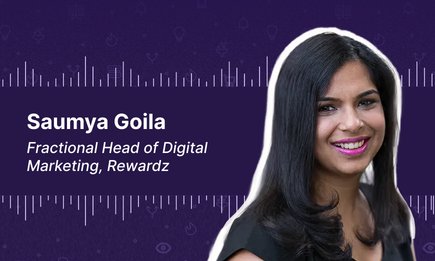
Saumya currently works as the fractional head of digital marketing at Rewardz, where she leads global B2B digital marketing across performance, SEO, content, and the website with a strong focus on driving measurable results.
Rewardz is a B2B SaaS platform based in Singapore, helping organizations strengthen employee engagement, flexi benefits, and customer loyalty through people-first experiences.
Saumya brings over 14 years of experience working across media agencies and global brands in B2B and B2C.
In this episode, we talk about how marketing has evolved, how CRO and experimentation influence real-world decision-making, and what it takes to drive sustainable growth in complex B2B SaaS environments.
Hello Saumya, a warm welcome to the VWO Podcast. Thank you so much for joining us. How are you doing?
Saumya Goila: Hi Natalia. Thank you for having me, and I’m doing really well. How about you?
Natalia Gamarra: I am doing really well. It’s so good to have you on our podcast today. So thank you so much for joining us. I have so many questions that I want to run past you. We’ve got so much to ask, so I’m looking forward to this chat with you today. But before we do begin, there’s one question I do want to ask you. What did you think you’d do when you grew up, from when you were a child, and how far is that from where you are?
Conversation
Early Career Aspirations
Saumya Goila: Um, I think till a certain point, because my parents were into business—both my mom and dad used to work together. They were running their own business. So till certain point of school I wanted to take that over and run that, et cetera.
But then as I grew to secondary or college years, more from higher study point of view, secondary onward, I always wanted to be in that marketing space and at that time there was no digital marketing. The world of marketing and advertising—actually more advertising I would say—was the traditional TV ads and print ads and all of that. And I really wanted to do those amazing advertising campaigns, do client servicing, you know, running, having those sort of war rooms, running those, et cetera.
So I would say, I don’t think so I’m too far because it’s branched out with the world, the adaptation, et cetera. So I’m still part of marketing and advertising, just that I haven’t touched traditional advertising and marketing at all in my career span. So I’ve been just a digital marketer.
Natalia Gamarra: It is the evolution of, so you really have landed where you wanted to be.
Saumya Goila: I would say that. Yeah.
Natalia Gamarra: Oh, isn’t that wonderful? Well, good on you. Okay, so I have a series of questions.
Evolution of Marketing Over a Decade
Natalia Gamarra: So Saumya, you’ve spent over a decade in marketing through major shifts in channels, technology and user behavior. When you reflect on that evolution, what’s changed the most and how does that show up in the way that you approach your work today?
Saumya Goila: Okay. I think the biggest change is that the conversation is around that performance and brand are no longer two separate conversations. Performance marketing and brand marketing—the teams need to be one. And when I started my career at Google, Google was my first job back in 2007, and initial years of my agency, I think we were as performance marketing. We were all very largely focused on, you know, last click model and efficiencies in those. So it could be for a normal campaign, it would be, um, say CTR or, you know, number of clicks for CPC could be one for efficiency, right? And ROAS, right?
But as I have moved further in my career and gone up the ladder, I would say in last five years or so, I have started to see the shift where it became clearer, not only to us as marketers, but even to the clients and the brands, that growth only sustains when you bring both brand and performance together because it helps to build the trust, the credibility and the performance will work together to bring scale and efficiency.
So today, I think the biggest change is that everybody is slowly but definitely starting to see marketing more holistically, focusing on the entire journey, not just the last click. And that is what I think matters. And I think that is the biggest positive change that I have seen over the years.
Natalia Gamarra: Look, I agree with that. So the brand team and the performance team need to be one, right? And the transition from efficiency to now understanding—I don’t know—the need to understand the decision journey is really quite vitally important. And if you come together as a team, you’ll get a better picture of that. It’s, you know, it’s the what, the why, the where, the behavior and the brand trust, and that’s pretty much what you’re referring to.
Saumya Goila: Exactly. I think the brand trust and credibility is very, very important. And the performance will come in handy in complement to that, if you have built that trust and credibility based on behavior and like what you said, what, why, when.
Natalia Gamarra: Yeah. No. Agreed. Agreed.
Balancing Channel Mix for Sustainable Growth
Natalia Gamarra: It leads me on to my next question. With the search landscape changing and paid channels not always being a long-term lever, how do you balance your channel mix to build sustainable growth?
Saumya Goila: Yeah, I think it’s tricky because there are two parts to it. One is if a brand focuses heavily and relies heavily on paid media, it’ll get expensive very, very fast. Right? Or you don’t bring in paid media at all. Even then the scalability will hamper because your reach and all of those will not be as scaled as it would be when you bring both together.
So I have, of course, like across APAC markets, across different clients and brands, I’ve managed a lot of multimillion budgets, et cetera. But I think when the reliability is on only paid media, I have realized that it gets fragile very, very soon and it starts to break or let’s say not perform right, much sooner than what you will anticipate because today, any platform that you take, especially in the digital one, they are changing their algorithms at a rapid fire speed. The competition increases for every small, little product, service, or let’s say the keywords, right, or the target audience. Each audience also has so much to choose from, so many players to choose from. So competition increases like many fold, and then hence, of course, the cost rises.
So I think the way I work is that it’s very important to bring a balance of your organic, the earned, the owned, and the paid media together. Right. So you need to bring lines like your SEO foundations have to be very strong. You should be able to, for anything primary and key, you should be able to rank, you know, at your top most possible. The CRM cycle has to be in place, right? Because that CRM brings you the lifecycle journey of your customer base. And that will help you in the whole marketing journey and a smarter retention and personalization, which becomes very, very important because it’s not just about scaling, it is not just about putting that million dollars of money that doesn’t hit close to heart of your customers.
The personalization helps. Otherwise people start to see—you also need to look at it from the lens of the frequency that you’re reaching your customers at, et cetera. Otherwise, it starts to feel a sort of click bait type of, you know, oh my God, again, they’re showing me their ad. So all of that has to be managed very well. Like, you know, in recent times that smart shopping ads and all of that have come in, whether it’s on Meta, whether it’s on Google, everything where they smartly convert your shopping cart or what you viewed recently into an ad and send it to you personally, you know, so that’s personalization and that is what connects or brings people back so it just becomes much smarter.
Natalia Gamarra: I agree. I mean, paid can become very, very expensive, very quickly, and so personalizing properly, it can pay dividends and obviously increase your retention.
How Experiments Feed Into Broader Marketing Strategy
Natalia Gamarra: Yeah. No, I couldn’t agree with you more. Okay. So my third question. How do experiments feed back into your broader marketing strategy now? In other words, how do tests move from isolated learnings to influencing performance, content, SEO and positioning decisions?
Saumya Goila: Okay. So I think what experiments will—the biggest shift that the experiments can bring is how you as an individual working or you as a team working on the experiments or the clients and the brands, how you start to think and approach and not just look at the lens of what is converting, you know, so there is a little bigger picture to it.
And like during my different roles across agencies, in-house brands, and teams, um, experimentation has been crucial, of course, because it helps with informed messaging, market prioritization. Like I—so I think very, very important to look at is that we are all in an APAC region where one size fits all does not work at all. So we are very different. We have to approach marketing and the markets and your target audience very differently from the western countries like US or Europe, where sort of behavior—US is one country overall, right? It may be huge, but it is one country that is considered as one whole in itself. So the way you approach it can be one size fits all.
But here the way the behavior of each market is very, very different. Their risk appetite is very, very different. Their propensity is very different. Their income levels are very different. There is lot of presence of local, let’s say languages also. Not all markets are English first markets. So there has to be that localization, there has to be that personalization and there has to be that prioritization—is Singapore and Australia my priority or am I able to get through countries or do I have to, or do I want to get through countries like say Indonesia, Vietnam, Philippines, which will need a very, very different sort of approach towards them.
It could also mean that, do I have the means or the products to service them? Right? Because like I said, you need to analyze that. Do we—are we testing the correct proposition for those markets? And that is what the experiments do and help. Right? So sometimes these good experiments, or the right experiments, I would say they can reveal what has worked in one country is not working and does not translate exactly into execution for the other country.
And that is where it’ll define your messaging. It’ll define your prioritization. It’ll define your narratives around say pricing, around the product, in terms of the SKUs also right of the product and your SEO. What keywords work in one country and will rank you on number one will probably not even be there in your top five keywords for the other country. And all of this is experiment. You need to pick up and you need to test and you do.
Natalia Gamarra: And you do. It’s, that’s interesting because when you look at it, you’ve gotta look at the market, you’ve gotta localize it, you’ve gotta look at the demographic. Right. And I would agree when I think about it, that the right experiments really do shift the right behaviors. Once you understand that market and you’re so right. When we look at APAC, you think about how many markets we’ve got within APAC compared to, say, the US. It’s vastly different, vastly. You’ve got sophistication with Singapore, and then you’ve got variances across others as well.
Saumya Goila: I had a client where we were doing a global campaign with 12 markets, which included markets like US and some four, five markets of Europe also. It was a travel and tourism client. Right. And then just after I think two years of that, I was working for a client who was doing 12 markets of APAC only because that team worked on APAC. And I was like, oh my God. Right? So of course my 12 market for tourism, they did not cater to the smaller markets of APAC. But then there was a client, an FMCG client who was like, whole of APAC is my domain. I need to be present there. I need to be selling my products. So 12 markets for a global campaign versus a 12 market campaign for a regional APAC only.
Natalia Gamarra: Vastly different. Vastly different. Yeah.
Experimentation in B2B Categories
Natalia Gamarra: So at Rewardz, you work in categories like employee benefits and engagement, where obviously trust and clarity matter deeply. Right? So what kind of experiments tend to deliver the biggest impact there?
Saumya Goila: Yeah. I think the experiments that are less aggressive but focused on solving the immediate business problem, right? The experiments that help you strengthen your proof points, I think they work well for brands like Rewardz, which are B2B SaaS company. And so there has to be, you know, for this category, the clarity in terms of what is the pain point.
So our category is employee benefits, right? And employee engagement. So it is very important for Plum to identify that which kind of industry is struggling with that employee engagement, right? Where the, let’s say, churn rate is very high, right? Or dissatisfaction is very high, and our experiments are around trying to find those solutions and around the messaging because for B2B, we are reaching the target audiences like your CTOs, your CMOs, your head of human resource or people or somebody like that, right? Apart from your, let’s say CEOs, et cetera.
And so you need to really identify that we have multiple products. Right. So you need to identify which product is for which hierarchy or which level, and our experiment is largely on the right messaging for them. Now, whether that experiment is an A/B test on my website—what am I talking? How am I talking? Or it is on my actual marketing campaigns. The focus is on, you know, trying to get an outcome-led framing of the solution that, yes, this is the problem we have identified. You need a solution and this is your solution. And then if you like the solution and you want to, let’s say, expand into different things or bring new things, like for example, our one solution is on employee benefits and engagement, et cetera.
And then there is a, I would say there is an offshoot of wellness also where there are some clients who would take our wellness product to induce those healthy habits in their employees. So they will do a 10,000 step challenge every day for employees where employees have to log in and then you have your sort of rewards for them accordingly, right? So yeah, so like I said, those experiments need to have a consistent outcome that helps to outperform the cosmetic changes.
Natalia Gamarra: So based on what you’ve just said, I’m thinking about it. I think that solving business problems for you, a convergence at Rewardz.
Saumya Goila: Maybe you have one and we should let us know what is yours and we will help you. Maybe we have a solution for you.
Natalia Gamarra: No, that sounds good.
Aligning Teams Around a Shared North Star
Natalia Gamarra: Alright. When different teams own different metrics, what helps keep everyone aligned around a shared North Star, and why is that alignment so important for experimentation to work?
Saumya Goila: I think a shared North Star is very important because the teams need to have an alignment or consensus to see together as what is the good outcome we are all working towards. It doesn’t always have to be that KPI of the campaign, but it—I mean, of course that is always there, but it can be complemented with other things like individual growth, team growth, team success, or which also of course includes the personal success and growth and upskills, et cetera.
So, which I mean, I have led many teams over 14, 15 years of my career. I have had teams of two people and I’ve had teams of 30 people also. I have had teams all in the same location or multi-market. Right. But I think what brings together is that common shared North Star that team looks at, because I have seen lot of disagreements and misalignments for sure. And it’s bound to happen. Right. Misalignments and disagreements also happen between parents and children, or husband and wife, right, or siblings. So it’s okay to have those misalignments, but bringing them back together to that North Star is what is important.
I always look at this, I always look the team and their work as a Christmas tree where the star on the top of a Christmas tree, if you visualize, is like your North Star, that we are all trying to work towards it. And each team, their progress and their deliverables, their growth, it’s all those different layers of the Christmas tree that are building up, that are complementing each other. Because even if there is one layer that dismantles, the tree will not take its shape and you will not reach the North Star. So it’s very important to have that.
So it helps in quality, the value it brings and ensures, you know, the growth. And experimentations also, even the team bonding or bringing who to pair up for the teamwork. That’s also an experiment that you have to do sometimes because it’s the vibe, it’s the relationship that they exchange. There could be some two or three complete opposite poles, misfits, et cetera. And it’s very important to identify and align them in a way where, you know, everybody’s able to learn and simultaneously keep that good vibe together. So the consensus is very important.
Natalia Gamarra: Yeah, it’s having that shared vision. This is where communication’s key, right? Having that shared vision, making sure that that consensus is there, but everyone understanding, okay, this is what good looks like and this is what we’re trying to achieve.
Saumya Goila: So.
Natalia Gamarra: So, yeah, I agree with that. Okay.
Working in a Mature Digital Market
Natalia Gamarra: So what is working in a mature digital market like Singapore? How does that change about how experimentation works in practice?
Saumya Goila: Okay. I think market like Singapore, we are very, very sophisticated. We are mobile first, digital first, and you know, we also have the lifestyle and income levels to spend if we have to. Right. So, which is why markets, people in markets like Singapore, they don’t like or tolerate fluff. They need—they will go deeper into their research. They will compare a lot more. There are many, many, many options available, right? So they don’t build the trust very easily and it becomes very, very important for a brand to build that credibility.
Once they know that either it’s through trust or they know that there is definitely good value that they are getting. So there is an obvious value that they can see in, you know, they will convert in what they’re getting. So in such scenarios, I feel the experimentation needs much sharper hypotheses. Much clearer and cleaner process of execution and then of course quality, right? We need, you need to think of quality over quantity. So there is no point of doing many, many vanity tests, right? We may be optimizing for small margins, but in the long run they help to scale. They will help to make better decisions, right?
Natalia Gamarra: I agree that Singapore is a very mature market and buyers there are very savvy and they do an enormous amount of due diligence beforehand, but it is about having the right brand, the right credibility, the right reputation and trust. It is so—I agree. Having worked there.
Changes in Buyer Behavior in Singapore
Natalia Gamarra: In saying that, do you see any changes that are happening with the way that buyers are behaving in Singapore? Has there been any shift in the time that you’ve been there?
Saumya Goila: Yeah, yeah, of course. I came to Singapore about 11 years back. Right. I’ll give you my personal example. When we came in 2015, we were both working, right. And we had a small child at that time, toddler in fact. So I remember for us ourselves, um, weekend was about going to the grocery stores to do your week long grocery shopping, et cetera, et cetera, with your toddler spending three, four hours, so either a Saturday or a Sunday, you would dedicate like half a day to doing all of that.
And the biggest change is that today I have more than three online grocery players. So like I said, I have options, I have comparison, right? I will try to see that which one every week is giving me a better value in terms of what I want. Whether it’s a deal, whether it’s a—I don’t know, the product offer, or it could be just like free shipping or whatever, right? So it has changed, like I said, that I have seen that shift happening. We have become a lot more digital savvy and a lot more mobile first. The consumer behavior has shifted to online shopping a lot more.
This is grocery. I’m talking even for your normal—there used to be when I came, there used to be that great Singapore sale, very famous. It used to be I think around a month or too long where all the stores were—so, you know, it’s like a Thanksgiving in Australia or your Boxing Day in, uh, sorry, Boxing Day in Australia and Thanksgiving in US. And, you know, those big retail days that you have and people would, we would all go and try to, you would try to take those best offers at that time. Imagine, which was a peak highlight for Singapore and even for tourists when they came to Singapore, they would try to plan around that time.
It has vanished and been eradicated completely from Singapore because you have so many players now. And there is so much online also that people don’t feel the need to go. But still the malls are always full. I don’t know why, don’t ask me.
Natalia Gamarra: And they are, and you’ve just answered that from a B2C lens and I appreciate that. That’s great. What about B2B? What have you seen change in the time that you’ve been in Singapore from a B2B perspective?
B2B vs B2C Psychology
Saumya Goila: Okay, so I think the main difference in B2C and B2B is—like I just mentioned, sort of that B2C is a lot more about desire, right? And B2B also, I will say the shift that I have seen is the conversations and the kind of conversations that are made now, like I said, right at Rewardz, what we look for is the solution of business problem with some proof pointing. So that conversation shift has happened where you bring in a lot more assurance and reassurance to a business that, yeah, this is the problem and this is the solution. We assure you because you have those proof points, data points, et cetera. Right? So that’s definitely there.
In terms of the way we test B2B and B2C overall, I think B2C is more focused on emotion and urgency. The need is now, that is what you create, that, oh, you have the need now. Right? B2B is more about longer lifecycle journey and hence the conversations are more about reassurance, validations, and justifications with proof points, right?
So B2C is a storytelling that is emotional and solution based for the needs and urgency, whereas B2B is more about, you know, looking from a—I would say a non-emotional lens, a business lens, and trying to give them that assurance that yes, we will help you solve. Right? So the person would be same. I am reaching Natalia for my consumer product from a B2C marketing point of view and a testing point of view. So I will test her behavior on the urgency, the needs, and the emotion by touching her emotionally more versus when I’m talking to Natalia, the head at VWO, I don’t need to bring that emotion point here. I need to tell her that you and your employees are going through this issue. I have solutions for you and I can prove it to you by data points, by proof points, that I have a solution and that solution will work. You want to talk, we talk. So it’s the psychology that you talk differently.
Natalia Gamarra: Look, I agree. The psychology is completely different. And when you think about the personal aspect, if it’s spending our money, it’s obviously very emotional. It’s very different, rather than obviously acting in a B2B situation. My son sells houses for a living and I don’t know how he does it because there’s so much emotion behind all of that. Yeah. And they’re big purchases as well, but it’s very different. So I can see how obviously the testing would vary between the two, and also the way that people buy is vastly different.
CRO as a Broader Decision System
Natalia Gamarra: Okay, so in saying that, CRO no longer seems to be limited to page level optimization. It’s evolved into a broader decision system, I should say. How’s that shaped or changed your strategic priorities?
Saumya Goila: Okay, let me think. So I think the one shift I would say is that CRO today influences what we build more holistically and not just what we tweak after building something. Meaning that it is no more a button level or a page level optimization that you look at. It is today helping to shape how marketers want to approach whether it is a new market to enter, whether it is the messaging or the scale or even which features to prioritize or, you know, what section to prioritize, right? So it’s the whole journey.
And CRO has become very, very important and imperative in the whole decision making journey and discipline with regards to your overall marketing piece, rather than a—I already know what I want to do on my marketing now, on this page, on my this campaign page. Tell me what button is working or what text is working or, you know, how I can change the page. But it is more about, for example, if I’m talking about a page here, I would say today you take decisions with the help of, you know, through CRO to build your whole website, not one page. How your hero image and hero section needs to be versus how your add to cart needs to be, or your lead form needs to be. Everything is based on, again, data points and based on that whole decision of the journey that from the entry point to the exit point, how I need to appear or how I need to showcase.
Natalia Gamarra: And also weaving into that, it would be brand trust and credibility.
Saumya Goila: Of course. I think it ties back to everything. Like I said, that if you are, it goes back to the first question that I had answered for you, that when I’m saying that the whole performance and brand is now looked as one. So this whole journey will bring everything together. And the first thing, and most important thing is brand trust and credibility.
Natalia Gamarra: Agreed. Agreed.
Using Experimentation to Align Stakeholder Expectations
Natalia Gamarra: So stakeholders often come with strong expectations from marketing, right? We’ve seen it, you and I have both seen this. How does experimentation help align those expectation with what the data reveals?
Saumya Goila: I think data reveals a lot of things and it makes hard conversations very easy. Now, when I say that, what I mean is that mostly stakeholders have their instincts or opinions that how they want it and what they want, et cetera, right? And sometimes they’re very, very strong. Now experimentation will help you create that baseline, create sort of a neutral ground where you can help to maneuver those decisions if they are not favorable. Right?
And experiment also helps to show that, for example, like it happened very often when we were, when I worked at agency, right? So for agencies it happens very often that client will see you more as a vendor and not as a partner. So they feel that in lot of situations they will sometimes feel that you are not thinking from my business point of view, right? So you do what I am telling you to do.
It becomes easier to tell them and show them that the decision or our recommendation is not a personal attack or it’s not personal, right? It is coming from a fact where as let’s say specialists or experts, we feel that it’ll not work for you. Right? Or it may not give the desired results that you want. So I think instead of going through that whole cycle of debate, there were lot of times I would accept that, okay, we’ll do it your way. These are the caveats and let’s experiment.
Now, sometimes it could be an A/B test that we do, one their way and one our way. Sometimes it could be that you run the campaign first their way, and then you tell them that, okay, this is the results that have come. Now let’s tweak it and let’s make changes based on what we were saying. And then these other results that have come and then—I think the good part is of experimentation and data together is that even if an experiment fails, it leaves data behind to learn something from right? It helps you to learn that this is the path I don’t need to go.
There is a crossroad you are at where you know that, let’s say that I don’t know whether to go straight, left or right. An experiment has helped me to know that going right is not the correct choice. Now, going straight or left could mean that one, when you take a left turn, you will reach your destination by going a little longer route. And if you go straight, you will reach it much faster. But either ways, taking one of the routes will help you reach again, I will say that it is not right or wrong because both left turn and going straight are helping you reach your destination. It is just the data points that tell me that, oh, it took me 30 minutes versus it took me 45 minutes. You know?
So it’s just that, that I think it has helped us. I have worked on so many conversations, the presentations, et cetera, where repetitive, sort of, you know, you are trying to explain certain things. Every time when we have gone with a lot of data, the conversations have just become very, very easy. So, like I said, hard conversations become very easy if you go with data. Data is a proof point of coming from either experiments or whatever way. Right. So whatever it is, but it does—I love that.
Natalia Gamarra: I love that. I love what you’ve just said, and I’m going to steal that and apply that if you don’t mind. We’ve basically said that data makes hard conversations easier.
Saumya Goila: Yeah.
Natalia Gamarra: That’s what you’re saying, and it’s obviously with data that you can trust, right. And proof points. And that’s great. And I mean, we often use that with any type of conversation that we may have, including performance reviews with staff. Right. You are always pointing to the data points, but I love that it makes hard conversations easier.
Saumya Goila: Easier, to tell them that experiment failed because you have data. Providing the data—
Natalia Gamarra: Well the data, providing the data is reliable.
Saumya Goila: Of course, of course. That caveat is the biggest caveat, right?
Natalia Gamarra: Of course.
Biggest Constraint in Running Meaningful Experiments
Natalia Gamarra: Okay. So what do you see as the biggest constraint in running meaningful experiments today and why?
Saumya Goila: Mm, okay. I think it would be the depth and patience, I would say, because to have a meaningful experiment, it needs time, you know, mindfulness, thoughtfulness. It has to be very, very thoughtful on what you want to do. What is your hypothesis? And I think the biggest, biggest thing is patience. You can run lot of multiple, you know, like surface level campaigns, they will not give you, like what you said, right? They will not—in the previous one—they will not give you the reliable data. They will not be as meaningful.
I always tell my stakeholders when we are doing, even if it’s not an experiment, I would say, right, even if it’s like starting a new campaign, what is required is time that you want to give to that and patience. You need to wait. Every two days you will not see magic. It’s same thing with experiment. Running a one week experiment, it is useless. It will not give you any reality check. You need to do longer experiments. Your experiments should be minimum, bare minimum of four weeks to six weeks. One and a half months is bare minimum. I would say ideal is to try something or experiment something for even longer period if budget, time, everything allows you. But doing a one week experiment is as useless as running a one week search campaign, which is a, you know, let’s say, I don’t know, Boxing Day holiday campaign. Your keywords will not even have been picked up. The basic learning for any platform now is 14 days for it to learn and start bringing efficiencies, you know?
So like tactical campaigns—there are a lot of times when I was working at Economist, we used to work on our content calendar in a way where my tactical campaigns were always dealt where the performance team would start the campaign much earlier, right? Or there were, if there was some offer or tactical campaign, which was a very short period, for example, a three day campaign or whatever, I made sure that we worked with the team and we said, the three day campaign does not make sense on paid media. You will burn money and you will get no results.
So we had the whole strategy and we had the whole calendar where there were a lot of campaigns, which were short term campaigns, which were only—which were email only campaigns. You reach out to your customer base, or we use them as retention campaigns, right? So we made those campaigns as only CRM and email only campaign. That offer for three days was only valid. That pricing of Economist Magazine was only valid for my customer database people, right? We will send out the emails to them. We will send out to our past customers that it is a limited time offer only for you. We will send it to our current customers for retention, and we will send it to our past customers to bring them back, right? But it became only, it became email only campaign because it just made no sense.
So all of that has to be very, very important with patience, with thoughtful hypothesis, execution plan, process, everything. Like I said, especially in complex journeys like subscriptions, which has retention, which also has a high turnover rate, for B2B, it becomes important also because your customer lifecycle is very long, right? Until you are able to actually convert into a deal, the lifecycle is very long. So again, quality has to take over the quantity, and only then you can find depth and with patience.
Natalia Gamarra: I was just thinking that, I was thinking you are talking about far more depth and length. Right. And you get a lot more learnings and far more value from these experiments. So it’s also patience. Right? And being strategic, being strategic. And I know you’re not in favor of vanity tests, are you? That’s something that, yeah, you’ve already spoken to me about that previously.
AI and Technology in CRO and Marketing
Natalia Gamarra: And so where do you see AI adding real value in the CRO and marketing today? Yeah, beyond the hype, which it is, it’s a massive buzzword. And beyond AI, are there any other technologies that you particularly are excited about that could change how marketing works?
Saumya Goila: Yeah, I think AI has definitely added a lot more value as a complementer, as a force multiplier, and not, of course, strategist. Meaning it has helped to make your insights and analysis faster. There is lot of creative iterations that you can do. You know, there is a sort of pattern detection type of like, you know, like you can detect a pattern that, okay, what we used to call the seasonality in market, right? You’re able to define it more granular, at more granular level through AI. You’re able to identify that your DCOs right—dynamic creatives that we do in paid media. It has become much easier because I think at that time, the beginning of DCO, when that came into picture, I would say it was very, very small form of AI at that time, right? Because you just give your input prompts. You give your one basic image, you give your headline text, blah, blah, blah, and the machine or the system would help you create multiple variations of it. That was also AI.
So AI has been there, it has just taken a higher seat today, right? But I feel even after that, still today, that what we call as human judgment, it matters. That human intervention is very, very important for building the trust, for better positioning, right? And I think in marketing the more deeper AI involvement would be in some level of advanced analytics and intent modeling that can help, you know, that would be important. That will be very exciting, because if you can have, you know, right, we work on MMMs, et cetera, but if we can have a modeling, which is based on behavior and intent, right, a lot more on intent. Now, I think that will be—I haven’t seen, maybe it’s there already or it’s building, but I haven’t seen, so I would love to see something like how does that happen.
Natalia Gamarra: Look, it’s changing so quickly and we are seeing so much efficiency and value just in AI. You know, we are working smarter, we’re scaling faster, and it’s taking up a lot of the heavy lifting, particularly in our space. So we are very excited to see what it will bring. However, I wholeheartedly agree with you. The human intervention is very, very important.
Saumya Goila: I don’t think so it can replace humans completely because even for AI to work, human intervention is important to give that right feed, right prompt. If humans are replaced, then nobody knows what’s happening and there will be no right, you know, prompts or feeds for AI to work in the back to be able to give you the right answers. Right. So yeah, human intervention will always be important.
Natalia Gamarra: It will, but geez, it’s made our lives so much more efficient, hasn’t it? It really has helped, but I agree.
Best Piece of Advice
Natalia Gamarra: Okay, so we’re going to move on to another question that’s completely off topic. What’s the best piece of advice you’ve ever received?
Saumya Goila: I think what I received was to learn to say no when you have to, otherwise it’s very easy for anyone to walk over you. Now, whether it’s, I received it from a professional point of view, but I feel it also applied at a very personal level. Also, like in personal life also, it’s very important to be able to stand up and say no. Right?
Now when you’re saying no in any sort of situation, like if I talk about at a professional level, learning to say no—just to give you example, that a lot of times at agency, at least this was, and this was all more before COVID or during COVID, where clients would come to us and, you know, come to me and say that on a Friday, 4:00 PM or 5:00 PM that please keep your team on standby. We have urgent launch coming and we will need it to launch. You need to stand up for your team to say no, because if it was an urgent launch, I feel there would have been some backstory in the sense that we would have been informed that something is coming up much earlier. It cannot happen that on a Friday morning you come to know that you have to launch.
Of course, there are situations and that is where you need to assess and be able to say no when it is important to say no and deliver and say yes and do it when you see that, yes, it is actually right. So that differentiation to be able to assess those situations, to be able to stand up and say, no, that, sorry, my team will not work. They have life or they have personal life and they need to go back.
Similarly, I stood up for myself by saying, no, I will not work here. When I found the environment, not very—like the work environment was not very happy for me. Again, everybody’s individual is very different. One environment can feel very claustrophobic and toxic to me, but it may not feel to you. So having the courage to stand up and say, no, this is not for me, and taking those hard decisions is very important. And yeah, so it applies to personal life, professional life, even at home, like what we say today also, right, that we teach whether it’s—we teach our children that no is important and no means no after that nobody can, you know, approach you or poach you or whatever. So especially being a mother to a girl, it’s very important. Every now and then, I keep reminding her.
Natalia Gamarra: It’s good advice. I wish somebody had given me that advice when I was a child. Yeah. So I struggled with that on a personal level. And not in a business level, but on a personal level. It took years where I really struggled with that. And I suppose it is really good advice because it also sets some really clear boundaries. Yeah, it does.
Rapid Fire Round
Natalia Gamarra: Well, Saumya, we are now moving into our rapid fire questions part of the segment. Yeah. So there are gonna be some rapid fire questions and I’ll be firing away at you. Just answer them as easily and quickly as you can.
If you were starting a career in marketing today, what’s the one thing that you’d do differently?
Saumya Goila: If I was starting my career today—
Natalia Gamarra: If you could turn back time, what would you do differently?
Saumya Goila: I think what I would do differently is, again, not get very focused—I mean, I think what I would do differently is to first understand the whole marketing, overall marketing in the world. And then choose my branch of specialization or where I want to move, like I said, that I think I would have done, or I will be able to do much better now also if I get the understanding of traditional marketing and advertising also. Right? How does that piece work together? Because it just makes us all like, you know, that core marketing also is very, very important. So it just makes us all—I think it will widen my thought process in terms to look at it or when we are doing planning.
Right now, of course I plan all digital and there’ll be a person for a client. When we work on clients from agency, there’ll be a person who’s working on that piece. But that, I think integrated marketing—to have the deeper understanding of the whole integrated marketing is very important now, whether it involves events, whether it involves your traditional media, or it involves digital media, et cetera, everything together, I think you can do much better, or you can deliver much better when you have that whole spectrum of understanding of the whole spectrum.
Natalia Gamarra: I agree with that. I agree. Just understanding all of it. Knowledge is power and, and yeah, I wholeheartedly agree.
So what’s the one thing your non-industry friends still don’t understand about your job?
Saumya Goila: That digital marketing is not just about paid ads and sponsored ads that you see on Google or Instagram or wherever, right? It is that whole, again, it is a bigger umbrella, which will include your, let’s say, website or your analytics, your paid ads, but your owned and earned portions also. It will include your, let’s say, CRM and everything, right? So it’s the whole journey. It’s the whole umbrella that is digital marketing, and not just that one ad on Google or one ad on Instagram.
Natalia Gamarra: I remember having that conversation with my children very, very long time ago. What do you do for a living? I solve problems, darling. I solve problems for people. That’s what I used to say to them. Trying to explain it to them was too difficult.
Alright, so what’s your go-to travel destination?
Saumya Goila: My go-to travel destination. Okay. I think it would be, I don’t think so it’ll happen, but it will be one of those Scandinavian countries to see the northern lights. And why I say it won’t happen is more because of the fact that I cannot take cold, I just cannot do it well with cold. And those temperatures are like extreme minus. So I don’t think so that I am, I don’t see myself planning that trip and it is happening, but that would be something that I would really want to go. Otherwise, maybe something like Hawaii or something, which is, which I know I can do. So it would be Hawaii.
Natalia Gamarra: Look the only time I can, yeah, the only time I can tolerate the cold weather, like the extreme cold is when I’m skiing. Otherwise, I just don’t want to be there.
Saumya Goila: So I’ve been to New York—
Natalia Gamarra: So I’ve been to New York, but it was minus 13 and I’ve been in minus 13. And I can assure you, if you’re skiing, it’s acceptable. If you’re not—
Saumya Goila: I lived in New York for four years, so I’ve seen those temperatures, so I cannot do, I don’t do well with that.
Natalia Gamarra: Yeah.
One thing that AI will probably take over in the next three years?
Saumya Goila: I think all mundane and admin work fully, which can also include things like scheduling meetings, this, that, everything. I think everything like it has already started working so well in terms of, if I look at it from our portfolio, started taking things like, you know, reporting—where we as teams used to spend so many hours in crunching numbers, right? It has become better, but there is a lot more to go there also. But yeah, I think eventually all of this will be taken fully. I feel lot of ground level of work can be taken and, you know, more strategic level thinking with the best, like we said, you know, judgments to be able to make the right decision that will still sit with human.
Natalia Gamarra: Yeah, I think the admin, the reporting, you’re right. I wish AI could process my tax returns for me, so I wouldn’t have to do it. Wouldn’t that be wonderful? And get it accurate as well. Oh.
Saumya Goila: Tell you all the reliefs and everything in one go. I know.
Natalia Gamarra: I know it’ll happen. It’ll happen eventually. There’ll certainly be some form of intervention with data being available as well. The taxation offices—they’ve got access to everything now anyway. It will be more simplified.
So if not CRO or marketing, what other profession would you have chosen?
Saumya Goila: I think without any other thought, event marketing. I still wish or I still think that maybe when I’m winding off completely, event marketing is something that I want to, and I would have probably been in.
Natalia Gamarra: It’s in your blood. I can see it. Marketing. I mean, we asked you this question at the beginning and it was just all about marketing. So you’ve found your calling, but why event marketing?
Saumya Goila: So more, actually not event marketing, I would say probably the wrong word. I would say event management. Yeah. So event management as such. Not event marketing, but event management, you know, organizing events. Now they don’t have to be—I mean, whether they are professional events or they are personal events like birthday parties or corporate events, or even if it’s like, I am always one of the person to raise my hand in office for any, you know, like social committee or the committee that organizes the day, Boxing Day, all of those for the teams or for the office. I am always there. All my jobs—
Natalia Gamarra: Isn’t that wonderful? I think that’s great. Okay. I’ll keep that in mind for when I’m celebrating a big milestone birthday. Definitely.
So, one CRO metric that you wish people would stop obsessing about.
Saumya Goila: Oh, any conversion rate for a particular button? Like what is my conversion rate on add to cart button? Because like I said, I think CRO is no more about buttons or a tweak or a page level optimization. Yeah.
Natalia Gamarra: It’s much more than that. Much, much more. It is.
A dream or goal you want to achieve in the next three years.
Saumya Goila: I think to be able to do more of expanded role in terms of, let’s say regional, bigger regional or global roles, meaning multi-market and multi-market location management—I mean it doesn’t have to be sort of team management, but even campaigns, right, which are more regional and more global. And definitely client servicing. It has to include client servicing.
Natalia Gamarra: President role?
Saumya Goila: Okay. I don’t know, president or not, but yeah, maybe CMO or yeah, something like that. Yeah. More regional or global scope.
Closing
Natalia Gamarra: Well, Saumya, thank you so much. Thank you so much for answering all—
Saumya Goila: They weren’t that difficult. Your rapid fire wasn’t that difficult, so I’m glad.
Natalia Gamarra: No, no. And thank you. So this brings us to a close of this episode, Saumya. I have to thank you. You’ve been such a pleasure. Thank you for answering so honestly and so practically all of these questions. And it’s great to hear how you show up every day and what you do and been able to share that with us all.
So for our audiences, if you’ve enjoyed this episode, don’t forget to subscribe to the VWO Podcast for more conversations with leaders across marketing, growth, product and experimentation. So thank you for tuning in and we will see you all next time. Saumya.
Saumya Goila: Thank you so much. Thank you Natalia. Thank you so much and have a good day. I loved this.