

Note: VWO recently launched a full Go SDK for teams building Golang applications, enabling low-latency performance and native capabilities without relying on the VWO Gateway Service.
Shipping backend changes has never been about writing code alone. It is about managing risk, coordinating teams, and making sure performance never drops, especially when the code runs in business-critical paths.
For teams building in Go, those constraints are even tighter.
The VWO Go SDK enables experimentation and feature control directly within your Go application, without introducing latency, complexity, or operational overhead. It allows teams to ship more frequently while staying safe, observable, and in control.
Release management that fits real engineering teams
One of the biggest shifts we see in mature engineering organizations is the move away from tying every change to a deployment. Teams want to decouple engineering effort from product and configuration changes, so they can release continuously without putting production at risk.
With the Go SDK, feature flags and experiments become part of the runtime, not the release event. Backend teams can roll out new logic gradually, pause changes instantly if something goes wrong, or run controlled experiments on high-impact systems like pricing, search, recommendations, or subscriptions. This makes release management calmer, without slowing teams down.
Easy to integrate, easy to live with
The Go SDK is lightweight and is designed to drop into existing services without retooling.
Integration is straightforward, and once in place, the SDK stays out of the way. Teams can monitor, manage, and evolve experiments using REST APIs, IDE integrations, and clear, example-driven documentation. Whether you are running a monolith, a microservice, or an event-driven system, the Go SDK adapts to your environment rather than the other way around.
Execution support that works with your stack
Modern backend systems rarely exist in isolation. They connect to frontends, mobile apps, data pipelines, and third-party services.
The Go SDK supports OpenFeature and integrates cleanly with existing delivery pipelines. This ensures targeting logic and feature behavior remain consistent across platforms, while letting teams adopt experimentation incrementally. VWO augments what you already have; it does not replace it.
Governance without slowing development
Speed and governance do not have to be opposites.
With VWO Feature Experimentation, teams can define role-based access, approval flows, and environment-specific permissions. Production remains tightly controlled, while development and staging environments can be opened up for faster collaboration using Open Access. This allows developers to move quickly where it is safe, while leadership retains confidence where it matters most.
Performance first, always
For backend teams, performance is non-negotiable.
The Go SDK evaluates feature flags entirely in memory, using local data. There are no network calls in the request path, which means decisions happen in sub-millisecond time. Even in high-throughput services, experimentation adds no measurable latency and introduces no runtime dependency on external systems.
This makes the Go SDK safe for critical flows, from checkout and pricing to authentication and personalization.
Keeping experimentation clean over time
As teams experiment more, feature flags can pile up. Without discipline, this leads to dead code and long-term technical debt.
VWO includes specialized tools and workflow integrations that help teams identify stale or unused flags, clean them up confidently, and prevent flag sprawl from becoming a problem. Experimentation stays structured and intentional, even as it scales.
In addition to flag hygiene features built into feature workflows, VWO also offers a Tech Debt Client that helps teams take a proactive stance on managing technical clutter. This client analyzes your codebase and checks how VWO feature flags are being used, generating actionable recommendations that guide teams toward removing unused or redundant flags. By surfacing where flags aren’t referenced or are no longer serving a purpose, the Tech Debt Client reduces uncertainty around clean-up decisions and helps teams maintain a lean, intentional experimentation layer as their codebase and test portfolio scale.
Complementing cleanup tooling, the VWO MCP (Model Context Protocol) Server bridges your development environment with VWO’s feature experimentation system so developers can manage flags directly where they code, without context-switching.
It supports AI-powered IDE integrations, letting teams create, list, update, delete, and toggle feature flags in familiar tools like Cursor or VS Code, and ensures consistent control across environments. This server makes flag operations more fluid and accessible, improving workflows and reducing overhead while giving dev teams tighter command over feature release logic and lifecycle.
Developer experience
A recurring theme in modern development is context switching, or more accurately, the desire to avoid it.
VWO’s developer experience is designed so that feature experimentation lives exactly where developers already spend their time.
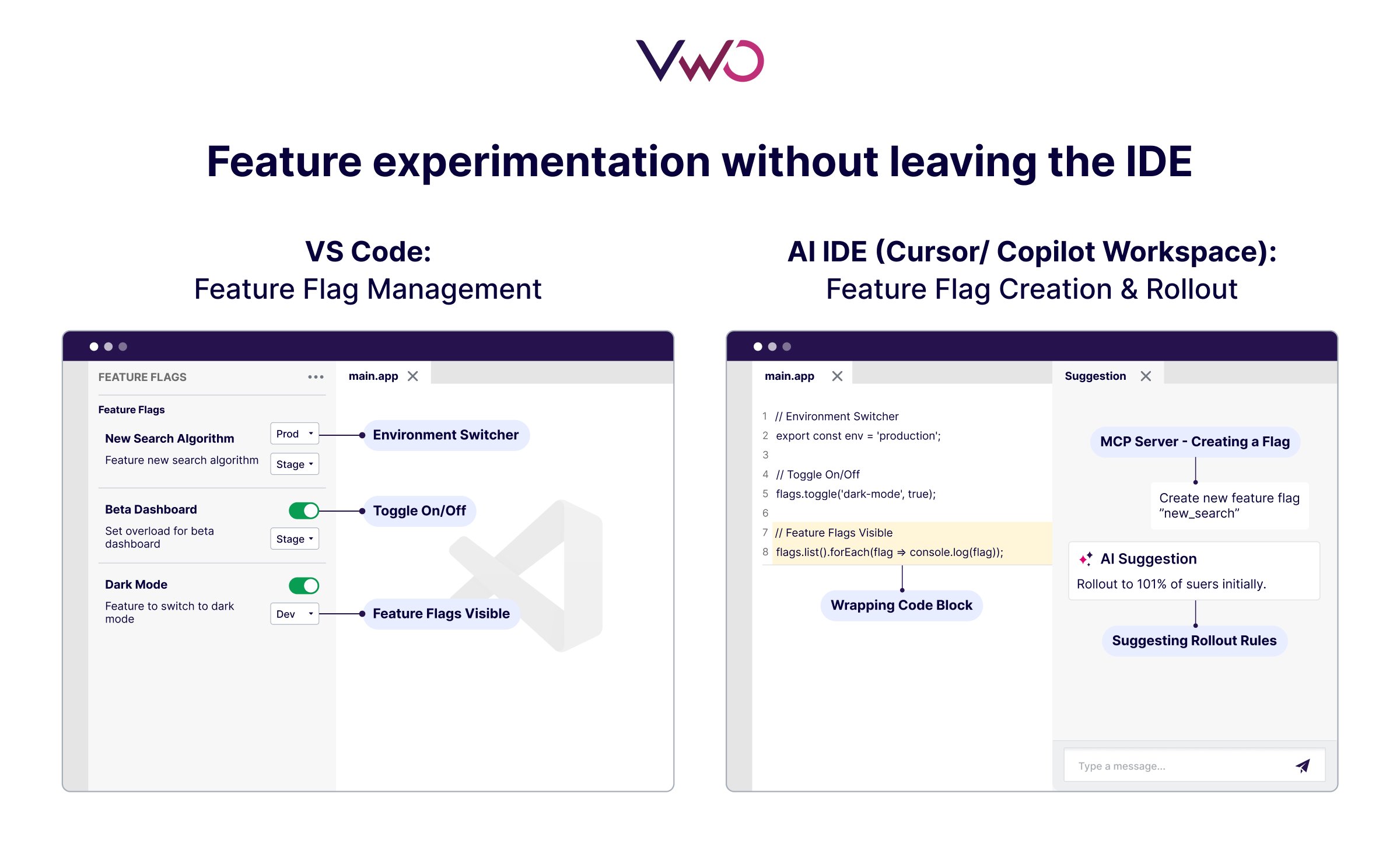
Feature flags inside VS Code
With the VWO VS Code extension, developers can view, toggle, and manage feature flags without leaving their editor. Flags can be enabled or disabled instantly, environments can be switched from the status bar, and SDK code snippets can be inserted automatically.
Instead of treating feature management as a separate task, it becomes part of the coding workflow.
MCP Server and AI-native workflows
As AI becomes a daily development companion, feature management needs to integrate with it naturally.
VWO’s MCP Server brings feature experimentation directly into AI-powered IDEs like Cursor and Copilot Workspace. From within the IDE, AI agents can create flags on the fly, wrap code blocks, configure experiments, suggest exposure rules, and even help monitor rollout impact.
Developers can also bootstrap SDK integrations instantly. With a single command, MCP Server configures Cursor rules, generates language-specific SDK examples, and ensures best-practice implementations from the start. Installation is intentionally simple, requiring nothing more than an npx command and VWO credentials.
Over time, MCP Server also helps teams stay clean by scanning codebases for stale or unused flags, reducing technical debt before it accumulates.
One SDK, every stack
The Go SDK is part of a broader, full-stack experimentation ecosystem. VWO supports Go alongside Ruby, NodeJS, Java, .NET, Python, and more, and works seamlessly with code generated by tools like Cursor, Windsurf, Antigravity, or Replit.
No matter where your logic runs, experimentation behaves consistently.
Why this matters
Together, the Go SDK, MCP Server, and VWO Feature Experimentation enable teams to treat experimentation as an engineering capability, not a risky add-on.
Teams ship faster without losing control, experiment deeply without hurting performance, and scale optimization without creating chaos. Feature flags become clean, intentional, and easy to manage, even in complex systems.
For Go teams building high-performance, business-critical systems, this is experimentation done right.
Get started
Get started with VWO Feature Experimentation and start shipping features with more confidence, cleaner workflows, and faster learning from day one.