Choosing a GDPR-compliant experimentation platform is only one part of the equation when it comes to protecting user privacy.
Compliance also depends on how teams collect consent, handle visitor data, configure tracking, and design their experimentation workflows.
Without a clear understanding of these requirements, organizations can introduce compliance risks into their experimentation programs.
In this guide, we’ll explore the practical realities of GDPR in experimentation, the challenges teams commonly face, and the practices that help balance privacy requirements with experimentation goals.
When approached correctly, GDPR and A/B testing can work together rather than being at odds with one another.
What is GDPR-compliant A/B testing?
GDPR, or General Data Protection Regulation, is the European Union’s data privacy law that sets the rules for how organizations collect, process, and store personal data of EU residents (regardless of where your organization operates).
Violations of GDPR laws can result in fines of up to €20 million or 4% of the company’s global annual turnover, whichever is higher.
A GDPR-compliant A/B test starts with the legal basis for data collection established upfront, with users informed and consent obtained where required.
It also ensures that only the data necessary for the experiment is collected, keeping user privacy central to the test’s design and execution.
Cookie IDs, IP addresses, session identifiers, and behavioral event data are all treated as personal data under GDPR.
Benefits of GDPR compliance in A/B testing
1. Increased user trust and reputation
Obtaining consent for the data collection that powers your A/B tests and being transparent about how that data is used helps build confidence among users. It lets them know that your site handles their information responsibly.
2. Improved data quality and integrity
GDPR’s data minimization principle encourages teams to collect only the data needed for experiments, resulting in more focused datasets and better data governance.
GDPR doesn’t stop experimentation, but it does require teams to think more carefully about how experiments are triggered, measured, and analyzed. Ensuring that consent mechanisms and tracking setups work correctly is essential for collecting reliable data while respecting user privacy.
Encrypt data at rest and in transit, and pseudonymize visitor identifiers by replacing them with randomized tokens. In this case, even if data is accessed without authorization, it can’t be tied back to real users. Treat both as baseline requirements, not optional additions.
4. Operational efficiency
Implementing GDPR frameworks creates standardized data management processes and documentation. This streamlines the setup and execution of future tests, as data handling procedures are defined and compliant.
5. Long-term strategy alignment
GDPR compliance aligns your organization with international data regulations, making it easier to scale testing initiatives globally without experiencing unforeseen legal obstacles.
7 core principles for GDPR-compliant A/B testing
1. Lawful basis for processing
Before launching an experiment, you must determine the particular lawful basis under Article 6 of the GDPR that applies to your data collection method. For most cookie-dependent A/B tests, consent is a defensible choice.
Other setups, such as testing within a logged-in product where a contractual relationship exists, may qualify under a different basis.
2. Data minimization
Collect only what the test needs to answer the hypothesis. Whether it is running tests or recording user sessions, ensure you collect only the necessary data.
3. Purpose limitation
User data collected for a test can’t be redirected into retargeting or audience segmentation without a separate legal basis. It is better to define the use case before collection starts, not after results come in.
4. Storage of data
Once a test has ended, individual-level data should either be deleted or anonymized. Only aggregate, non-identifiable insights should be retained for reporting purposes, in line with GDPR’s storage limitation principle.
5. Transparency
Your privacy notice should name the A/B testing tool, describe what data it collects, specify the legal basis for processing, outline data retention periods, and explain how users can exercise their rights.
This includes their right to access, deletion, and portability. Describing the opt-out process is also a part of this, but not the entirety of your transparency obligation under GDPR Articles 13 and 14.
6. Accuracy
Personal data collected during experiments must be accurate and kept up to date.
So, behavioral events or session data must reflect real user actions and should not be corrupted by implementation errors such as duplicate event firing or misconfigured goals.
Outdated or incorrect records should be corrected or deleted promptly, particularly when test data feeds into broader analytics or CRM systems.
7. Integrity and Confidentiality
Personal data must be processed in a way that ensures appropriate security against unauthorized access, accidental loss, or destruction.
For A/B testing programs, this means encrypting data at rest and in transit, restricting access to experiment data to only those who need it, and pseudonymizing visitor identifiers before storage.
A/B testing challenges under GDPR
1. Valid consent for tracking
Capturing explicit, informed consent before setting cookies or tracking user behavior for experiments is a key challenge in A/B testing.
2. Collecting unnecessary data
GDPR requires collecting only the minimum data necessary for the required purpose.
Testing platforms often capture excessive behavioral data, requiring stricter filtering of what is stored.
3. Difficulty in re-identifying data
In cases where a test combines user-level data with the databases of other tools, “anonymous” IDs might also be deemed “personal data” if they allow for re-identification.
4. Third-party cookie restrictions
Browser-level restrictions (such as Safari, Chrome) combined with GDPR mean long-term tracking of users to ensure they see the same variation across sessions is more difficult.
5. Managing opt-outs and data rights
GDPR gives each user the right to request access to their personal data and also ask for it to be corrected or deleted.
Teams must have processes in place to respond to these requests and ensure personal data is handled in accordance with GDPR requirements.
How to run GDPR-compliant A/B tests
1. Gate your testing tool behind consent
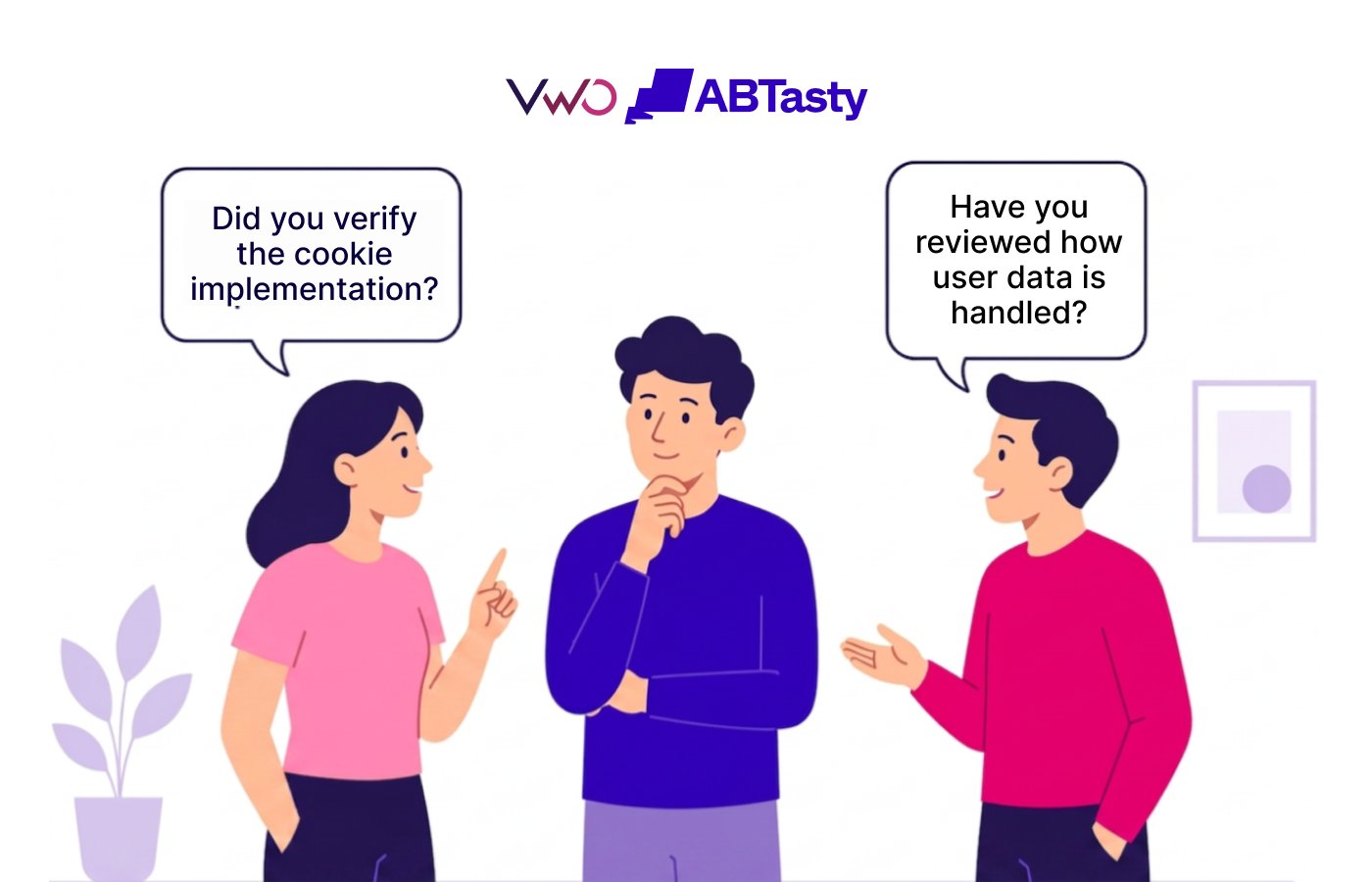
Configure your tag manager so that the A/B testing script only fires after a user accepts the relevant consent category, typically ‘analytics’ or ‘performance’ depending on how your CMP categorizes it.
One common approach is to have your consent management platform (CMP) pass a consent signal to your tag manager, which then activates the testing tool.
Whichever approach you use, ensuring that the testing tool fires only after consent is received resolves one of the most common GDPR violations in experimentation setups.
2. Consider server-side testing
Server-side testing assigns users to variants on the backend before the page is delivered, reducing cookie dependency and eliminating the visual flicker that skews behavioral data.
VWO’s server-side testing enables teams to run experiments without placing client-side cookies, a compliance advantage for programs with development resources to implement it.
The shift toward a cookieless future is ultimately a positive development for the industry. While it makes some traditional marketing tactics more challenging, it also gives users greater control over their data and how it’s collected.
Benni Lucas, GM Growth, Product and Innovation, Resolution Digital
3. Protect visitor identifiers before storage
Replace actual user identifiers with randomized tokens before storage.
VWO does this by default, where visitor UUIDs are replaced with hashed tokens before storage, and IP addresses are anonymized before reaching VWO servers.
4. Sign a DPA (Data Processing Agreement) with your testing tool
A DPA is a legal requirement under GDPR Article 28 whenever a data controller engages a third-party data processor.
When you use VWO to run experiments, VWO acts as a data processor on your behalf, making a DPA mandatory before processing begins.
5. Document every experiment
According to GDPR’s accountability principles under Article 5(2), organizations should not just comply with data protection principles, but they must also demonstrate compliance.
For each test, record the legal basis, data collected, retention period, and tools involved. This documentation also acts as an evidence trail for your testing efforts.
GDPR compliance strategies for A/B testing teams
Along with the right technical setup, compliant programs also need the following habits built into the day-to-day workflow.
1. Make privacy review part of your roadmap
Add a privacy check to test planning. Before any experiment enters the queue, confirm that the data collection is proportionate and that the legal basis is documented.
A short checklist covering the type of data a test needs, how well it matches the hypothesis, and whether the legal basis is documented will resolve the vast majority of standard tests without requiring legal involvement.
2. Limit reporting and analysis to consented users
Non-consenting users should not be entered into the test or assigned any tracking identifier.
Your reporting should be built entirely around users who have given consent.
Any analysis or segmentation should only apply to that consented group, as attempting to draw insights from non-consenting users, even in aggregate, risks stepping outside your lawful basis for processing.
Pro Tip!
Share VWO’s GDPR compliance documentation and Data Processing Agreement with your legal and IT teams before reviews begin. This gives stakeholders the vendor-level detail they need to sign off without delays. With pseudonymization, consent integrations, and built-in data residency controls, most infrastructure concerns are resolved before they become blockers.
3. Automate data deletion at test closure
Data retention schedules must be set up as part of the standard experimentation process.
When a test closes, trigger data aggregation or deletion as part of the closure process. Build this into your standard operating procedure so it happens automatically.
4. Audit your CMP and testing tool integration periodically
A setup that correctly gated your A/B testing tool six months ago may have shifted due to CMP version updates, tag manager reconfigurations, or changes to consent categories.
A quarterly check that verifies consent signals are still passing correctly before the testing script fires, and that no new tags have been inadvertently added outside the consent gate, takes an hour and prevents silent compliance failures.
Common GDPR risks in A/B testing and how to avoid them
1. Scripts firing before consent
Audit your tag manager and confirm your A/B testing tags are in a consent-gated category.
For example, VWO’s implementation team helps you understand your current configuration during onboarding, ensuring every aspect is set up correctly.
2. Tracking users who withdrew consent
When a user changes their consent preferences, your system needs to stop processing their data in real time, including removing them from active test variants.
Your CMP and testing platform also need a live integration to consistently track and update consent changes.
3. Vague privacy policy language
Stating that your site “may use analytics tools” is not enough, as it can create a transparency violation.
Your policy should name the A/B testing tool, explain what data it collects, and describe the legal basis.
Wrapping up
GDPR-compliant A/B testing isn’t just about avoiding fines or passing compliance reviews.
It’s about building an experimentation program that respects user privacy, operates transparently, and earns long-term trust from both customers and internal stakeholders.
For teams evaluating whether to build this infrastructure internally or use a dedicated tool, the compliance overhead of building in-house is worth accounting for.
VWO comes with pseudonymization, anonymization, consent integrations, DPA documentation, and data residency controls already in place.
Schedule a demo to see how VWO’s built-in privacy and compliance features help you run experiments without having to worry about the compliance overhead.
Frequently asked questions (FAQs)
Q1. Does A/B testing require user consent under GDPR?
It depends on how your tests are implemented. If your tests rely on cookies to assign users to variants and track behavior across sessions, consent is required before placing those cookies, while non-essential cookies require opt-in under GDPR and the ePrivacy Directive. Server-side testing reduces cookie dependency and generally collects less data than client-side testing, which is a genuine compliance advantage. However, users still need to be assigned to variants consistently, typically via a user ID or session token, which can qualify as personal data under the GDPR. The legal basis still needs to be documented regardless of which approach you use. Consent remains the safest position either way.
Q2. Does A/B testing use personal data under GDPR?
Most A/B testing setups process personal data even when it doesn’t feel that way. GDPR applies to any information that can identify an individual directly or indirectly. Cookie IDs, IP addresses, device identifiers, and behavioral sequences tied to a session all fall within scope. If your testing tool assigns a unique visitor identifier and tracks actions associated with it, the GDPR applies.
Q3. How can I make my A/B tests GDPR compliant?
Start with a consent management platform that gates your testing scripts behind consent. Get a Data Processing Agreement from your testing vendor and review their data storage locations. You should apply data minimization and collect only what the hypothesis requires. Set a retention schedule for individual-level data and build deletion into your test closure process. Server-side testing reduces cookie dependency for teams with development resources. Document the legal basis, data collected, and your retention processes. GDPR requires that you can demonstrate compliance, not just intend it.
Hi, there! I’m an Associate Manager of Content at VWO with 6 years of experience in B2B and B2C marketing. I work across blogs, SEO, thought leadership, newsletters, landing pages, and a video podcast I built and manage from scratch. At VWO, I’ve gained expertise in CRO, experimentation, user behavior research, and personalization, creating content that makes complex ideas clear and actionable. Outside of work, I enjoy experimenting with memes and short-form video on Instagram.
Uncover hidden visitor insights to improve their website journey
One of our representatives will get in touch with you shortly.
Awesome! Your meeting is confirmed for at
Thank you, for sharing your details.
-
, you're all set to experience the VWO demo.
I can't wait to meet you on at
Account Executive
, thank you for sharing the details. Your dedicated VWO representative, will be in touch shortly to set up a time for this demo.
We're satisfied and glad we picked VWO. We're getting the ROI from our experiments.
Christoffer Kjellberg
CRO Manager
VWO has been so helpful in our optimization efforts. Testing opportunities are endless and it has allowed us to easily identify, set up, and run multiple tests at a time.
Elizabeth Levitan
Digital Optimization Specialist
As the project manager for our experimentation process, I love how the functionality of VWO allows us to get up and going quickly but also gives us the flexibility to be more complex with our testing.
Tara Rowe
Marketing Technology Manager
You don't need a website development background to make VWO work for you. The VWO support team is amazing
Elizabeth Romanski
Consumer Marketing & Analytics Manager
Trusted by thousands of leading brands
Awesome! Your meeting is confirmed for at
Thank you, for sharing your details.
Your Roadmap to Better Results
1:1 Demo customized to your industry and optimization goals.
Feature deep-dive into the user behaviour tools you need most.
No-pressure advice on the best path forward for your team.





 ChatGPT
 Perplexity
 Gemini
 Claude
 Grok
Grok