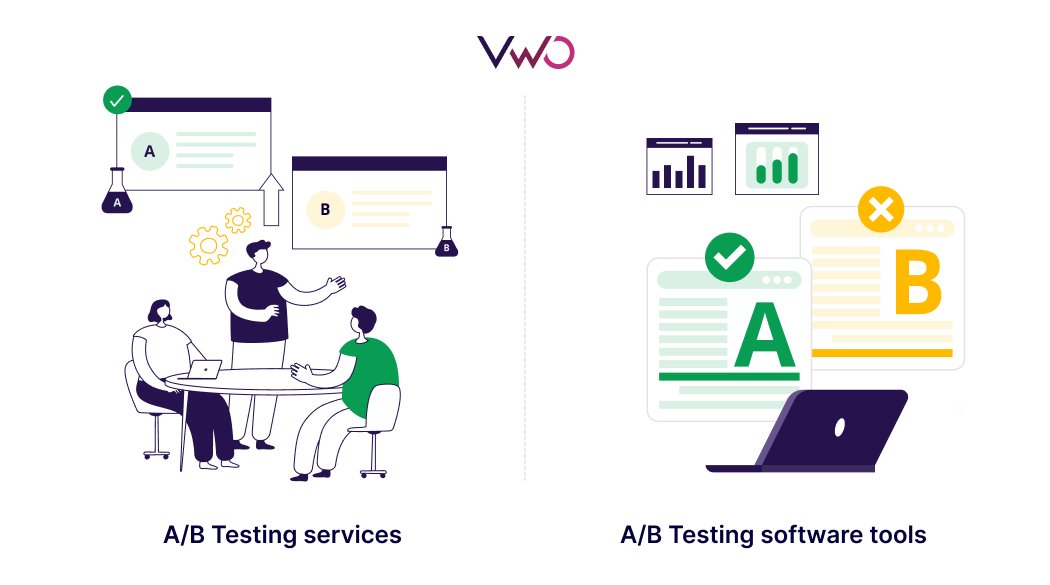
The main difference between A/B testing services and software tools is that services deliver expert-led experimentation, while software tools enable teams to run and manage experiments internally. Services prioritize speed and expertise, while tools prioritize control and scalability.
If you’re deciding whether to outsource experimentation or build an in-house testing capability, the sections below break down the key differences and decision factors.
A/B testing services vs A/B testing software tools: Key differences
For organizations with high monthly tracked users across web, mobile app, or server environments, the decision isn’t about whether to run experiments; it’s about who owns the experimentation engine.
A/B testing tools like VWO give organizations direct control over experimentation. However, running an experimentation platform requires an internal team capable of designing hypotheses, implementing variations, monitoring experiments, and interpreting results.
When this ownership exists internally, teams across marketing, product, engineering, and analytics can run experiments continuously and scale testing as their experimentation maturity grows.
A/B testing services (agencies), on the other hand, provide a turnkey experimentation process. The agency typically handles strategy, experiment design, implementation, QA, and statistical analysis using its own testing workflows and tools.
This model works well when organizations want experimentation outcomes but do not yet have the internal team or processes required to run a testing platform independently.
However, outsourcing experimentation can create long-term gaps in data ownership, experimentation velocity, and institutional knowledge of user behavior. Core differences that can actually impact the decision:
Scaling depends on internal team capacity but allows organizations to run and expand experimentation programs across web, mobile, and backend environments.
Depends on agency bandwidth, contract scope, and the tools used for experimentation.
Experimentation velocity
High once internal processes mature
Fast initially; limited by engagement bandwidth
Data ownership & governance
Full access to experimentation data, user behavior insights, and unified reporting
Subscription pricing, typically based on monthly tracked users or feature tiers
Custom pricing tied to scope and retainer agreements
Long-term ROI
Compounds as internal teams improve testing maturity
ROI tied to agency contract duration
Ultimately, this decision shapes how experimentation scales inside your organization. Here’s how to determine which model aligns with your resources, growth stage, and long-term optimization goals.
Pros & cons of using A/B testing software tools
For a mature product or growth team, a comprehensive experimentation platform is not just a testing utility; it becomes a feature management platform that de-risks every release.
At scale, this is about infrastructure, governance, and the compounding maturity of experimentation.
Pros
Infrastructure for controlled innovation
Beyond simple split URL testing, modern platforms provide visual and code editors, feature flags, remote configuration, and robust feature flag management. Engineering teams can manage feature releases with controlled rollouts and kill switches, ensuring new features do not degrade user experiences or performance.
Deep behavioral context, not just outcomes
Leading experimentation tools integrate behavioral analytics tools (such as heatmaps or session recordings) with test variations. You don’t just see which variation improved conversion rates; you see the visitor behavior that explains why, and how changes influence user engagement.
Unified data ecosystem
Enterprise-grade tools integrate seamlessly with your customer data platform and analytics tools, such as Google Analytics, eliminating the need to switch between multiple tools to analyze experimentation data.
This enables unified customer profiles and allows teams to measure how experiments influence customer lifetime value, not just session-level metrics.
High-velocity, cross-platform testing
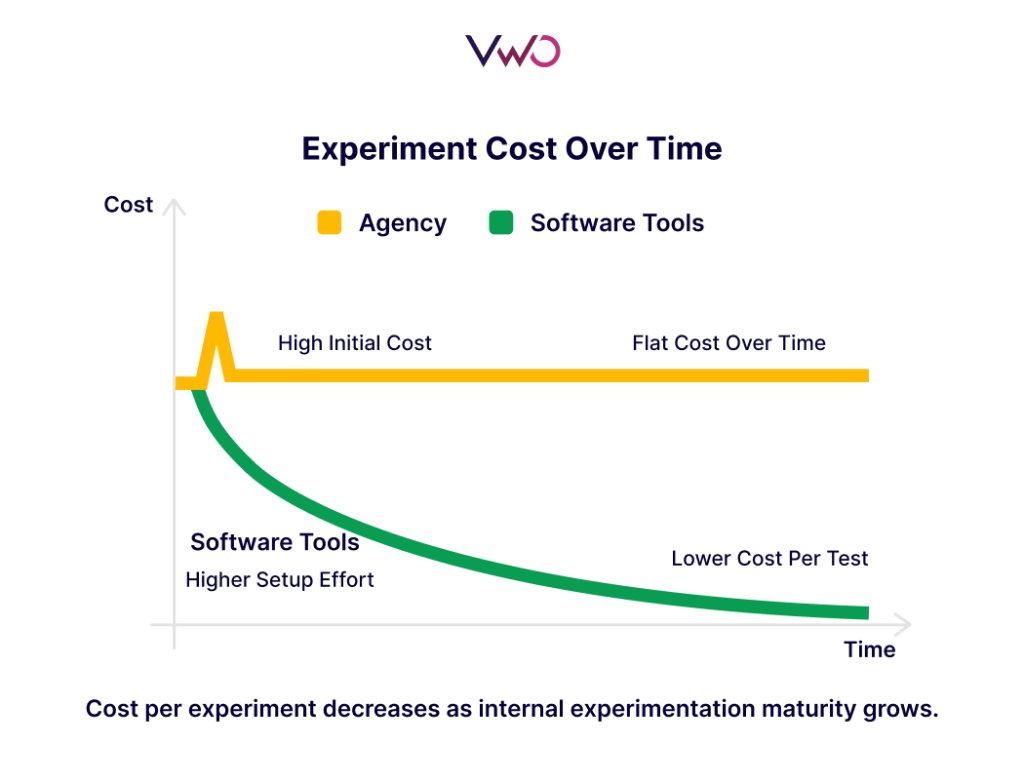
Once embedded in existing systems, teams can run multiple tests simultaneously across landing pages, web testing environments, and mobile app testing, without waiting for an external sprint cycle. The cost per experiment decreases as experimentation maturity increases.
Ownership of experimentation data
All experimentation data, statistical analysis, and user behavior insights remain internal. This builds institutional knowledge instead of distributing it across vendors.
AI-powered capabilities
Modern experimentation platforms now integrate AI and machine learning to automate optimization ideas, enable real-time behavioral targeting and personalization, and surface predictive insights.
These capabilities lower the barrier to running sophisticated experiments, allowing smaller teams to test complex user experiences, such as feature rollouts, algorithm outputs, or customer journey flows, without deep technical expertise.
Evaluating enterprise-grade experimentation? Here’s a complete checklist of A/B testing tool features to assess before investing.
Cons
Time required to build experimentation expertise
Effective experimentation requires specialized roles and processes. Building and aligning this expertise internally takes time before consistent results emerge.
Upfront implementation complexity
Server-side testing, advanced targeting capabilities, and deep integration require initial development effort and cross-team alignment.
Learning curve for advanced capabilities
While visual editors support non-technical users, mastering multivariate testing, sequential testing, and complex experiments requires technical expertise and a clear understanding of experimentation principles such as sample sizing, statistical significance, and result interpretation.
Risk of underutilization
Without a structured experimentation program, advanced features, from feature management to behavioral targeting, can remain underused, limiting ROI.
Pro Tip!
Use VWO Copilot to cut the setup time between idea and experiment. Instead of manually writing hypotheses, building variations, or digging through heatmaps, let Copilot generate test ideas from your goals, create variations via natural language commands, and summarize session recordings in minutes. Your team spends less time on setup and more time acting on results.
Pros & cons of hiring an A/B testing agency service
Hiring is often the fastest route to high-impact results for organizations with the budget but lacking the technical expertise to manage a full-scale testing program internally. However, outsourcing experimentation comes with its advantages and disadvantages.
Pros
Immediate access to specialized expertise
Testing agencies typically bring a full experimentation team, including strategists, developers, designers, and analysts. This eliminates the steep learning curve associated with mastering advanced features or in-house statistical analysis.
Faster time to early results
Because agencies already have established workflows and testing frameworks, they can often activate experimentation programs faster than internal teams that are still building processes and capabilities.
Organizational enablement
A high-tier service can help break down barriers to internal testing. By demonstrating the ROI of data-driven decisions through a professional testing process, they build an organizational “appetite” for deeper experimentation.
Opportunity to learn from experts
Partnering with an agency allows your marketing teams to observe optimization frameworks and best practices that can later support the development of an in-house testing program/team.
Cons
Higher initial investment
Agency engagements often require significant upfront budgets or ongoing retainers, especially when multiple testing roles and dedicated experimentation resources are involved.
Limited business context
External partners may not always have the same depth of understanding of your product, customers, or industry dynamics as internal teams. This can sometimes affect the quality of hypotheses or the prioritization of experiments, leading to test variations that technically “win” but don’t align with long-term brand values.
Experimentation may remain externalized
While agencies can deliver results, expertise in experimentation often remains with the service provider unless deliberate knowledge transfer occurs.
When this model works best
A/B testing agency services are often most effective for organizations that:
Are new to experimentation and need a structured program launched quickly
Have limited internal bandwidth or technical expertise
Prefer outsourcing optimization initiatives rather than building internal experimentation teams
Have sufficient budget to prioritize speed and external expertise
Explore the guide if you are considering outsourcing experimentation to accelerate results.
The biggest change when experimentation is owned versus outsourced is that it empowers teams much more to do their best work. It gives designers, developers, and product teams the power to verify their ideas and have influence in deciding what to do next.
Use the framework below to determine which model best fits your situation.
1.Traffic volume
Choose A/B testing software tools if:
You have moderate-to-high traffic and can run continuous experiments across product flows, landing pages, and feature rollouts. Higher traffic allows internal teams to reach statistical significance faster and run multiple experiments simultaneously, making an experimentation platform more efficient over time.
Choose an A/B testing agency if:
Your traffic is limited (either low or highly seasonal), and each experiment must be carefully prioritized. Experienced agencies can help design high-impact tests and extract meaningful insights even from smaller data sets.
2.Experiment complexity
Choose software tools if:
You need to own experimentation across the full product stack, from landing pages to server-side testing. If your roadmap includes feature flag management, controlled rollouts, or mobile app experimentation, internal tools provide the infrastructure product and engineering teams need for safe releases and continuous testing.
Choose an agency if:
You plan to run complex experimentation programs involving advanced segmentation, multi-page funnels, or cross-device user experiences, but lack the in-house dev team to design and implement them. Agencies can provide CRO strategists, designers, and developers who help build and execute experiments without overloading internal product or engineering teams.
3. Budget and cost considerations
Choose software tools if:
You want a predictable pricing structure in which the cost per test decreases as your team’s efficiency increases. Many experimentation platforms also offer a free plan or trial tier, making it easier for teams to start experimenting before committing to a full implementation.
Choose an agency if:
You prefer outsourcing experimentation strategy and execution rather than investing in internal expertise. Agencies typically operate on retainers or project-based pricing.
4. Security and compliance requirements
Choose software tools if:
You operate in a highly regulated industry (FinTech or Healthcare) and need to maintain complete control over experimental data. Leading platforms provide enterprise-grade security controls and support compliance with frameworks such as GDPR and CCPA, while allowing organizations to manage data governance internally.
Choose an agency if:
Agencies typically run experiments using compliant experimentation platforms. While the underlying tool provides the security and compliance infrastructure, agencies help ensure experiments are implemented in accordance with the organization’s data governance and consent policies.
Checklist: When evaluating A/B testing software tools
Before choosing an experimentation platform, confirm that it supports:
Integration with your analytics stack (e.g., Google Analytics or CDPs)
Feature flags and server-side testing capabilities
Experimentation across web and mobile applications
Real-time analytics and experiment reporting
Minimal performance impact on page speed
Compliance with security and privacy standards
Scalability for running multiple tests simultaneously across multiple platforms
Explore our detailed guide on how to choose the right A/B testing tool before making your decision.
Checklist: When evaluating an A/B testing agency
If you are considering outsourcing experimentation, evaluate agencies based on:
Industry expertise and track record: Look for agencies with documented case studies and proven results within your industry.
Technical expertise and platform proficiency: Ensure the agency provides a full-service team, including strategists, analysts, designers, and developers, and has hands-on experience implementing leading experimentation platforms.
Strategic testing methodology: Choose partners who follow a scientific, data-driven CRO process rather than relying on intuition or generic best practices.
Communication and reporting transparency: Confirm how frequently results are reported and how insights will be communicated to internal stakeholders.
Pricing model and engagement scope: Determine whether pricing is per-test, project-based, or retainer-based, and ensure it aligns with your experimentation goals.
Before selecting an agency, review the key evaluation criteria in our guide to ensure the right fit for your experimentation goals.
Conclusion
While this article outlined when each option works best, the decision is not always binary.
Many organizations combine both approaches. They may rely on agency services to accelerate early stages like implementation, insights, hypothesis building, prioritization, execution, and evaluation.
At the same time, they use that experience to build in-house capability by adopting proven workflows, frameworks, and ways of working over time.
Once you are confident in building an internal experimentation team based on the factors discussed in this article, VWO can provide the infrastructure your team needs to start experimenting and to scale a structured experimentation program across your digital experiences.
This allows organizations to run experiments across marketing pages, product experiences, and backend features, and collaborate with engineering teams when deeper implementation is required.
See VWO in action:
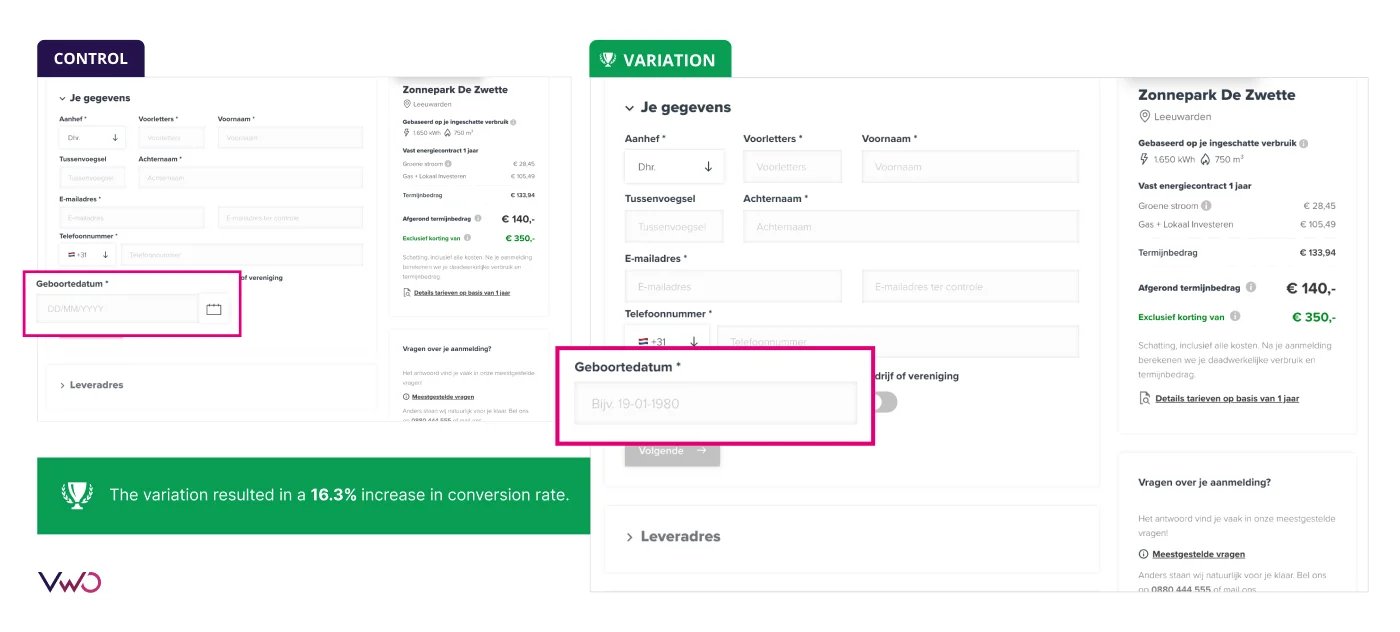
Dutch green energy provider Vandebron selected VWO as its experimentation platform for its combination of user behavior analytics and A/B testing in a single environment. Vandebron identified a usability issue in the date-of-birth field on its registration form and validated a simplified input method through an experiment. The change reduced friction and delivered a 16.3% increase in sign-up conversions, demonstrating how quickly behavioral insights can translate into measurable improvements.
Ready to see how a unified experimentation platform can consolidate your tech stack and accelerate your testing velocity? Request a demo today!
FAQs
When should I hire an A/B testing agency instead of using a software tool?
You should hire an agency if you have the budget and traffic volume to test but lack the internal headcount, specifically strategists, designers, and developers, to manage a consistent testing process. External teams can drive testing while your internal teams remain focused on product development.
Can A/B testing services save time compared to software tools?
In the short term, yes. Agencies bypass the time required for recruitment and the steep learning curve of mastering a new experimentation platform. However, once an internal team is proficient with a tool like VWO, their ability to manage feature releases and iterate in real-time is typically faster than the back-and-forth communication required with an external service.
Are there hybrid solutions combining services and software tools?
Absolutely, and this is often the most scalable model. In a hybrid setup, you own the experimentation platform (the software) to ensure long-term data ownership and unified customer profiles, while retaining an agency to provide the strategy and execution until your internal marketing teams are ready to take full control.
Hi, I’m Pratyusha Guha, manager - content marketing at VWO. For the past 6 years, I’ve written B2B content for various brands, but my journey into the world of experimentation began with writing about eCommerce optimization. Since then, I’ve dived deep into A/B testing and conversion rate optimization, translating complex concepts into content that’s clear, actionable, and human. At VWO, I now write extensively about building a culture of experimentation, using data to drive UX decisions, and optimizing digital experiences across industries like SaaS, travel, and e-learning.
Uncover hidden visitor insights to improve their website journey
One of our representatives will get in touch with you shortly.
Awesome! Your meeting is confirmed for at
Thank you, for sharing your details.
-
, you're all set to experience the VWO demo.
I can't wait to meet you on at
Account Executive
, thank you for sharing the details. Your dedicated VWO representative, will be in touch shortly to set up a time for this demo.
We're satisfied and glad we picked VWO. We're getting the ROI from our experiments.
Christoffer Kjellberg
CRO Manager
VWO has been so helpful in our optimization efforts. Testing opportunities are endless and it has allowed us to easily identify, set up, and run multiple tests at a time.
Elizabeth Levitan
Digital Optimization Specialist
As the project manager for our experimentation process, I love how the functionality of VWO allows us to get up and going quickly but also gives us the flexibility to be more complex with our testing.
Tara Rowe
Marketing Technology Manager
You don't need a website development background to make VWO work for you. The VWO support team is amazing
Elizabeth Romanski
Consumer Marketing & Analytics Manager
Trusted by thousands of leading brands
Awesome! Your meeting is confirmed for at
Thank you, for sharing your details.
Your Roadmap to Better Results
1:1 Demo customized to your industry and optimization goals.
Feature deep-dive into the user behaviour tools you need most.
No-pressure advice on the best path forward for your team.




 ChatGPT
 Perplexity
 Gemini
 Claude
 Grok
Grok