You might have 10,000 visitors who land on your pricing page, but only 200 start a trial.
You know there’s a leak, but you’re not sure where exactly it is. Maybe it is the confusing pricing structure, a misplaced CTA, or a confusing form.
Without this missing piece of the puzzle, you’re simply just guessing.
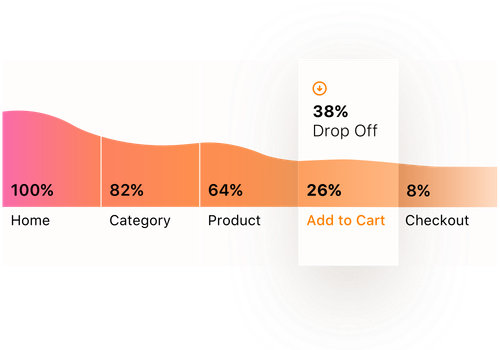
Funnel analysis helps you track user journeys through your website, showing you exactly where they leave, and what’s potentially causing them to hesitate or exit.
It also enables you to spot hidden friction points, make targeted improvements, and fix leaks in the funnel before they cause major damage.
6 benefits of using funnel analysis
Let’s understand why funnel analysis is valuable for understanding and improving customer journeys:
1. Spot and fix where users drop off
Many sales and marketing funnels often see only about 3% to 10% of prospects completing the target action.
With funnel analysis, you can pinpoint the exact stages where users abandon the process and focus on improving those stages.
2. Prioritize high-impact optimizations
Conversion funnel analysis helps teams uncover performance gaps by segmenting funnel data across multiple attributes such as device type, traffic source, geography, visitor behavior, or new vs. returning users.
By identifying segments with the highest drop-offs or the strongest engagement, teams can prioritize improvements that deliver the greatest business impact rather than randomly optimizing different stages of the funnel.
3. Understand user behavior, trends, and intent
Funnel analysis reveals how users progress through key stages and highlights exactly where they drop off.
When combined with session recordings or heatmaps, it helps teams understand what motivates users to continue and what blocks them from moving forward.
By understanding the path customers take, you can optimize the process to be more intuitive, reduce friction, and improve engagement.
A funnel isn’t something you choose to have. It already exists through every interaction someone has with your brand. Each touchpoint can either move people forward or create hidden revenue leaks that add up over time. That’s why it’s essential to map out the full user journey and recognize where prospects are in their awareness stage. When you align your offers with those moments, you make longer sales cycles far more effective.
4. Improve conversions at every stage of the funnel
When you track the number of visitors moving from one step to the next, you can spot trends, identify sudden drop-offs, and clearly measure the impact of changes or redesigns.
Whether it’s awareness, product discovery, checkout, or onboarding, you can compare stage-level insights and take confident decisions to improve conversions at each step.
5. Increase marketing and product ROI
When you know which channels and customer journeys convert best, you can optimize spend and boost ROI across campaigns and experiments.
6. Unlock highly optimized and personalized campaigns
With all the data of your key conversion funnels, you can uncover hidden insights faster, leading to more hypotheses and, as a result, more experiments and personalization campaigns.
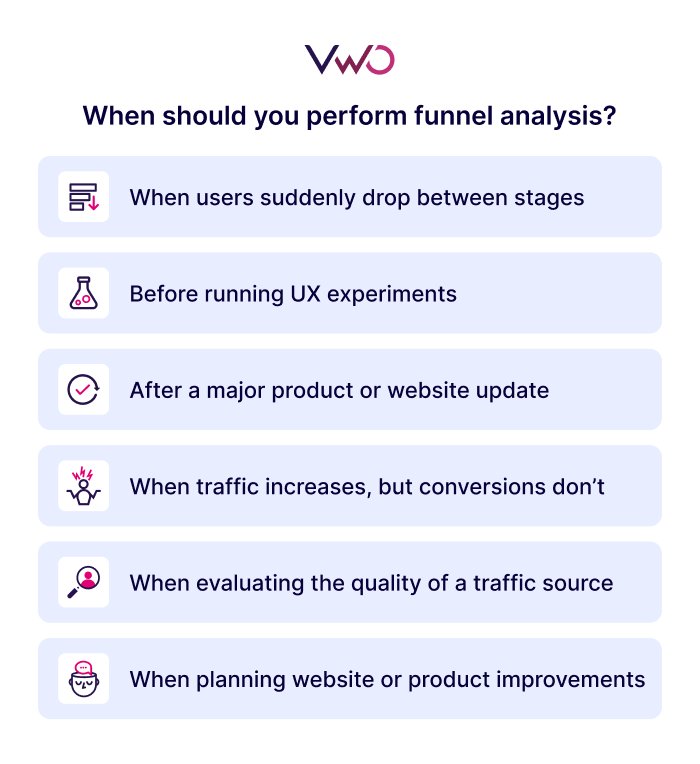
When should you perform funnel analysis?
Funnel analysis is most effective when a clear goal or signal drives it.
When you know why you’re analyzing a funnel, it helps you focus on the right stages, ask better questions, and act on insights more confidently.
How to do a website funnel analysis: Step-by-step guide
A step-by-step process on how to do a funnel analysis:
1. Define your primary goal
Start by identifying the end action you want users to take, which can be:
Purchase
Sign up
Demo request
Add to cart
Having an end goal helps you to identify optimization opportunities and analyze user behavior at each stage.
2. Map the key steps in your website funnel
Outline the real sequence of actions leading to the final conversion.
For instance, a sequence could be:
Homepage → Product page → Cart → Checkout
Blog → Signup → Email verification → Onboarding
3. Set up tracking for each step
Ensure that each stage of the conversion funnel is properly tracked, including clicks, page views, form submissions, and other key interactions.
Tools like VWO make it easier to analyze funnel performance, allowing you to track progression through each step and identify exactly where users exit the funnel.
4. Segment your audience
Segment your website visitors and break down funnel performance by device, traffic source, new vs. returning visitors, and other key attributes.
This helps you isolate hidden drop-offs and understand which audience segments struggle the most at specific stages.
Many teams already know which pages need improvement, but the real challenge is knowing what to change. Our process starts with reviewing design, UX, and performance data to spot where the biggest leaks and opportunities exist. But the real depth comes from qualitative research. Through customer interviews, surveys, social listening, and review analysis, we ask meaningful questions to uncover the root problems.
Once you’ve set up funnel tracking, you can analyze drop-off percentages of users moving from one step to the next to pinpoint where users are dropping off the most.
This allows you to identify the biggest optimization opportunities, rather than optimizing the entire funnel at once.
6. Analyze why drop-offs happen
Pair funnel data with qualitative insights to understand the “why” behind user behavior. Use tools like:
Heatmaps to see whether users notice key elements such as CTAs
Session recordings to spot confusion or hesitation
Experiments can help validate whether your changes improve progression before rolling them out broadly.
8. Monitor, iterate, and optimize
Re-run funnel analysis after implementing changes to compare performance before and after optimization.
As user behavior evolves, your funnels and optimization strategies should evolve too.
Pro Tip!
Track how your experiments impact key website funnels. Within test reports in VWO, you can instantly compare the performance of the control vs. variation on each stage of the funnel, identify where users drop off, and pinpoint friction points that would otherwise remain hidden.
Different types of funnel analysis
Below is the list of the most common funnel analysis types used across marketing, product, and UX teams.
Website conversion funnel analysis
It tracks how users move through key funnel steps on a website (homepage, product page, checkout) to highlight pages or actions causing drop-offs.
This type of funnel analysis focuses on a specific task within a single channel, such as moving users from a landing page to a form submission.
Marketing funnel analysis
Evaluates how users progress from awareness to consideration to conversion across campaigns, channels, and touchpoints.
It helps marketers understand which efforts attract, engage, and convert prospects into customers more effectively.
Sales funnel analysis
Focuses on converting leads into paying customers, often across stages such as lead generation, qualification, and deal closing.
Tracks how new users progress from sign-up to activation and retention. This is common in SaaS and product-led businesses and focuses on encouraging core feature adoption.
It analyzes in-app user actions, such as sign-up, onboarding, activation, and feature usage, to diagnose friction in product adoption.
eCommerce funnel analysis
Focuses specifically on add-to-cart, checkout, and purchase steps to optimize revenue-critical flows.
This funnel analysis type helps identify barriers that prevent users from completing transactions.
Mobile app funnel analysis
Examines how users navigate app screens, complete actions, or drop off due to usability or performance issues.
Zooms in on specific, smaller flows, such as form submissions, search usage, or CTA interactions, to optimize individual touchpoints.
Cohort-based funnel analysis
Segments website visitors into cohorts (such as first-visit month, device, campaign) to compare funnel performance over time.
It helps teams understand how different user groups behave and convert across stages.
Funnel analysis examples
Here are a few funnel analysis examples that show how different organizations track and optimize user journeys.
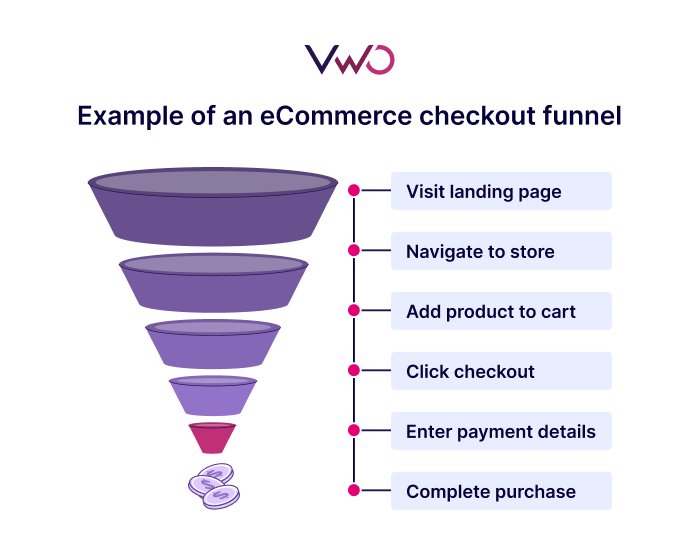
Example 1: eCommerce checkout funnel
→ Visit landing page
→ Navigate to store
→ Add product to cart
→ Click checkout
→ Enter payment details
→ Complete purchase.
For instance, 3,540 visitors visit the landing page, but only 612 complete the purchase.
This implies a 17.3% conversion rate from first touch to sale. In many cases, the highest drop-off rate occurs during the checkout stage, indicating high cart abandonment or friction.
You can implement various strategies, such as adding trust signals or offering free shipping, to tackle this issue and improve completion rates.
Example 2: SaaS/product onboarding funnel
Here are the stages in this funnel:
→ User signup
→ Account setup
→ First key action (such as completing a profile / activating a feature)
→ Activation
→ Retention (first usage, onboarding completion)
Teams use funnel analysis to measure how many users activate the product after sign-up, how many drop off before activation, and which onboarding steps create friction.
If a large percentage of users drop off between signup and activation, you can reduce steps, use guided tours, and provide contextual help to increase activation and retention.
Analyze and optimize your funnels with VWO
Funnels in VWO enable you to visualize real visitor journeys, pinpoint bottlenecks, and segment funnel performance to understand which audience groups convert better or worse.
And once you identify friction points in your funnel, you can seamlessly transition from analysis to action with VWO’s experimentation capabilities.
Run experiments, test hypotheses, and validate changes in your funnel, all within the same platform.
For example, Bunzl used VWO to analyze its conversion funnel and identified a significant drop-off just before the final checkout stage.
Using these insights, the team tested and optimized the checkout experience.
The result was a 9% uplift in total sales and a 9.5% increase in click-throughs to checkout, demonstrating how combining funnel analysis with experimentation can drive measurable business outcomes.
If you’re ready to uncover your biggest conversion opportunities and turn insights into measurable wins, schedule your demo with VWO today.
Frequently asked questions (FAQs)
Q1. What is funnel analysis?
Funnel analysis is the process of tracking how users move through a defined series of steps, such as landing on a page, viewing a product, and completing a purchase, to identify where users are dropping off and why. It helps teams optimize journeys, reduce friction, and improve conversions.
Q2. Why is it important to do funnel analysis?
Funnel analysis highlights the exact stages at which users abandon a process, helps you understand user behavior, fix bottlenecks, improve UX, and increase conversion rates.
Q3. What are the best funnel analysis tools?
Popular funnel analysis tools include: – VWO – Mixpanel – Google Analytics (GA4) – Amplitude – Hotjar
Q4. What is a funnel in web analytics?
In web analytics, a funnel is a sequenced set of steps a user takes to complete a desired action. Funnels help visualize progression and pinpoint drop-offs. Here’s an example of a common funnel used by eCommerce teams: →Home page → Product category/details page → Add to cart/View cart → Checkout
Q5. What are the five stages of the typical sales funnel?
The classic 5-stage sales funnel includes: 1. Awareness: Prospect discovers your brand 2. Interest: They explore your offerings 3. Consideration: Comparing options or requesting more information 4. Intent: They show readiness to buy 5. Purchase: Transaction is complete. The prospect is now a customer.
Hi, there! I’m an Associate Manager of Content at VWO with 6 years of experience in B2B and B2C marketing. I work across blogs, SEO, thought leadership, newsletters, landing pages, and a video podcast I built and manage from scratch. At VWO, I’ve gained expertise in CRO, experimentation, user behavior research, and personalization, creating content that makes complex ideas clear and actionable. Outside of work, I enjoy experimenting with memes and short-form video on Instagram.
Uncover hidden visitor insights to improve their website journey
One of our representatives will get in touch with you shortly.
Awesome! Your meeting is confirmed for at
Thank you, for sharing your details.
, you're all set to experience the VWO demo.
I can't wait to meet you on at
Account Executive
, thank you for sharing the details. Your dedicated VWO representative, will be in touch shortly to set up a time for this demo.
We're satisfied and glad we picked VWO. We're getting the ROI from our experiments.
Christoffer Kjellberg
CRO Manager
VWO has been so helpful in our optimization efforts. Testing opportunities are endless and it has allowed us to easily identify, set up, and run multiple tests at a time.
Elizabeth Levitan
Digital Optimization Specialist
As the project manager for our experimentation process, I love how the functionality of VWO allows us to get up and going quickly but also gives us the flexibility to be more complex with our testing.
Tara Rowe
Marketing Technology Manager
You don't need a website development background to make VWO work for you. The VWO support team is amazing
Elizabeth Romanski
Consumer Marketing & Analytics Manager

 DE
DE
 BR
BR




 ChatGPT
 Perplexity
 Gemini
 Claude
 Grok
Grok










![10 Best Enterprise Analytics Platforms [2026]: Expert Picks with Reviews and Comparisons](https://static.wingify.com/gcp/uploads/sites/3/2025/08/Feature-image-10-Best-Enterprise-Analytics-Platforms_-In-Depth-Reviews-and-Comparisons.jpg?tr=h-600)