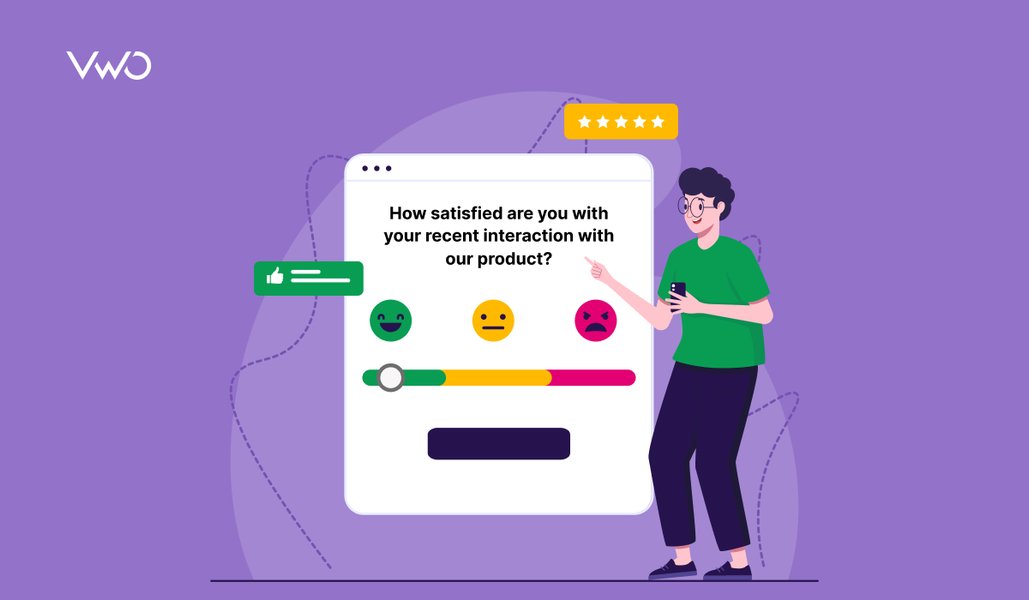
CSAT and NPS: two widely used customer satisfaction metrics in modern SaaS that often tell very different stories.
The main difference between CSAT and NPS lies in their scope: CSAT (Customer Satisfaction Score) measures immediate satisfaction with a specific interaction, while NPS (Net Promoter Score) gauges long-term customer loyalty and overall brand perception.
In this guide, we’ll break down how these two metrics differ, when to use each, and how to combine them to move from tracking satisfaction to actively managing retention, advocacy, and growth.
What are CSAT and NPS?
If you’ve ever finished a support chat and clicked a smiley face, or received an email asking how likely you are to recommend a brand to a friend, you’ve encountered CSAT and NPS.
Think of these two as the “Pulse” and the “Big Picture” of your customer experience. One tells you how a specific moment felt, while the other tells you how the customer feels about your brand as a whole.
CSAT (Customer Satisfaction Score)
CSAT is your “right here, right now” metric. It’s designed to capture immediate satisfaction after a specific customer interaction, such as a support call, a demo, or a purchase.
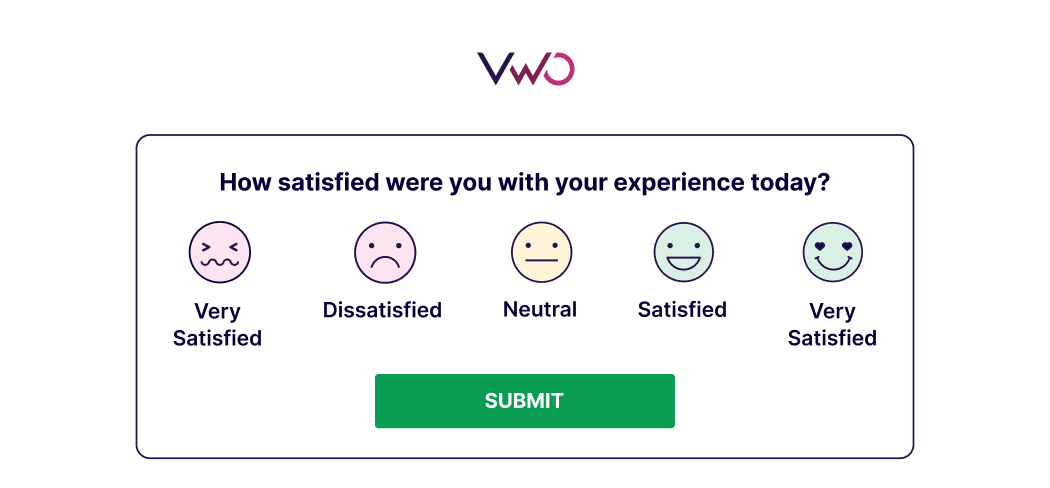
The question:“How satisfied were you with your experience today?”
The scale: Typically 1–5 (from “Very Dissatisfied” to “Very Satisfied”).
The goal: To measure the efficiency of your team and the quality of a single touchpoint
Find out how top product teams turn CSAT into smarter roadmap decisions.
NPS (Net Promoter Score)
NPS focuses on the relationship. It measures overall customer loyalty and brand advocacy.
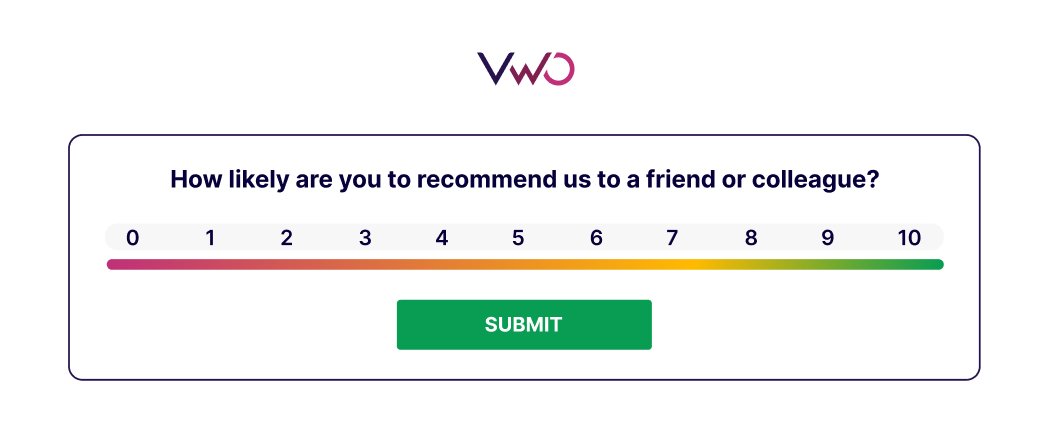
The question used in most NPS surveys:“How likely are you to recommend us to a friend or colleague?”
The scale: Customers respond on a 0–10 scale and are grouped into:
Promoters (9–10): Your brand’s “superfans.”
Passives (7–8): Satisfied, but easily swayed by a competitor.
Detractors (0–6): Unhappy customers who might actively discourage others from using you.
The goal: To predict business growth and identify who is actually sticking around for the long haul.
CSAT vs NPS: What’s the difference?
While both are essential customer experience metrics, they serve different purposes. CSAT is transactional (if your customer is happy right now); NPS is relational (if they’ll still be your customer next year). Here’s how they differ:
Scope of measurement: CSAT focuses on a single touchpoint, a support call, checkout experience, onboarding session, or product demo. NPS evaluates the entire relationship between the customer and your brand.
Time horizon: CSAT captures short-term customer satisfaction at the moment. NPS reflects long-term customer loyalty and brand advocacy.
Business objective: CSAT helps teams improve operational performance across support interactions and agent performance. NPS helps leadership assess brand health, retention risk, and business growth potential.
Instant action: You get real-time feedback. If a customer is unhappy with a support call, you know it within minutes and can “close the loop” immediately.
Granularity: It’s hyper-focused. It tells you exactly which part of your journey, the checkout, the demo, or the delivery, is turning users into satisfied customers or creating friction.
Low friction: Because it’s usually just one click (a smiley face or star rating), response rates are typically higher.
The limitations:
Short-sighted: A high CSAT doesn’t guarantee loyalty. A customer might be happy with a single interaction but still switch to a competitor for a better price tomorrow.
Subjectivity: “Satisfaction” is vague. One person’s “Satisfied” is another person’s “Neutral.”
Recency bias: It only measures the last five minutes, not the last five months, which is why some teams also track customer effort score to balance perception with ease-of-experience insights.
NPS: The “macro” view
The benefits:
Growth predictor: High NPS scores are strongly correlated with organic growth and lower churn. It identifies your “Promoters”, the people who do your marketing for you.
Boardroom ready: It’s a high-level metric that leadership understands. It’s the ultimate pulse check for brand health.
Standardized: It’s the industry standard, making it much easier to benchmark your performance against competitors.
The limitations:
Lacks context: A low NPS score is a warning light, but it doesn’t tell you where the engine is smoking. You know they won’t recommend you, but you don’t know why.
Many teams now rely on generative AI for NPS analysis at scale. While AI can surface themes quickly, it also risks overgeneralized summaries and misleading patterns without oversight. This automation strengthens Voice of Customer programs only when paired with structured validation and human judgment.
Slow to move: NPS is a “lagging” indicator. By the time your NPS drops, the problems have likely been brewing for months.
Ambiguous “Passives”: The 7-8 scorers are often ignored, yet they are the biggest “at-risk” group for churn.
When to use CSAT vs. NPS
The “best” metric depends entirely on what you’re trying to fix. If you want to know if your website’s new checkout flow is confusing, NPS is too broad. If you want to know if your brand is losing market share, CSAT is too narrow.
Use CSAT when:
Closing a support ticket: To monitor agent performance and the quality of your support interactions.
Post-purchase or onboarding: To see if the initial “hand-off” from sales to product was seamless. Low scores/ratings at this stage often signal potential early churn.
Testing new features: To get a quick “Reaction” to a specific UI/O change or a new tool in your stack.
Identifying friction: To know exactly where in the customer journey people are getting stuck.
Subscription renewals: To surface unresolved issues 1–2 months before renewal and give account managers time to address concerns before the “stay or go” decision.
Use NPS when:
Gauging brand health: To understand your overall brand perception and how you stack up against competitors.
Predicting churn: To identify “Detractors” before they actually cancel their subscription.
Strategic planning: When you need a high-level metric for leadership to assess business growth and long-term customer loyalty.
Building an advocacy program: To find your “Promoters”—the loyal customers who are ready to provide case studies or referrals.
Can you use CSAT and NPS together?
For many product leaders, CSAT is becoming the preferred daily driver. Its granularity is its superpower; by capturing sentiment at a specific moment, it becomes much easier to validate a new feature or prioritize a fix that actually shifts user behavior.
However, the most sophisticated teams don’t look at these metrics in isolation. CSAT provides the “What” (What happened during that call?), while NPS provides the “What’s Next?” (Does that experience actually change how they feel about us?). But, using them together moves you from measuring “happiness” to measuring business health.
It identifies “product-brand mismatches”
When metrics are viewed in isolation, they can create a false sense of security.
The signal: Your support CSAT is a perfect score.
The reality: Your NPS is tanking.
The lesson: Your support team is doing a heroic job of saving a failing product. Customers love the people, but they are losing faith in the platform. Without both metrics, you’d keep rewarding your support team while your product team remains unaware of the structural rot.
It distinguishes friction from failure
Every product has bad days. A server goes down, or a UI update confuses a power user.
The signal: A loyal user gives a 1/5 CSAT after a bug.
The reality: Their NPS remains high.
The lesson: This user isn’t leaving; they’re just annoyed. Because you have the NPS “safety net,” you know you don’t need to panic about churn; you just need to fix the bug.
It turns data into a “loyalty-satisfaction matrix”
When you plot these two together, you stop seeing a list of scores and start seeing a map of your customer base.
Interaction (CSAT)
Relationship (NPS)
Customer type
Strategic move
High
High
Brand champions
Nurture them. These are your case studies and referral goldmines.
High
Low
“At-Risk” satisfied users
They like the tool, but they don’t love you. They’ll switch for a 10% discount elsewhere.
Low
High
Frustrated loyalists
They trust your vision but are struggling with the product. Fix their friction before their patience runs out.
Low
Low
Churn risks
They’ve checked out emotionally and technically. Immediate intervention or “graceful exit” territory.
When you combine CSAT and NPS, you unlock predictive power. By tracing how micro-moments of friction or delight influence macro-loyalty, feedback transcends the dashboard to become a strategic growth lever.
This integration connects daily product iterations directly to long-term retention, allowing you to detect loyalty erosion early, validate which releases move the needle, and focus optimization efforts where they have the most meaningful impact on business results
Voice of customer is a form of social proof that you can add, incorporate, and weave through all of your messaging. See the actual language that your customers are using to describe your product. What value is that bringing to them? Use those words in your messaging. When you do that, you avoid making your messaging too marketing-ish and avoid having that jargon that can sometimes creep in.
Ali Good, Global Head of Strategy and Product Marketing, Quizizz (Source: Webinar)
Closing the loop: From feedback to action with VWO
Collecting customer feedback only matters if you can act on it, fast. That’s where VWO Pulse makes the difference. It transforms CSAT and NPS from periodic surveys into a continuous feedback-to-action system built for modern product teams. Whether feedback is collected across mobile apps, websites, or external channels, VWO Pulse helps teams capture it, understand it, and act on it, often in hours, not weeks.
With contextual survey triggers, you can deploy CSAT and NPS at critical moments in the customer journey to capture real-time sentiment tied to actual behavior.
Instead of manually reviewing responses, AI surfaces recurring themes, patterns, and emerging risks, translating qualitative feedback into clear hypotheses.
Pro Tip!
Pair surveys with behavioral analytics like heatmaps and session recordings in VWO Insights to connect what customers say with what they actually do, uncovering friction that feedback alone may miss.
Those insights can feed into your testing workflow, powered by VWO Testing, enabling teams to validate changes, experiment with alternatives, and measure impact quickly.
With VWO Personalize, you can go a step further and deliver context-aware experiences tailored to user behavior, device, location, lifecycle stage, or intent. This ensures optimized experiences reach the right audience at the right time, improving engagement, conversion rates, and long-term customer loyalty.
Request a demo to see how VWO brings feedback, behavior, and experimentation together to keep your experience optimization engine running.
FAQs
What is the difference between CSAT and NPS?
The difference between CSAT and NPS lies in what they measure. CSAT (Customer Satisfaction Score) measures short-term satisfaction after a specific interaction, while NPS (Net Promoter Score) measures overall customer loyalty and likelihood to recommend a brand. CSAT is transactional; NPS is relational.
Can you convert CSAT to NPS?
No. There is no mathematical formula to convert them because they measure different things: immediate sentiment vs. overall relationship health. However, they are highly correlated; consistent high CSAT scores usually indicate that your NPS will rise over time.
Hi, I’m Pratyusha Guha, manager - content marketing at VWO. For the past 6 years, I’ve written B2B content for various brands, but my journey into the world of experimentation began with writing about eCommerce optimization. Since then, I’ve dived deep into A/B testing and conversion rate optimization, translating complex concepts into content that’s clear, actionable, and human. At VWO, I now write extensively about building a culture of experimentation, using data to drive UX decisions, and optimizing digital experiences across industries like SaaS, travel, and e-learning.
Uncover hidden visitor insights to improve their website journey
One of our representatives will get in touch with you shortly.
Awesome! Your meeting is confirmed for at
Thank you, for sharing your details.
, you're all set to experience the VWO demo.
I can't wait to meet you on at
Account Executive
, thank you for sharing the details. Your dedicated VWO representative, will be in touch shortly to set up a time for this demo.
We're satisfied and glad we picked VWO. We're getting the ROI from our experiments.
Christoffer Kjellberg
CRO Manager
VWO has been so helpful in our optimization efforts. Testing opportunities are endless and it has allowed us to easily identify, set up, and run multiple tests at a time.
Elizabeth Levitan
Digital Optimization Specialist
As the project manager for our experimentation process, I love how the functionality of VWO allows us to get up and going quickly but also gives us the flexibility to be more complex with our testing.
Tara Rowe
Marketing Technology Manager
You don't need a website development background to make VWO work for you. The VWO support team is amazing
Elizabeth Romanski
Consumer Marketing & Analytics Manager

 DE
DE
 BR
BR
 ChatGPT
 Perplexity
 Gemini
 Claude
 Grok
Grok