 DE
DE
 BR
BR




 ChatGPT
 Perplexity
 Gemini
 Claude
 Grok
Grok
Real-Time Personalization: The Future of Customer Engagement
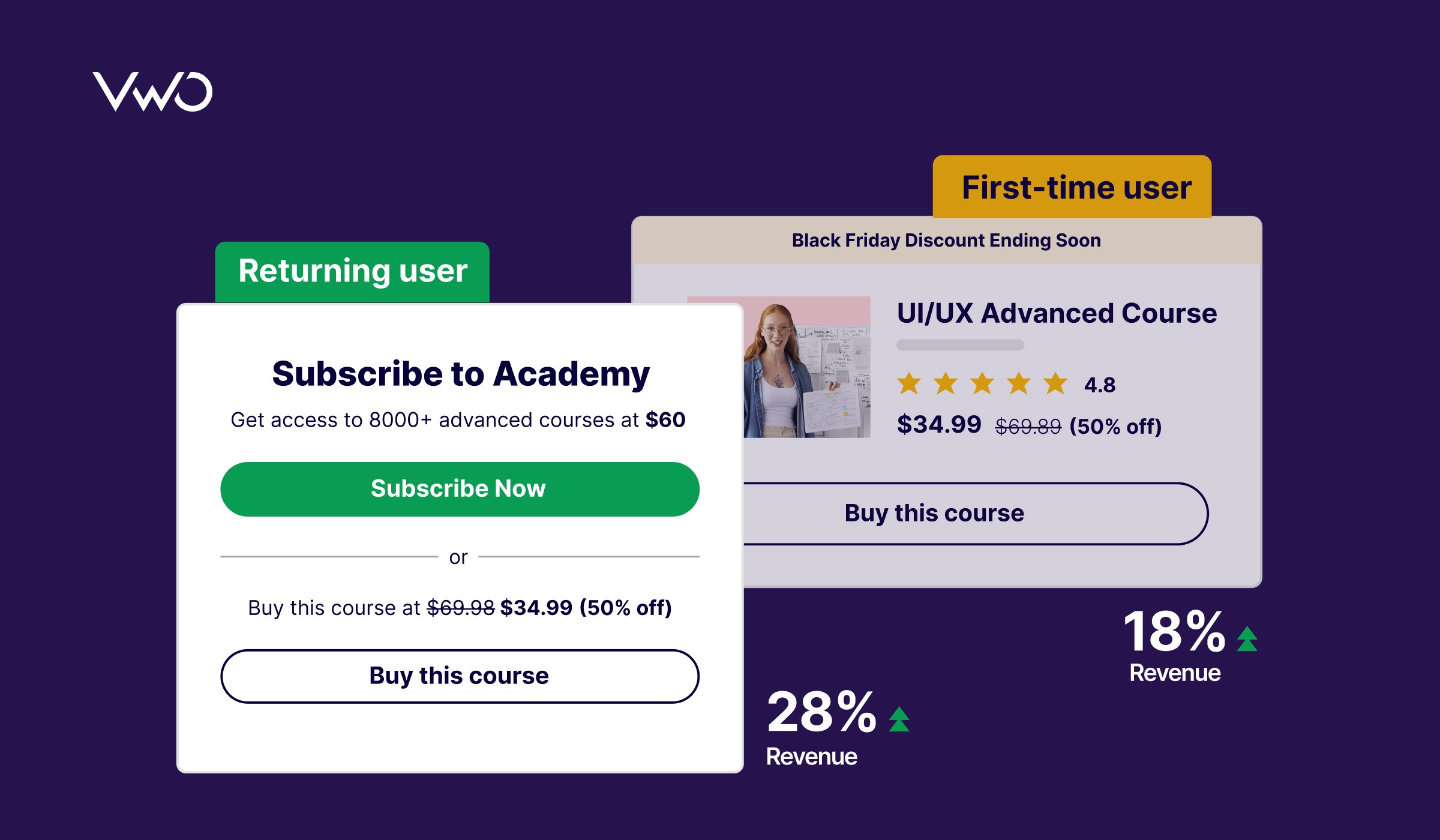
Two users. One homepage. Two completely different worlds.
User A is a returning subscriber looking for advanced tutorials. User B is a first-time visitor who just clicked on a “Black Friday” ad.
In the old world, they both see the same generic “Welcome” banner. Within ten seconds, one is bored, and the other is lost. Opportunity missed.
In the real-time world, the site pivots in milliseconds:
- User A sees: “Welcome back! Pick up where you left off on Lesson 4.”
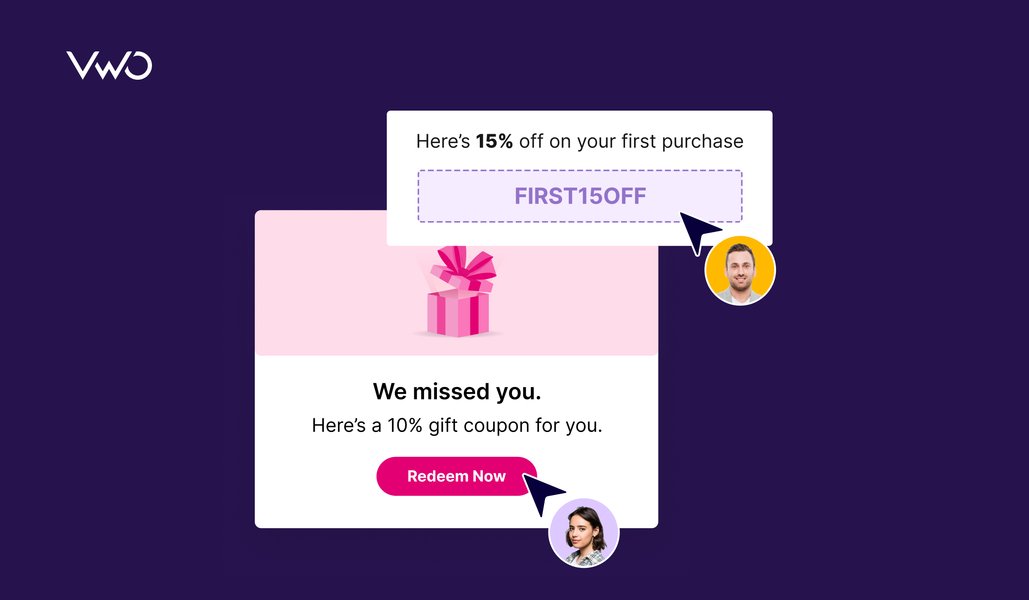
- User B sees: “Your 20% discount is applied. Shop the sale now.”
In 2026, relevance isn’t a luxury; it’s the baseline for meeting rising customer expectations. If you aren’t responding to a user’s intent the moment it’s signaled, you’re already behind.
This guide is about turning live clicks into conversations and instant intent into customer engagement and long-term loyalty.
What is real-time personalization?
Real-time personalization is the practice of dynamically adapting digital experiences, such as website content, offers, and recommendations, based on a user’s live behavior, context, or intent during an active session.
Imagine a visitor on an electronics site who has viewed the same noise-canceling headphones three times and just spent two minutes on the “Shipping & Returns” page.
Instead of waiting to send an “abandoned browse” email tomorrow, the site recognizes this hesitation in real time. The moment the user returns to the product page, a dynamic banner appears offering “Free Express Shipping for the next 30 minutes.”
This intervention happens instantly, addressing a friction point exactly when the user is most likely to convert.
Benefits of real-time personalization
Real-time personalization shifts your marketing from being assumption-driven (what we think they want based on last month) to signal-driven (what they are showing us they want right now). Some of the benefits are:
1. Exponential lift in conversion rates
When you respond to a user’s intent within the same session, you capture them at the “peak” of their interest, guiding decisions while users are actively evaluating options.
Industry research consistently shows that fast-growing companies generate more revenue from personalization, often cited at around 40% higher than slower-growing competitors.
2. Reduced friction and bounce rates
Real-time tools can be configured to interpret “struggle signals”, like rapid clicking or navigating back and forth between two similar products. By instantly triggering a comparison guide or a helpful tip, you resolve the user’s confusion before they decide to leave.
3. Increased average order value (AOV)
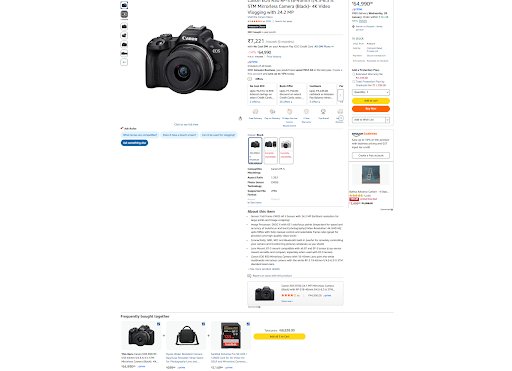
Static “You might also like” sections often show items the user has already bought or seen. Real-time personalization analyzes the current cart and browsing history to suggest complementary items relevant to that specific checkout.
Example: If a user adds a camera to their cart, the site instantly features a “Frequently Bought Together” bundle with the exact accessory and memory card compatible with that model, increasing relevance without interrupting the purchase flow.
4. Maximizing the value of “perishable” data
User intent has an expiration date. A user’s search for “urgent home office setup” is incredibly valuable now, but loses relevance by tomorrow. Real-time personalization allows you to capitalize on these micro-moments that traditional batch-processing would miss.
5. Building long-term loyalty
Personalization isn’t just about the immediate sale; it’s about making the customer feel “known.” When a site remembers a user’s preferences across devices in real time, it builds trust and strengthens customer satisfaction.
As a result, 60% of consumers are more likely to become repeat buyers of brands that consistently deliver a personalized experience.
How does real-time personalization work?
Real-time personalization is a high-speed orchestration of data and design. To the user, the website feels intuitively responsive to their needs; in reality, it is a seamless Listen–Think–Act–Learn loop operating within milliseconds.
The process follows a clear, repeatable flow:
1. Unified data collection
The journey begins by collecting real-time event-stream data. Unlike traditional personalization that stores data for later batch processing, these signals are captured and evaluated as they happen.
- Behavioral signals: Scroll depth, mouse hovers, click patterns, and time spent on key sections.
- Contextual inputs: Device type, geographic location, local time, and traffic source (for example, a specific ad campaign).
- In-session actions: Repeated views of the same category or struggle signals, such as rapid clicking or back-and-forth navigation.
For real-time personalization to be effective, these signals work best when unified into a shared customer context, often via a CDP or a centralized data layer, so decisions reflect both the current session and the user’s known history across the customer journey, rather than only a single click.
Check out the discussion below on how customer data fuels relevant, intent-aligned experiences. Learn how teams translate insights into effective personalization strategies.
2. AI-driven decisioning
Once the data is collected, it needs a brain. This is where Artificial Intelligence and Machine Learning (ML) become increasingly important in real-time systems.
- Identifying intent: While a human marketer might see a user visiting a “Shipping” page, an AI engine can instantly categorize that user as a “High-Intent Hesitator” based on patterns across millions of other sessions.
- Predictive modeling: The system doesn’t just react to what has happened; it forecasts the Next Best Experience (NBE). It determines whether the user needs a discount code to convert or more technical information to feel confident.
3. Dynamic experience delivery
Once intent is identified, the experience adapts instantly, often within milliseconds. This may involve:
- Updating headlines, CTAs, or banners
- Surfacing contextual recommendations or bundles
- Triggering comparison guides, reassurance messaging, or limited-time offers
- Experience continuity: Real-time personalization ensures on-page experiences adapt to what the user has just done, so each interaction builds on the previous one within the same session.
Speed is critical here. Any noticeable delay risks breaking immersion or creating the “flicker effect,” where original content appears briefly before the personalized version loads.
4. Continuous feedback loop
The engine doesn’t just “set and forget.” Every interaction, or lack thereof, is a new data point. If a user ignores a real-time recommendation, the ML models refine the user’s profile instantly, ensuring the next interaction is even more accurate.
The key takeaway: Real-time personalization is the death of the “data silos.” It requires your website, ads, and CRM to speak the same language simultaneously to create a journey that builds on every new click.
How to implement real-time personalization: step-by-step
Follow this blueprint to build a scalable, high-impact personalization strategy:
Step 1: Define clear personalization objectives
Start by clarifying what real-time personalization should achieve. Choose one primary outcome, such as:
- Increasing conversions on high-intent pages
- Reducing drop-offs during evaluation or checkout
- Improving engagement with key content or features
Clear objectives ensure every segment, trigger, and response is tied to a business outcome.
Step 2: Collect and unify customer data
Ensure your data sources are connected. Real-time personalization depends on access to live behavioral data combined with relevant historical context.
Focus on unifying:
- Website or app interactions
- CRM and customer profile data
- Campaign, referral, or traffic-source data
This unified view allows decisions to reflect both current intent and past behavior, such as browsing patterns and purchase history.
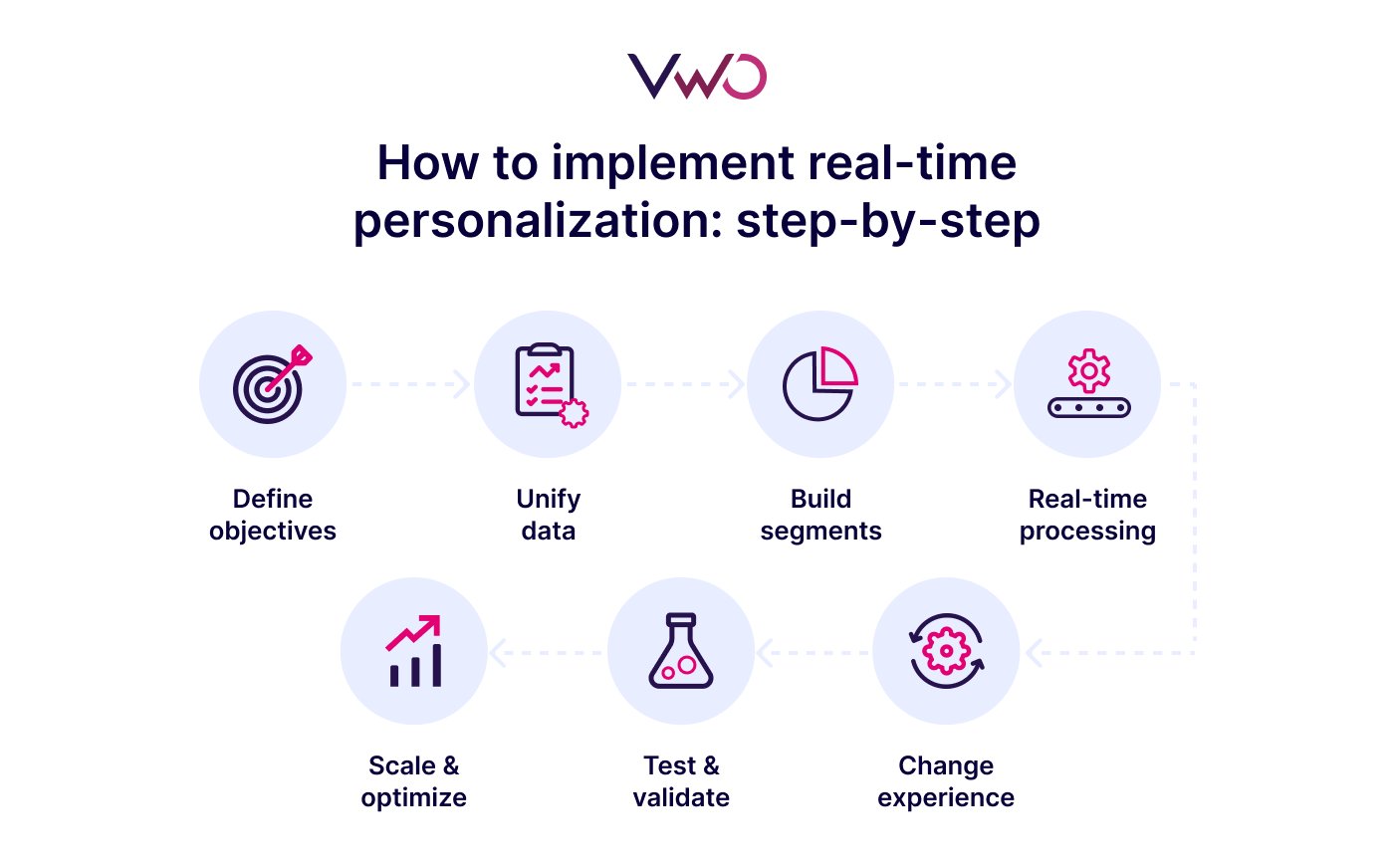
Step 3: Build actionable audience segments
Rather than personalizing for individuals immediately, create audience segments that group users with shared characteristics. Common segmentation criteria include:
- Behavioral patterns (repeat visits, feature exploration)
- Journey stage (new, evaluating, returning)
- Context (device type, location, acquisition source)
These segments provide the foundation for consistent, scalable personalization.
Step 4: Enable real-time data processing
Real-time personalization works only when data is processed as it is generated, not after the session ends. Instead of reacting to isolated events, systems continuously interpret live behavioral and contextual signals to understand evolving intent.
This requires low-latency processing that updates user context in milliseconds, allowing experiences to adapt while the user is still engaged, when decisions are actually being made.
Step 5: Specify the real-time response
Once real-time processing is in place, define what should visibly change in the experience. This step focuses on how the page adapts, not how data is interpreted.
Effective changes are focused, contextual, and help reduce friction or guide the next step. This might include adjusting CTAs, reordering content, surfacing comparisons, or highlighting reassurance elements.
Step 6: Test and validate personalization impact
Without validation, personalization becomes guesswork. Testing ensures personalization decisions are data-driven. Using an experimentation platform like VWO, teams can:
- A/B test personalized versus generic experiences
- Measure incremental lift in conversions or engagement
- Identify which segments and triggers actually perform
Step 7: Scale and optimize continuously
Real-time personalization should evolve alongside customer behavior, not remain static. Once a rule or trigger proves effective:
- Extend it to similar segments or journeys
- Add supporting signals where needed
- Retire rules that stop performing
While the implementation steps provide the roadmap, the true power of this technology is best understood through real-world applications across different industries.
Examples of real-time personalization
Below are examples of how organizations across industries use live signals to adapt experiences in the moment and drive measurable outcomes.
1. eCommerce and Retail
In retail, real-time personalization helps close the gap between browsing and buying by responding instantly to hesitation.
The Signal: A visitor dwells on the Shipping & Returns section, repeatedly scrolls between product details and delivery info, and moves their cursor toward the back button or address bar.
The Response: The moment this hesitation pattern is detected, a contextual overlay appears on the same page with a time-bound incentive, such as: “Order in the next 15 minutes for Free Express Shipping.”
The Result: The experience intercepts uncertainty at the exact moment it arises, reducing drop-offs and improving checkout completion.
2. Software as a Service (SaaS)
For SaaS companies, real-time personalization accelerates value during evaluation and onboarding.
The Signal: A trial user opens a premium feature page multiple times in a single session but does not activate it.
The Response: While the user is still exploring, an in-app nudge appears offering a 30-second walkthrough video or a use-case example tailored to their industry.
The Result: Immediate, contextual guidance increases feature adoption and improves the likelihood of conversion to a paid plan.
3. Travel and Hospitality
In travel, where availability and demand shift rapidly, real-time personalization simplifies decisions and creates urgency.
The Signal: A user refreshes search results multiple times and repeatedly clicks boutique hotels in the same neighborhood.
The Response: In that same session, the system updates the results view to surface similar properties first and overlays live cues such as “2 rooms left at this price — booked 3 times today.”
The Result: Reduced choice overload and timely urgency encourage faster booking decisions.
4. Financial Services and Banking
In financial services, real-time personalization reduces uncertainty during high-stakes decisions.
The Signal: A customer repeatedly adjusts loan amounts and tenure in a mortgage calculator, then pauses while toggling between eligibility and repayment tabs.
The Response: Instantly, a contextual prompt appears within the interface: “See your estimated eligibility in one click” or “View a tailored repayment breakdown for this tenure.”
The Result: Support arrives precisely at the moment of hesitation, increasing calculator completion and downstream applications.
Some challenges in real-time personalization
Real-time personalization can deliver meaningful gains in engagement and conversion, but implementing it well requires navigating a few practical challenges.
1. Scalability: Growing without losing relevance
As personalization efforts expand, so does complexity. Processing large volumes of behavioral data in real time, across multiple channels and touchpoints, can strain marketing technology systems that weren’t designed for low-latency decisioning.
The challenge becomes even greater when customer data lives in multiple tools. Inconsistent or delayed data synchronization can lead to fragmented customer profiles, reducing the accuracy of real-time decisions.
How teams address it:
Successful teams invest in platforms and processes that unify data streams and automate decision-making, allowing personalization to scale without sacrificing speed or accuracy. Just as importantly, they test and optimize continuously to ensure scale doesn’t dilute impact.
2. Privacy: Balancing relevance with trust
Real-time personalization relies heavily on behavioral and contextual data, making privacy a critical concern. Customers are increasingly cautious about how their data is collected and used, and regulations like GDPR and CCPA demand transparency and control.
If personalization feels intrusive or unclear, it can quickly erode trust rather than build it.
How teams address it:
High-performing organizations prioritize first- and zero-party data, implement clear consent mechanisms, provide opt-out options, and remain transparent about how personalization works. Strong governance and security practices ensure data is used responsibly, reinforcing trust while still enabling relevance.
3. Data consistency across channels
Personalization loses its impact if it is inconsistent. A customer who just purchased a product on your mobile app should not immediately see a “first-time buyer” discount for the same product when they open your website moments later.
When customer data is fragmented across channels, experiences can quickly become disconnected or contradictory.
How teams address it:
Use a unified customer data layer, often supported by a CDP, to centralize behavioral and transactional data into a single source of truth. When all channels reference the same continuously updated customer profile, email, SMS, and web experiences work in harmony, extending the journey rather than repeating it.
Addressing these challenges effectively requires tools that are purpose-built for real-time decisioning, experimentation, and governance, making choosing a platform a critical next step.
Top tools for real-time personalization
Real-time personalization requires a combination of multiple capabilities working together in real time. Below are the core categories of tools teams rely on, and the role each plays in a personalization strategy.
1. Customer Data Platforms (CDPs)
A CDP collects and organizes customer data from multiple sources, websites, CRMs, and offline touchpoints into a single, persistent profile.
They maintain a consistent view of user behavior and attributes across channels, enabling continuity as they move between touchpoints.
While CDPs are foundational for data, they typically need to be paired with an execution, experimentation, or marketing automation platform to actually deliver personalized experiences in real time.
Watch the discussion below to learn how teams use CDPs not just to unify data, but to activate and test personalization in real time.

2. Real-time decisioning and personalization engines
Real-time decisioning and personalization engines determine how an experience should change based on live user behavior during an active session.
They power in-the-moment changes like dynamic content swaps, CTAs, contextual messages, or recommendations, allowing experiences to respond to intent while the user is still engaged.
Without experimentation, it can be difficult to determine whether the personalized experience is driving incremental impact or simply reacting to behavior.
3. Experimentation and testing platforms
Experimentation platforms enable teams to run controlled tests by comparing personalized experiences against non-personalized controls.
They provide the measurement layer, helping teams validate which signals, segments, and responses within personalized campaignsactually improve conversions, engagement, or retention.
Experimentation alone doesn’t unify data or orchestrate personalization across channels without integration with decisioning and delivery systems.
4. Analytics and behavioral insight tools
Analytics and behavioral insight tools track how users interact with digital experiences, capturing actions such as clicks, scrolls, drop-offs, and navigation paths.
They are best suited for identifying high-intent signals and friction points worth personalizing. While not personalization tools themselves, these platforms help you decide what to personalize.
They are most powerful when tightly integrated with your experimentation platform so you can move from “insight” to “action” without switching tabs.
5. Marketing automation and engagement tools
These platforms specialize in delivering event-triggered messages across channels such as email, SMS, and push notifications.
They support near real-time responses to user actions outside the website or app, such as follow-ups, reminders, or lifecycle messaging tied to specific behaviors.
They are effective across the customer lifecycle marketing, but often require integration with a web-personalization tool to ensure the site and the email are showing the same message.
6. AI-powered recommendation tools
These tools use machine learning models to predict what a user wants to see next.
They excel at discovery-driven personalization at a massive scale, adapting recommendations based on what the user is engaging with right now, and learn from aggregate patterns (e.g., “People who bought X also liked Y”).
Most often, such tools perform better as components within a broader personalization stack.
Conclusion: Where and how VWO gives you the edge
AI-driven experiences may be imperative, but you can’t lose sight of control, validation, and proof.
This is where rule-based personalization still earns its place. Think compliance-sensitive industries like finance and healthcare, where experiences must adhere to strict eligibility rules.
While AI can surface patterns and predictions at scale, rule-based personalization gives teams something equally valuable: precision and intentionality. With VWO Personalize, teams can precisely control targeting and customize experiences for different visitor segments. The Visual Editor also allows teams to design and deploy these experiences without heavy developer involvement.
More importantly, these experiences can be tested and validated. With VWO Testing, teams can run tests and measure whether personalization efforts genuinely boost engagement and drive impact, ensuring decisions are guided by data rather than intuition. Meanwhile, VWO Insights provides behavioral visibility through tools like heatmaps and recordings, helping teams understand how different segments interact with personalized experiences and refine them further.
Request a demo to see how VWO helps teams personalize with clarity, control, and measurable impact.
FAQs
Real-time personalization typically requires a combination of tools: customer data platforms (to unify data), real-time decisioning or personalization engines (to adapt experiences in-session), analytics tools (to identify intent signals), and experimentation platforms (to validate impact). Many teams use an integrated platform to reduce complexity.
Yes, but only when built on the right foundation. Scalability depends on unified data, low-latency decisioning, automation, and continuous testing. Teams that start with high-impact use cases and scale based on proven results are far more successful than those trying to personalize everything at once.
Real-time personalization increases the sensitivity of data use by acting on live behavioral signals during an active session. This raises privacy expectations and the need for strong governance.
Clear consent, opt-out options, and compliance with regulations like GDPR and CCPA help ensure personalization remains relevant without compromising user trust.
Traditional personalization relies on historical data and batch updates, often reacting hours or days later. Real-time personalization adapts experiences within the same session, using live behavior and context to respond while intent is still high.
Success is measured through controlled experimentation. By testing personalized experiences against non-personalized controls, teams can track incremental lift in metrics such as conversions, engagement, retention, or revenue, ensuring impact is proven, not assumed.
Industries with high-intent, dynamic decision-making benefit the most. This includes eCommerce and retail, SaaS, travel and hospitality, financial services, media and content platforms, and B2B services, anywhere user intent can change quickly within a session.
Real-time personalization dynamically adapts content and experiences during an active session, using live user behavior and context to respond instantly, rather than relying on past data or delayed updates.