Teams make changes to their website almost every week.
But these changes are often rolled out without a clear way to measure their impact.
This makes it difficult to know whether they’re genuinely improving the user experience or unintentionally creating friction.
Without structured validation, even well-intentioned updates can lead to mixed or unclear results.
A/B testing helps remove this layer of “uncertainty” by offering a way to validate ideas, ensuring every change measurably improves user experience and drives business outcomes.
Instead of relying on opinions or assumptions, it helps you identify:
What works for your target audience
Why it works
How optimization efforts contribute to long-term growth
Below, we break down the key benefits of A/B testing with real examples that prove how small experiments can drive significant impact.
Why is A/B testing important?
A/B testing introduces structure into the optimization process by providing a systematic way to compare alternatives and evaluate their impact on user behavior.
Instead of making changes and hoping for the best, teams can:
Test variations side by side.
Measure outcomes against defined goals.
Learn which version performs better.
This turns optimization from a series of isolated changes into a repeatable, evidence-based practice.
It replaces opinion-led decisions with a consistent data-driven process, helping teams reduce internal bias, align faster, and optimize based on actual visitor interactions.
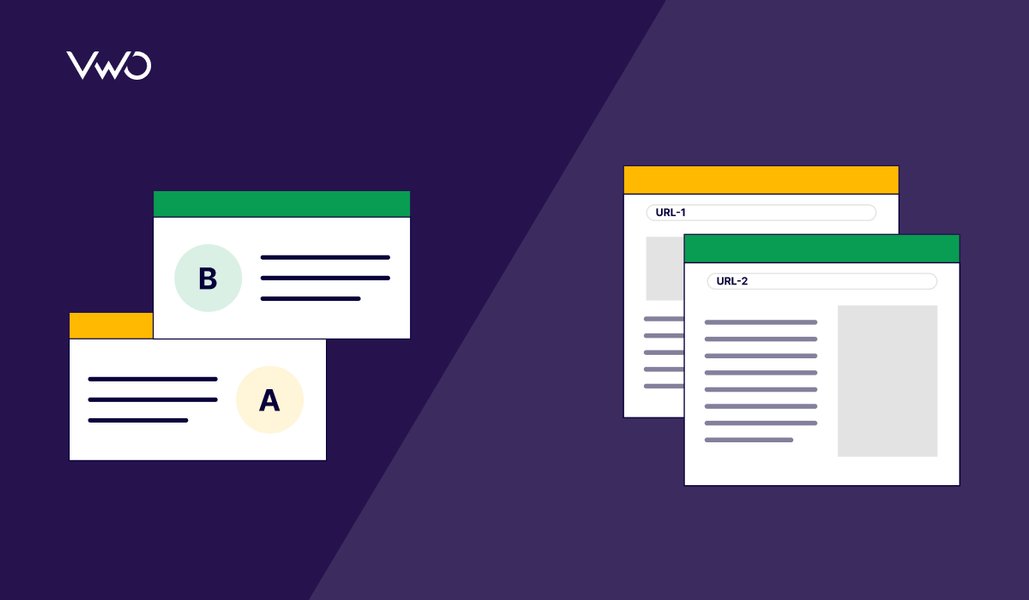
Apart from A/B testing, there are other testing methods as well, which include split testing or split URL testing, multivariate testing, and multipage testing.
The first stage of A/B testing typically involves identifying a problem or opportunity, such as a drop-off in a funnel, low user engagement, or an underperforming metric.
2. Build a hypothesis
Based on the initial findings, teams form a hypothesis about how the challenge can be tackled, what change might improve the experience, or which elements can be tweaked.
So we use quantitative data to make sure we’re looking at the right place and make sure we’re focusing on the actual problem, and then we use the qualitative data to then understand the why behind why it’s actually happening.
If you’re curious about A/B testing, just start. Because the moment you see how small changes influence user behavior, you begin to understand the power of experimentation. That first step often sparks deeper curiosity, and before you know it, you’re uncovering layers of insight you didn’t expect.
Once the hypothesis is defined, a new version is created by modifying the target element or experience. This could involve changes to copy, layout, design, messaging, or interaction patterns.
4. Run the test
The original version (control) and the new version (variation) are then typically shown to two different groups of visitors. The test is run until sufficient data is collected to make a reliable comparison between the two versions.
5. Collect data & analyze test results
Teams perform a statistical analysis on how users respond to each version and whether the variation performs better than the control against the primary goal.
Based on the valuable insights gathered from the test results, the change may be rolled out to all users, refined further, or discarded entirely.
Below is the list of the top 9 benefits of A/B testing.
1. Measure and improve impact on conversion rates
A/B testing allows teams to measure how specific changes affect conversions before rolling them out broadly.
By testing elements such as headlines, CTAs, page layouts, imagery, and even email subject lines, teams can determine which variations perform better based on actual user interactions.
While not every test leads to an uplift, the insight gained helps teams avoid rolling out changes that could negatively impact sign-ups, purchases, or clicks.
2. Eliminate guesswork from decision-making
With A/B testing, your decisions are based on actual data and evidence rather than assumptions or intuition. The process also helps you to:
Validate ideas based on how users interact
Track how different versions resonate with users
Remove guesswork from key decisions
3. Identify UX friction and usability
A/B testing can help you identify friction points and other hidden issues that impact the user experience.
By testing different hypotheses, you can compare how users interact with each version and make targeted changes to improve key usability aspects of your website.
4. Minimize risk with controlled experiments
Major changes to a website, product, or marketing campaign carry inherent risks.
With A/B testing, you can test these ideas before a full-scale launch, mitigating the overall risk and helping you make confident decisions.
So, rather than rolling out a home page redesign to all users, you can first test it with a small percentage of visitors and assess the impact before committing fully.
5. Maximize ROI from existing traffic
Instead of acquiring more visitors, A/B testing helps teams make better use of the traffic volume they already have by identifying which experiences perform better.
This approach can lead to meaningful results without an increase in ad spend, higher ROI on acquisition costs, and more value from the same number of visitors.
6. Build a culture of continuous optimization
The process of experimentation encourages teams to test ideas before implementing, and enables them to innovate more confidently.
Teams with a culture of continuous testing and data-driven optimization can be better-equipped to handle changing market trends and customer expectations.
7. Support product and feature validation
A/B testing is an effective way to guide product development with direct insights from actual users. It helps you to:
Measure the impact of new functionalities before launch
Prioritize features and updates based on actual user response
By testing your pricing models and strategies, you can uncover ideas that lead to higher revenue or greater user acceptance.
Teams regularly test pricing structures and key value propositions to identify the approach that works best for their target audience.
When users land on a pricing page, they’re probably not concerned about the color of your CTA button. Instead, they’re asking themselves, “Is this going to solve my problem?” or “Is this worth my money?”. So pricing page optimization is about understanding these concerns and making it easier for users to make a decision.
Creating content, elements, or web pages based on what visitors want to read or consume is an excellent way to attract new buyers.
By running tests for different segments (based on device, location, or traffic source), you can identify elements or changes that resonate well with specific user groups.
Personalized tests help you deliver an enhanced user experience that resonates uniquely with different user groups.
Pro Tip!
Compare user behavior on the control vs. variation using session recordings integrated directly into your VWO test reports. See the exact actions users take before conversion or drop-off and spot specific areas that confuse or delight them, so you can eliminate friction and optimize what works.
4 real-life examples of how A/B testing benefits businesses
The true power of A/B testing becomes clear when you look at how real companies use it to solve real problems.
Here is a list of some success stories that show how small experiments create measurable impact.
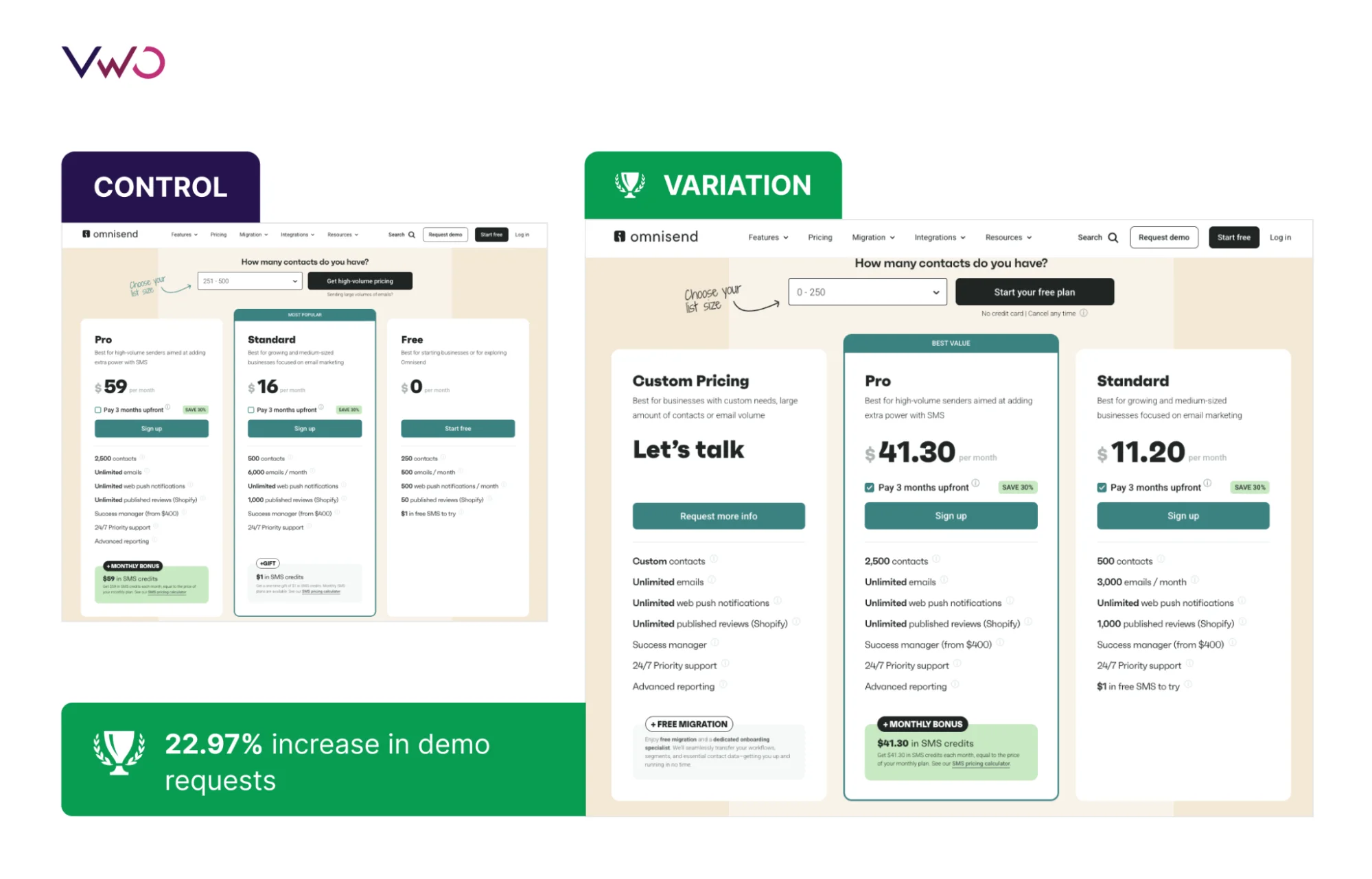
Omnisend increased demo requests by 22.92% with A/B testing
The team at Omnisend was looking to improve the performance of its pricing page and increase demo requests from high-intent visitors.
They conducted extensive user research and realized that visitors were struggling to understand which plan offered the best value.
Based on this insight, they decided to redesign the pricing page and ran an A/B test to compare the existing page (control) with the redesigned version (variation).
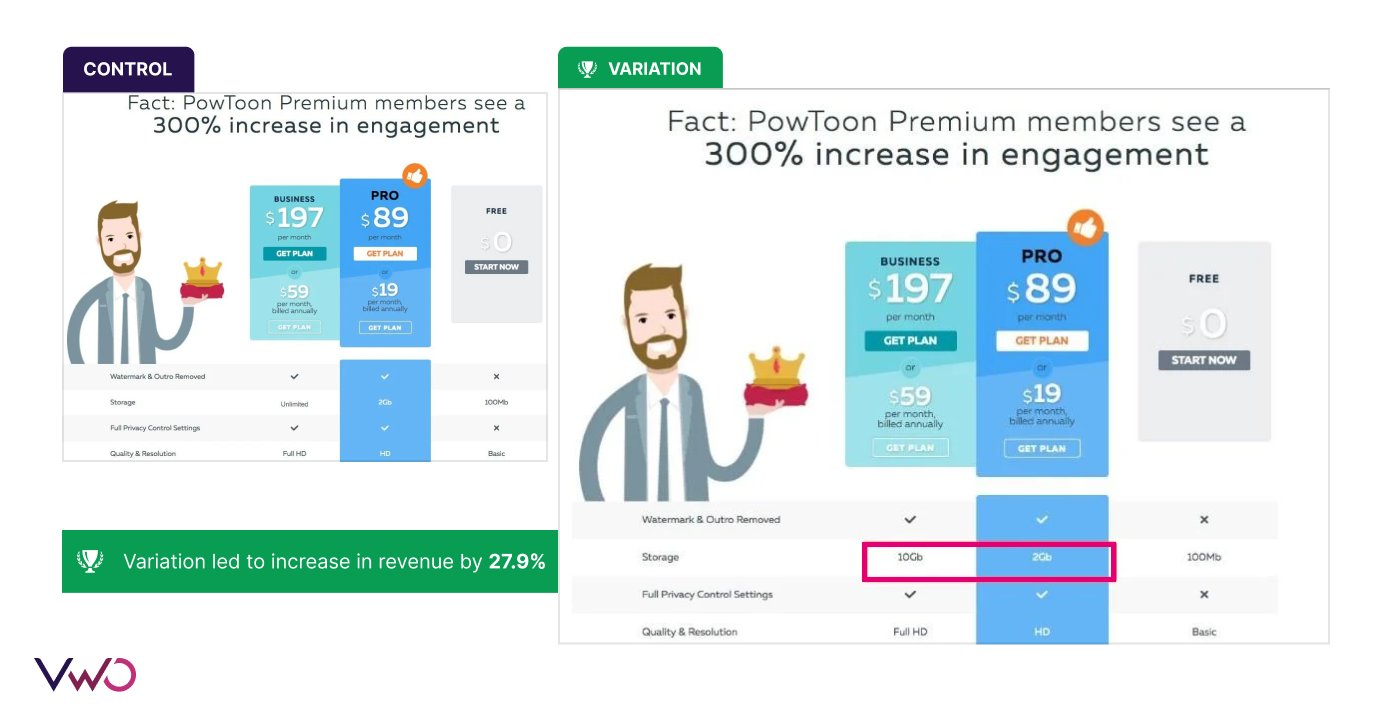
Powtoon increased revenue by 27.9% with experimentation
Powtoon, a SaaS-based animation software service, was looking to improve conversions on its pricing page.
The team hypothesized that the “unlimited storage” benefit offered under the business plan wasn’t adding much value to prospective buyers.
They decided to display the actual storage offered under each plan:
2 GB for Pro
10 GB for Business
The goal was to clearly showcase the value difference between the two plans.
They used VWO to test this hypothesis, and what looked like a tiny copy change led to a 27.9% uplift in revenue.
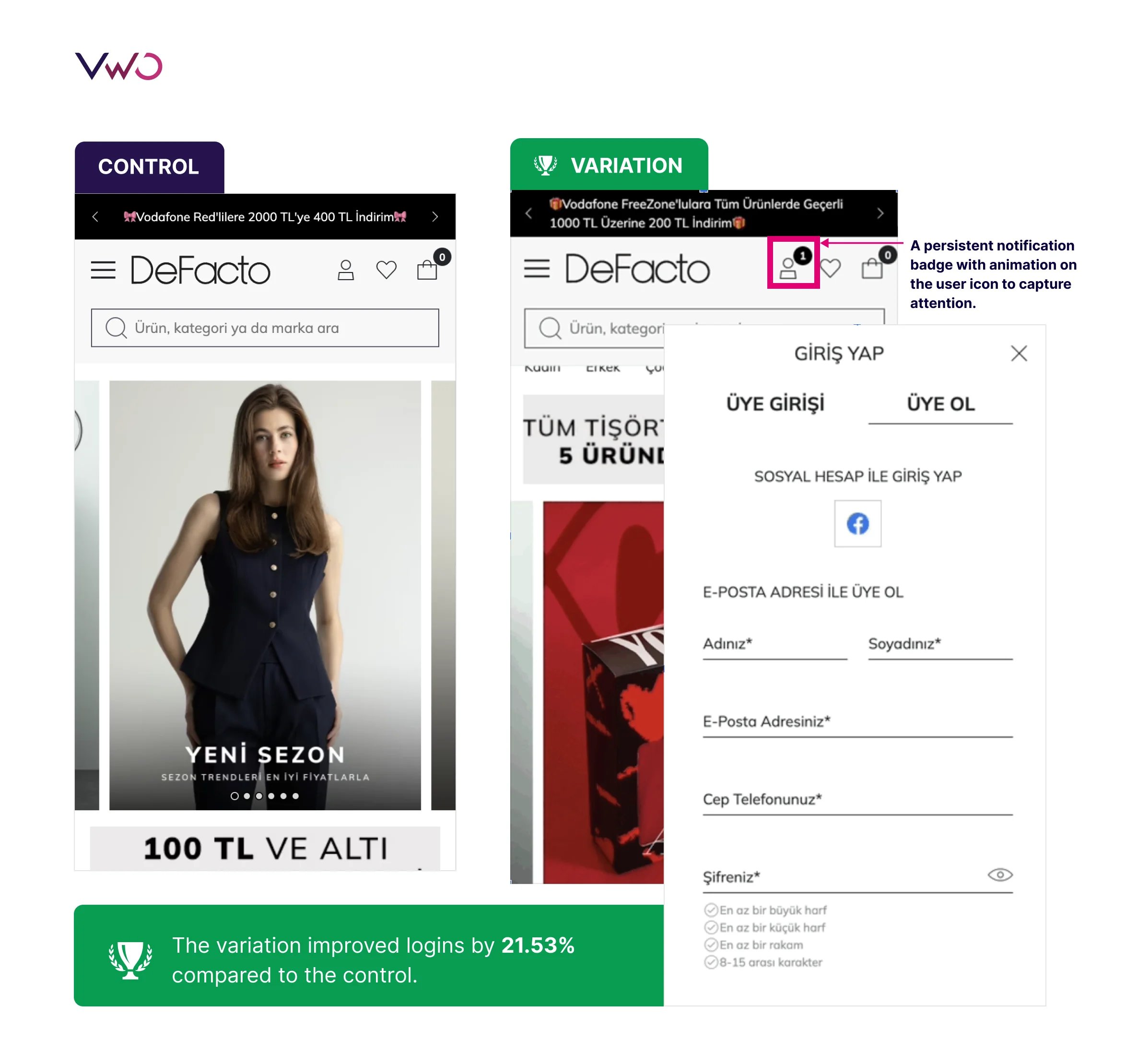
DeFacto’s A/B test led to 21.53% more user logins
DeFacto, a global fashion brand, wanted to increase account engagement during Black Friday.
Their research revealed that although many visitors browsed the website, very few chose to register, possibly because the account icon was not noticeable enough.
The team introduced a subtle animated badge on the account icon to draw attention and prompt users to log in or register.
Using VWO, DeFacto tested the updated visual cue against the original design during the Black Friday campaign.
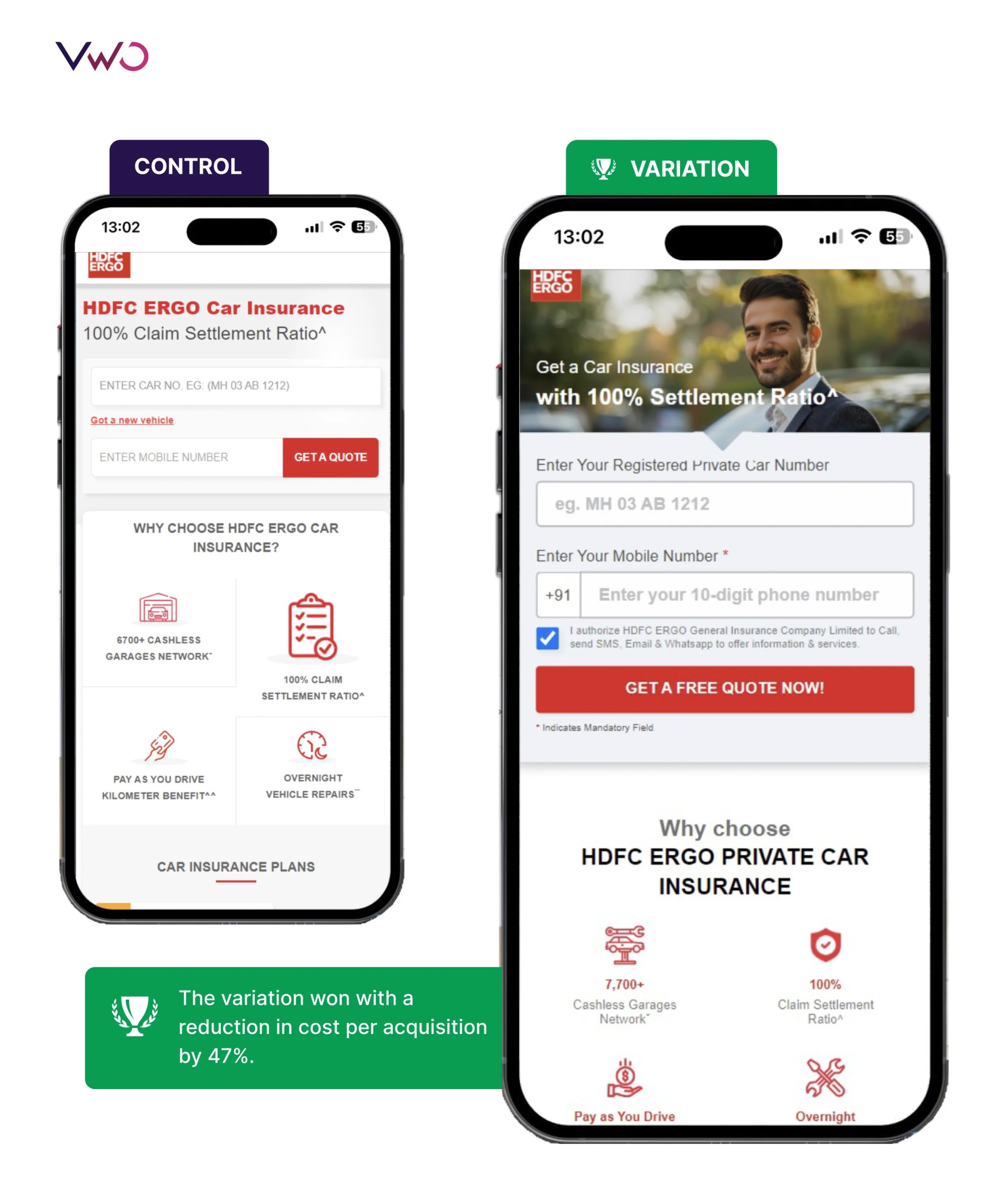
HDFC ERGO reduced cost per acquisition by 47% with targeted A/B testing
HDFC ERGO, India’s leading insurance provider, aimed to reduce drop-offs and improve conversions on its car insurance website.
Based on initial research, the team designed a variation of the page featuring a clear value proposition, new CTA copy, and better visibility for key icons.
Whether you’re trying to improve conversion rates, validate product ideas, or refine UX, A/B testing helps you make confident decisions backed by data and actionable insights.
And with a tool like VWO Testing, you can run and scale your entire experimentation program to build amazing user experiences.
From micro-interactions to full-scale redesigns, VWO gives you everything you need to learn faster, optimize smarter, and grow continuously.
A/B testing helps you: – Make data-informed decisions – Optimize user interactions iteratively – Personalize experiences thoughtfully – Build a culture of continuous experimentation – Identify the impact of changes on conversion rates – Mitigate risk before rolling out big changes
Q2. What is the significance of A/B testing?
A/B testing removes guesswork from decision-making. Instead of relying on assumptions, it shows you exactly what users prefer, helping you ship changes with confidence, reduce performance risks, and continuously improve outcomes across digital marketing, product, and UX.
Q3. When should you use A/B testing?
Use A/B testing when you want to: – Measure and improve the impact on conversion rates – Identify friction points in user journeys – Validate product features or updates before full rollout – Understand user preferences and what resonates better with different segments – Evaluate campaign or page performance A good rule of thumb: If the changes or updates will affect engagement or revenue, test it before shipping.
Hi, there! I’m an Associate Manager of Content at VWO with 6 years of experience in B2B and B2C marketing. I work across blogs, SEO, thought leadership, newsletters, landing pages, and a video podcast I built and manage from scratch. At VWO, I’ve gained expertise in CRO, experimentation, user behavior research, and personalization, creating content that makes complex ideas clear and actionable. Outside of work, I enjoy experimenting with memes and short-form video on Instagram.
Uncover hidden visitor insights to improve their website journey
One of our representatives will get in touch with you shortly.
Awesome! Your meeting is confirmed for at
Thank you, for sharing your details.
, you're all set to experience the VWO demo.
I can't wait to meet you on at
Account Executive
, thank you for sharing the details. Your dedicated VWO representative, will be in touch shortly to set up a time for this demo.
We're satisfied and glad we picked VWO. We're getting the ROI from our experiments.
Christoffer Kjellberg
CRO Manager
VWO has been so helpful in our optimization efforts. Testing opportunities are endless and it has allowed us to easily identify, set up, and run multiple tests at a time.
Elizabeth Levitan
Digital Optimization Specialist
As the project manager for our experimentation process, I love how the functionality of VWO allows us to get up and going quickly but also gives us the flexibility to be more complex with our testing.
Tara Rowe
Marketing Technology Manager
You don't need a website development background to make VWO work for you. The VWO support team is amazing
Elizabeth Romanski
Consumer Marketing & Analytics Manager

 DE
DE
 BR
BR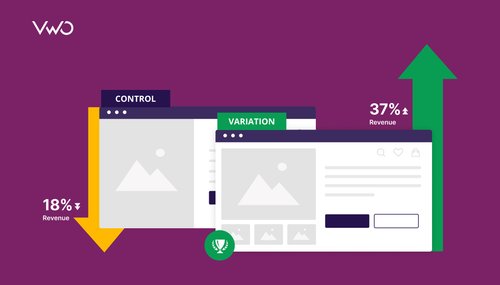

 ChatGPT
 Perplexity
 Gemini
 Claude
 Grok
Grok