 DE
DE
 BR
BR




 ChatGPT
 Perplexity
 Gemini
 Claude
 Grok
Grok
Complete Guide to Sales Funnel Tracking in 2026
Most businesses treat their sales funnel like a “black box.” They pour marketing dollars in at the top, watch revenue come out the bottom, and hope for the best.
But if sales dip or you’re ready to scale, “hoping” isn’t a strategy. You need to look inside that box to see exactly where prospects are moving across the entire sales funnel, and where they’re ghosting you. Are they engaging with your content but hitting a wall at the pricing page? Is a clunky mobile checkout causing users to abandon ship at the last second?
Sales funnel tracking acts as the GPS for your customer journey. It moves you past metrics like “total clicks” and gives you the exact coordinates of user behavior. It’s the difference between guessing why you’re losing leads and knowing exactly how to fix the leak.
In this guide, we’ll cut through the analysis paralysis and show revenue leaders, growth and product marketers, CRO teams, and scaling founders how to build a tracking system that turns raw data into a high-converting sales engine.
What is sales funnel tracking?
A sales funnel is a series of steps that potential customers go through from initial awareness to conversion. Sales funnel tracking is the process of monitoring, measuring, and analyzing how customers behave as they move through each of these stages.
While the funnel defines the path a customer is expected to take, tracking provides the data-driven view of how users actually progress through it, how many advance from one stage to the next, where movement slows or stops, and how long the journey typically takes.
Typical sales funnel examples include eCommerce, B2B SaaS, and consumer tech businesses, each with its own set of sales funnel stages and tracking requirements.
For example, a B2B SaaS funnel may track trial starts, activation milestones, and sales handoffs, while an ecommerce funnel focuses on product page views, cart progression, checkout completion, and repeat purchases. Product-led growth funnels often loop between content consumption, feature adoption, and upgrades, making non-linear tracking essential.
Why funnel tracking is important
In reality, modern sales funnels are no longer linear paths from awareness to conversion. Users revisit stages, switch devices, consume content out of sequence, and re-enter the funnel multiple times before buying. Effective sales funnel tracking must account for looping behavior, re-entry points, and parallel journeys across the full customer journey.
Here’s why sales funnel tracking is essential in 2026:
1. Pinpoints bottlenecks
It acts as a diagnostic tool, revealing exactly where prospects stall or drop off within specific sales funnel stages. Whether it’s a high bounce rate on a landing page or an abandoned checkout, it helps teams focus fixes on the stages causing the most friction.
2. Drives higher conversions
Monitoring how leads transition between stages helps you identify and strengthen weak spots in your messaging, ensuring a higher percentage of prospects cross the finish line and convert more prospects into paying customers.
3. Optimizes marketing budget
Tracking connects sales back to their source. This clarity helps separate high-performing channels from low-impact ones, enabling smarter budget allocation and higher ROI.
4. Personalizes the journey
Understanding where a user sits in the funnel allows you to deliver the right message at the right time, making the customer experience feel more relevant and less like a generic sales pitch.
5. Enables accurate revenue forecasting
When you know your conversion rates, revenue becomes a predictable math equation. You can use current lead data to forecast revenue, project future growth, and make smarter strategic decisions.
6. Benchmark performance
It establishes a clear baseline for success. Monitoring trends over time helps teams evaluate strategy effectiveness and quickly respond when performance starts to dip.
7. Aligns sales and marketing teams
Tracking creates a shared view of the customer journey across the organization. Marketing and sales can coordinate more effectively, ensuring lead quality matches what sales teams can realistically close.
How to build a funnel for tracking conversion rate: step-by-step
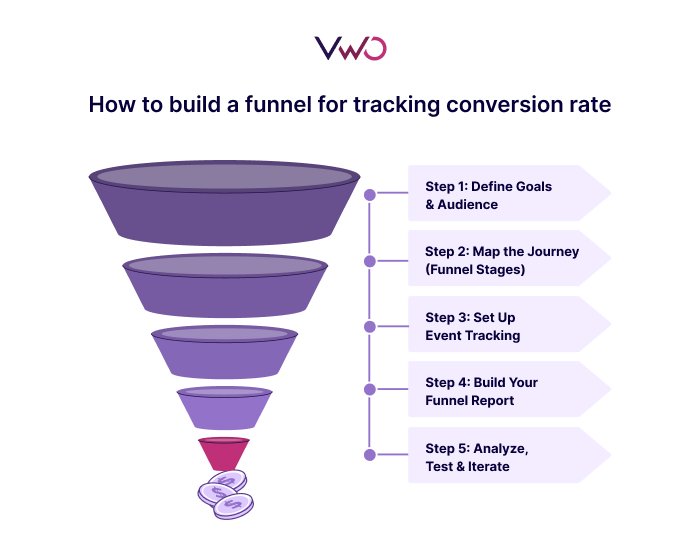
Step 1: Define your goals and audience
Before looking at data, you must know what you are measuring and for whom.
Identify the objective
Are you looking for newsletter sign-ups, free trial starts, or direct e-commerce sales?
Know the audience
Create a simple persona of your ideal customer. Knowing their pain points helps you create the specific content they need to see at each stage of the journey.
Step 2: Map the journey (the funnel stages)
To track effectively, you must categorize your customers’ journey into specific stages. Each stage has a different goal and requires different tracking metrics. A standard framework includes:
Awareness(Top of Funnel – ToFu):
- Goal: Attract a broad audience and support early-stage lead generation by introducing the brand as a solution to their problem.
- Activities: SEO-optimized blog posts, landing pages, social media content, and paid awareness ads.
Interest/Consideration (Middle of Funnel – MoFu):
- Goal: Nurture the lead by building trust and educating them on your specific value.
- Activities: Webinars, case studies, email newsletters, and in-depth “how-to” guides.
Evaluation/Decision (Bottom of Funnel – BoFu):
- Goal: Provide the final push to help prospects choose your product over competitors.
- Activities: Product demos, pricing comparisons, free trials, and customer testimonials.
Purchase/Action (Conversion):
- Goal: Enable a smooth transition from lead to paying customer.
- Activities: Optimized checkout pages, clear CTAs, and abandoned cart or drop-off recovery emails.
Loyalty & Advocacy (Post-Purchase):
- Goal: Retain customers and encourage repeat usage or referrals.
- Activities: Onboarding emails, loyalty rewards, and referral programs.
Step 3: Set up event tracking
Once the journey is mapped, you must “tag” the specific actions you want to measure.
Define “Events”
In analytics and optimization tools such as Google Analytics 4 (GA4), an event represents a meaningful user action, such as a button click, form submission, product view, or checkout completion.
Name consistently
Use clear, descriptive event names (e.g., click_signup_button or view_pricing_page) so funnel reports remain easy to interpret across teams.
Capture data
Use tracking pixels (like the Meta Pixel) or tags to ensure that every time a user hits a milestone, it is recorded in your dashboard.
VWO allows you to work with multiple events. This resource walks through how to create and name events to keep your funnel reports consistent.
Step 4: Build your funnel report
With your data flowing, you now need to organize it into a funnel visualization.
Order the steps
Arrange your events in a logical sequence (e.g., Step 1: Visit Site -> Step 2: Add to Cart -> Step 3: Purchase).
Set criteria
Decide if you are tracking unique users or total actions, and whether the steps must be completed in a strict order.
Filter results
Segment your data by source (e.g., “Mobile vs. Desktop” or “Organic vs. Paid”) to see how different groups behave through the funnel.
Learn how you can create funnels and interpret funnel reports in VWO.
Step 5: Analyze, test, and iterate
The final step is to use your funnel report to find and fix “leaks.”
Identify drop-offs
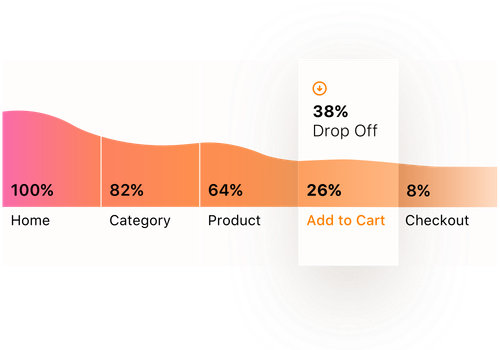
Look for stages with high exit rates. If 90% of people leave at the “Shipping Info” stage, your shipping costs might be too high.
A/B testing
Experiment with different headlines, button colors, or calls-to-action (CTAs) to see what boosts step-level conversion rates.
Continuous improvement
Funnel tracking is an ongoing process. Continuous monitoring helps you adapt as user behavior changes.
Once your funnel structure and events are in place, the next step is to track and interpret the metrics that indicate performance at each stage.
Key metrics for sales funnel tracking
Awareness: Reach & visibility
The goal
To measure total reach and assess how well your brand attracts new users from search engines, social media, and ads.
Key metrics:
- Traffic volume: The total number of visitors arriving from various sources (Organic, Paid, Social).
- Click-through rate (CTR): The percentage of people who saw your ad or search listing and actually clicked.
- Cost per lead (CPL): How much you spend on marketing to acquire a single lead’s contact information.
Interest: Engagement, trust & intent
The goal
To measure how well your content engages the right audience and supports movement toward higher-intent actions.
Key metrics:
- Lead-to-opportunity ratio: The percentage of raw leads that show enough interest to be considered “sales-ready.”
- Content engagement: Tracking which whitepapers, webinars, or case studies are being consumed most frequently.
- Micro-conversion rate: The percentage of users moving from a broad stage (blog reader) to a specific intent stage (newsletter subscriber).
Action: Conversion & efficiency
The goal
To quantify completed conversions and associated revenue, and evaluate how efficiently prospects are converted into customers.
Key metrics:
- Conversion rate: The percentage of total visitors who complete the final desired action (e.g., a purchase or a signed contract).
- Sales velocity: The average amount of time it takes for a lead to move from the first touchpoint to the final sale.
- Average order value (AOV): The average amount of money a customer spends when they convert.
Loyalty (Post-purchase): Retention & advocacy
The goal
To measure customer satisfaction and long-term value by understanding how effectively customers are retained and encouraged to become repeat buyers and advocates.
Key metrics:
- Retention rate: The percentage of customers who continue using or purchasing from your product over time.
- Churn rate: The percentage of customers who stop engaging or cancel within a defined period.
- Referral count: The number of new customers acquired through existing customer recommendations.
Overall funnel health
While stage-specific metrics are vital, you should also keep an eye on the “Big Three” metrics that define the overall health and ROI of your business’s sales funnel:
- Customer acquisition cost (CAC): The total marketing and sales spend required to gain one new customer.
- Customer lifetime value (LTV): The total revenue you expect to earn from a customer over the lifetime of your relationship.
- Funnel drop-off rate: The percentage of users who exit the journey at each stage, highlighting exactly where you are losing money.
How to track sales funnel metrics
In practice, funnel tracking maturity evolves over time. Teams typically move from basic visibility (tracking page views and conversions) to event-based funnels with defined drop-offs to segmented funnels by device, channel, or persona. Advanced teams go further, tying experiments to funnel stages and using predictive signals to forecast revenue and prioritize optimization.
This is where structured reporting, not raw data, makes the difference.
VWO Metric Reports help teams track key metrics, such as conversion rates, clicks, engagement, and revenue, in a way that directly reflects funnel performance. Instead of monitoring isolated numbers, teams can evaluate how each metric contributes to the business’s sales funnel and broader revenue goals.
Metric reports make it easier to:
- Monitor conversion rates across campaigns, devices, and segments
- Measure the impact of experiments and personalization efforts
- Track progress toward outcomes like lead generation and paying customers
While metric reports explain what is happening, funnel reports reveal where it happens. VWO Funnel Reports map user progression across specific sales funnel stages, clearly showing drop-offs, completion rates, and step-by-step movement through the funnel.
By viewing metrics in sequence rather than isolation, teams can pinpoint friction, prioritize optimization efforts, and understand how users experience the full customer journey.
AI is increasingly shaping how teams interpret funnel data by reducing manual analysis and highlighting what matters most. Instead of scanning dashboards, teams can surface prioritized bottlenecks, anticipate drop-offs, and focus experiments where they’re most likely to impact funnel performance and forecast revenue.
Together, metric reports and funnel reports provide a complete view of funnel performance, combining quantitative depth with visual clarity, so teams can move from tracking conversions to actively improving them.
It’s useful to separate funnel work into four stages: track what users do, diagnose where friction occurs, test changes at specific funnel steps, and validate results before scaling. Funnel tracking provides the measurement layer, but optimization only happens when insights are actively tested and validated.
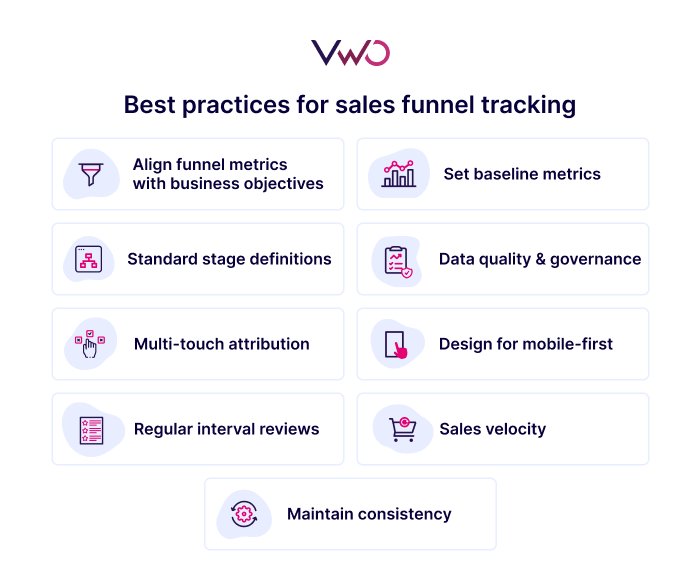
Best practices for sales funnel tracking
Many teams struggle with funnel tracking, not because they lack data, but because they track too much without intent. Common pitfalls include measuring every interaction equally, optimizing top-of-funnel traffic while ignoring mid-funnel friction, and treating attribution or conversion rates as static instead of dynamic over time.
What separates an average funnel from a high-performing one is the quality and consistency of its data and how well that data is applied to ongoing sales funnel management. Following proven best practices helps ensure funnel metrics remain accurate and actionable.
1. Align funnel metrics with business objectives
Funnel metrics should reflect what the business is trying to achieve, whether that’s revenue growth, retention, or pipeline efficiency. This alignment ensures tracking leads to decisions, not just reports.
2. Establish baselines before optimizing
Track funnel metrics over a consistent period to understand normal performance. Baselines make it easier to identify real improvements versus natural variation.
3. Standardize funnel stage definitions
Clearly define what qualifies as a lead, opportunity, and conversion so sales and marketing teams work from the same criteria. Consistent stage definitions prevent conflicting reports and ensure that funnel metrics remain comparable over time.
4. Prioritize data quality over volume
Focus on tracking high-intent actions rather than every interaction. Clean, well-audited event data leads to more reliable funnel metrics and clearer insights.
5. Implement multi-touch attribution
Most conversions involve multiple touchpoints. Tracking attribution across the funnel helps accurately assess which channels contribute to awareness, consideration, and final conversion.
6. Track sales velocity, not just lead count
Lead quantity alone doesn’t indicate funnel health. Monitoring how long users spend in each stage helps identify delays that affect revenue timing and pipeline efficiency.
7. Design for mobile-first behavior
Mobile friction can inflate drop-offs and distort conversion data. Regularly validating key funnel steps on mobile ensures that metrics accurately reflect true intent, rather than usability issues.
8. Support progression with automated nurture flows
Not all prospects convert immediately. Tracking repeat engagement and re-entry points helps maintain momentum through the funnel without manual intervention.
9. Review funnel metrics at regular intervals
Consistent reviews help keep funnel insights aligned with changes in campaigns, products, and user behavior.
10. Maintain consistency across data sources
Aligning CRM software, analytics, and tracking systems ensures visual sales pipelines remain accurate, consistent, and reliable across teams.
Tools for tracking funnels
Tracking sales funnels effectively requires the right set of sales funnel tools and a reliable sales funnel builder to capture user actions, connect them across stages, and surface insights without manual effort. As funnels become more complex and multi-channel, relying on spreadsheets or isolated reports quickly breaks down.
The right funnel tracking stack does more than count clicks. It enables teams to:
Create a unified view of the journey
Funnel tools connect interactions across channels, such as ads, landing pages, emails, and purchases, so you can see how users progress from first touch to conversion.
Visualize bottlenecks clearly
Instead of scanning raw data tables, funnel reports present stage-by-stage views that make drop-offs and friction points immediately visible.
Respond faster to performance issues
Advanced platforms support experimentation and rapid iteration, allowing teams to validate changes and address funnel leaks without long feedback loops.
Modern funnel tracking typically relies on a combination of tools, each playing a specific role in the customer journey.
Web analytics tools
They are often used alongside broader marketing tools, provide visibility into how users arrive at your site and move through top-of-funnel stages, helping track traffic sources, page interactions, and initial conversions.
Event-based product and funnel analytics tools
Focus on how users progress between specific steps, making it easier to measure stage-level conversion rates, drop-offs, and time between actions.
CRM and sales pipeline tools
These tools take over once leads enter the sales process, helping sales reps track progression through qualification stages, deal status, and revenue outcomes, especially important for B2B and longer sales cycles.
Marketing automation and email marketing software tools
Extend funnel tracking beyond the first conversion by monitoring nurture sequences, repeat engagement, and delayed conversions over time.
However, for some teams, particularly small businesses and lean marketing teams, the preference is shifting toward all-in-one sales funnel software that brings these fragmented capabilities into a single, cohesive dashboard.
Choosing the right fit: The best sales funnel software option depends entirely on your business model, funnel complexity, and how it compares with other sales funnel software you may already be using. For a deeper comparison of platforms, features, and use cases, explore our comprehensive guide to sales funnel software to help you choose the right fit for your tech stack.
Optimizing the journey with VWO
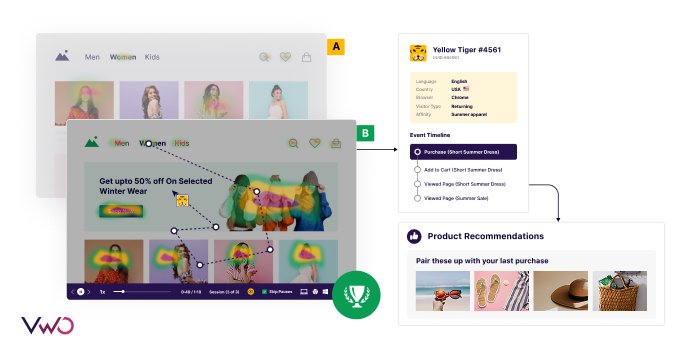
VWO is a conversion optimization platform that helps teams track and optimize user journeys across the full sales funnel. By unifying funnel data with experimentation and behavioral insights, it enables businesses to identify drop-offs, test improvements, and validate what actually drives conversions.
While analytics tools primarily explain what happened, VWO helps teams change what happens next through faster execution and a drag-and-drop builder, shortening the gap between insight and action, so insights don’t just sit in dashboards, but translate into measurable improvements.
Data-driven validation with A/B testing
VWO’s A/B testing capabilities make it easy to optimize critical funnel steps by testing different versions of landing pages, forms, and conversion elements.
Using the no-code visual editor, teams can experiment with headlines, CTAs, layouts, and messaging without heavy engineering effort. This ensures funnel improvements are driven by statistically valid user behavior, not assumptions.
This makes A/B testing especially useful for:
- Improving stage-level conversion rates
- Validating changes at high-impact funnel steps
- Reducing friction before scaling traffic or campaigns
VWO also supports advanced server-side and mobile app testing, which is especially useful for businesses with complex funnels that extend beyond web pages, such as logged-in experiences, pricing logic, or app-based journeys.
Deep insights via user behavior analytics
To fix a “leaky” funnel, you first need to see where the holes are. VWO Insights provides a 360-degree view of the user experience:
- Heatmaps: Visualize engagement patterns to see where users click, scroll, and focus their attention.
- Session recordings: Observe real user interactions.
- Funnel analysis: Directly identify the exact drop-off or exit points in your sales process.
- Form analytics: Detect friction in lead capture flows that might be preventing final conversions.
- On-page surveys: Collect direct qualitative feedback to understand the “Why” behind visitor behavior.

Use the Experience Score in the VWO Insights dashboard to get a quick view of your site’s UX health and prioritize the friction points most likely to impact conversions.
Scaling growth through personalization
A one-size-fits-all funnel often misses the mark. VWO Personalize allows you to tailor the journey based on a visitor’s unique data, such as browsing behavior, device type, or past interactions.
Personalization helps improve engagement and conversion by ensuring users see content that’s relevant to their intent and stage in the funnel.
This is particularly effective for:
- Nurturing mid-funnel users with targeted messaging
- Reducing drop-offs for returning visitors
- Supporting different funnel paths for different segments
See how Bandwidth improved a key funnel metric-> visit-to-lead conversion by 12% by using VWO to analyze on-page engagement and test a redesigned experience that better communicated value.
Request a demo to explore how VWO’s platform and features can help improve your funnel workflows.
FAQs
Sales funnel metrics are quantitative measures that track how prospects move through each stage of the sales funnel. They help assess progression, drop-offs, conversion efficiency, and overall funnel performance.
To assess funnel health, track stage-level conversion rates, drop-off rates, sales velocity, customer acquisition cost (CAC), and customer lifetime value (LTV). Together, these metrics indicate efficiency, quality of leads, and revenue impact.
Improvement starts with identifying high-impact drop-offs, validating issues using user behavior data, and testing changes at specific funnel stages. Consistent tracking, segmentation, and experimentation help optimize the sales process over time.
Industry benchmarks vary widely by business model, sales cycle length, and channel. While benchmarks can provide context, it’s more effective to compare performance against your own historical baselines and track improvements over time.
Sales funnel tracking is the process of monitoring user actions and conversions across funnel stages to understand how prospects progress from awareness to purchase and where friction occurs.
The five common stages are:
Awareness
Interest
Consideration or Evaluation
Conversion (Action)
Loyalty or Retention
Each stage reflects a different level of intent and requires different metrics.
How to measure the sales funnel?
A sales funnel is measured by tracking user volume, conversion rates, drop-offs, and time spent at each stage. This is typically done using event-based tracking and funnel reports in analytics or optimization tools.
Categories:




![10 Best Enterprise Analytics Platforms [2026]: Expert Picks with Reviews and Comparisons](https://static.wingify.com/gcp/uploads/sites/3/2025/08/Feature-image-10-Best-Enterprise-Analytics-Platforms_-In-Depth-Reviews-and-Comparisons.jpg?tr=h-600)