 ChatGPT
 Perplexity
 Gemini
 Claude
 Grok
Grok
Our CRO Perspectives series captures lessons from practitioners and industry leaders who are reshaping experimentation.
In this 23rd installment, we sit down with Carlos Neto, a B2B growth strategist who has spent years at the intersection of paid media, conversion optimization, and revenue operations, and whose thinking consistently challenges where most teams draw the line on experimentation.
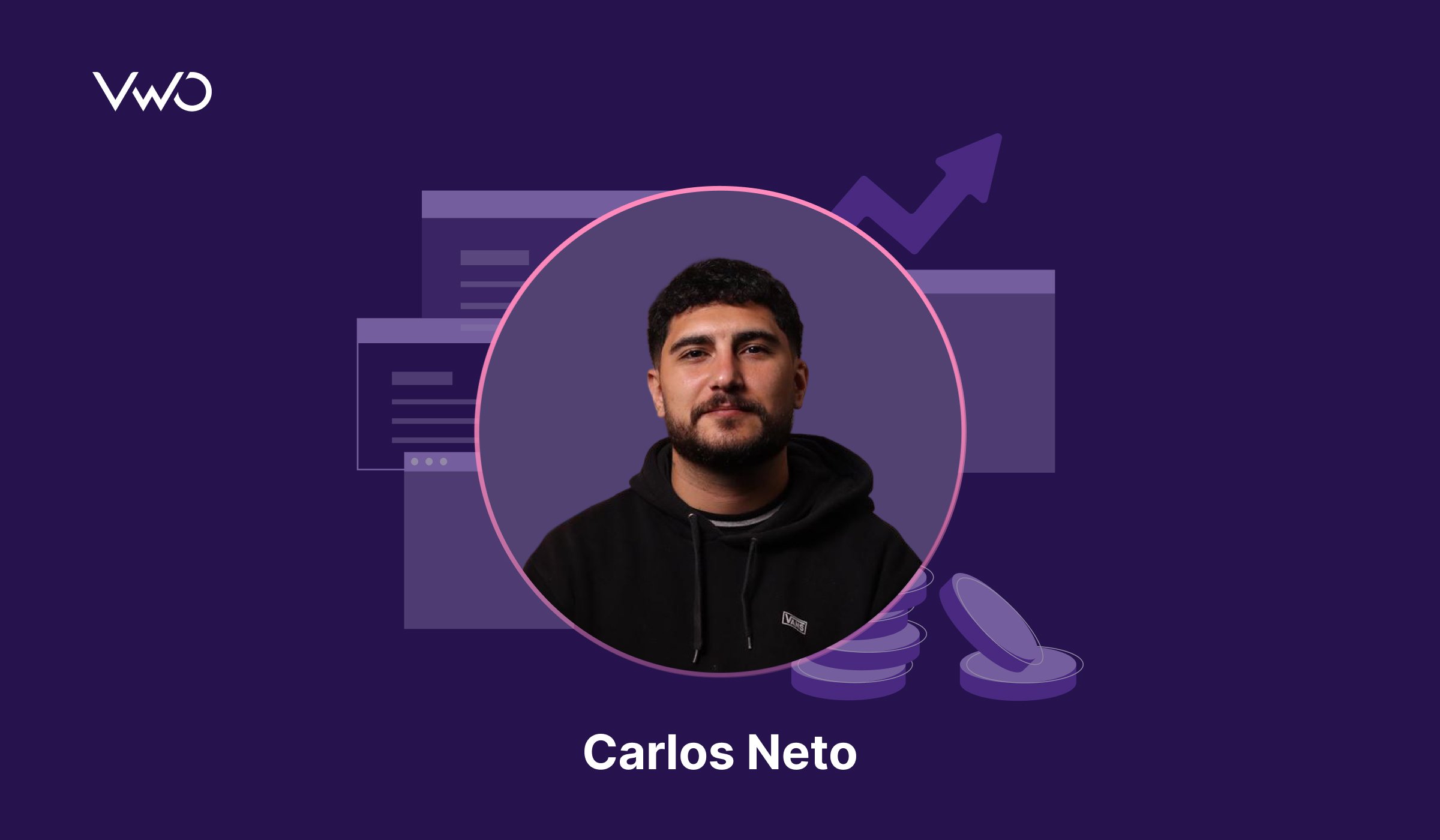
Leader: Carlos Neto
Role: Growth Specialist at Benner
Location: Brazil
Speaks about: Paid media and acquisition strategy • SEO • CRO • Data-driven decision making
Why should you read this interview?
Carlos Neto is a B2B growth and conversion strategist who has built experimentation programs across both in-house and consulting contexts. His work spans the full revenue funnel, from paid acquisition and landing page optimization through to demo attendance, trial activation, and onboarding success.
What sets his perspective apart is a refusal to let marketing and sales operate as disconnected workstreams. Carlos has consistently pushed experimentation into post-conversion territory: response time, first outreach messaging, pipeline progression, areas that most CRO practitioners leave untouched because they fall outside marketing’s traditional accountability.
He also brings a clear-eyed view of where AI genuinely accelerates the optimization process, and where it produces noise at scale if not filtered through rigorous human judgment. If you work in B2B growth, experimentation, or revenue operations, this interview is worth your full attention.
Identifying friction across the B2B funnel
Friction identification isn’t something I approach with a single lens. It’s a layered investigation, and no single source tells the full story.
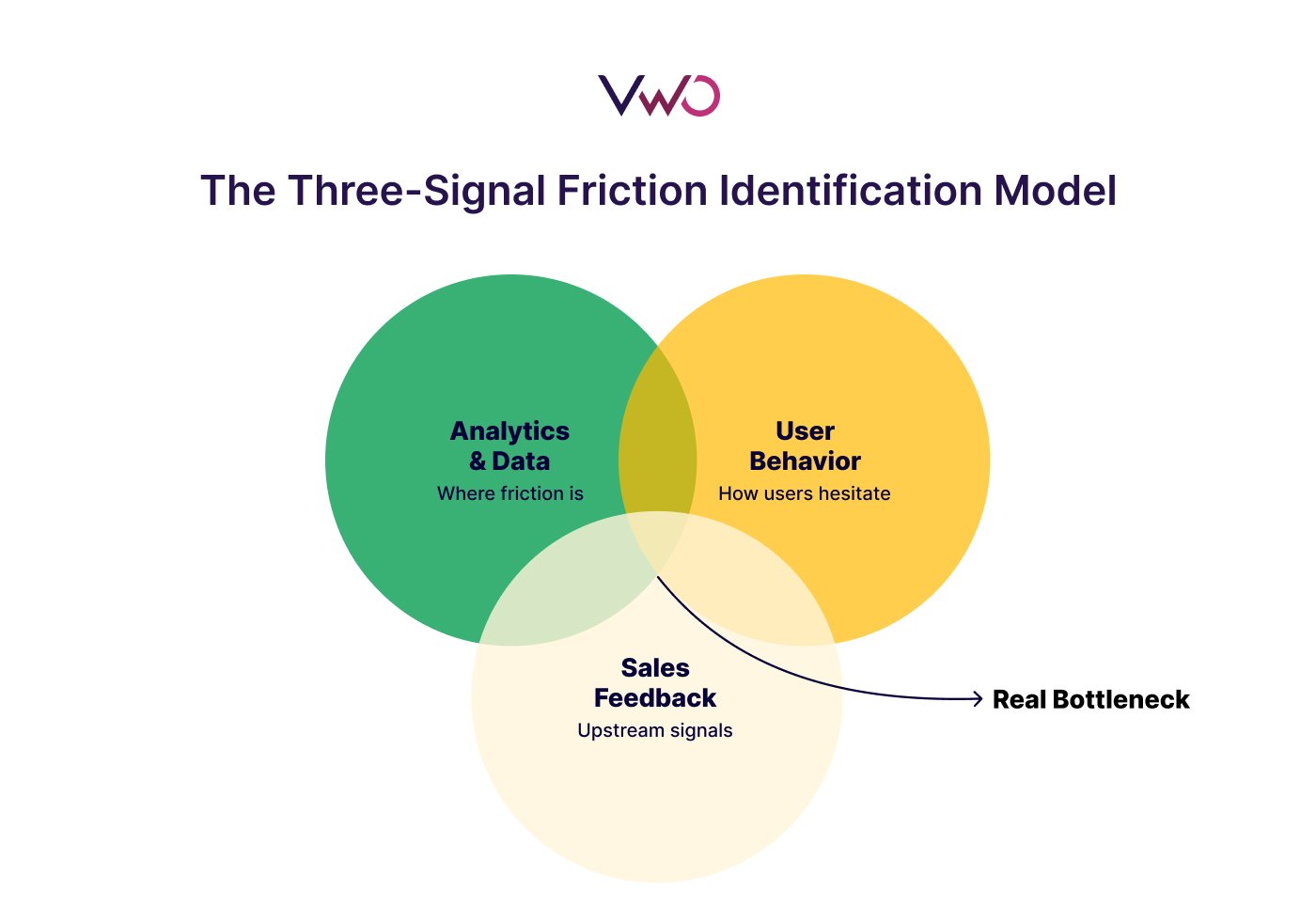
What I’ve found works is triangulating across three signal types: data, user behavior, and sales feedback.
On the analytics side, I start by mapping the funnel end-to-end. In B2B specifically, I look at the account level, because decisions involve multiple stakeholders and cycles are longer. I analyze conversion by stage, time between stages, and channel quality. That’s usually where the main bottlenecks start to surface.
But data tells you where the friction is, not why. So I go deeper into user behavior: heatmaps, session recordings, navigation analysis. That’s where you start seeing hesitation, forms with high abandonment, pages where the expectation doesn’t match what’s actually delivered.
At the same time, I bring in sales feedback. Recurring objections, out-of-profile leads, low show rates. These are almost always signals of a problem upstream, either in acquisition or in how value is being communicated.
The real insight comes from the intersection of all three. When the data, the behavior patterns, and the sales signals are all pointing at the same place, that’s when I’m confident I’m looking at a real bottleneck and not noise.
From there, I prioritize based on pipeline impact, structure clear hypotheses, and run tests. The goal isn’t just reducing friction. It’s increasing revenue predictability.
What separates a winning test from a real learning
For me, the end of an experiment is the beginning of the analysis. The question is never just “did it win or lose?” It’s what we actually learn about how users behave.
Before anything else, I validate the quality of the test. Sample size, statistical significance, duration, external factors that might have skewed the result. If the test wasn’t clean, the conclusion won’t be either.
Then I look at the full funnel, not just the primary metric. A test can improve CTR and quietly destroy lead quality at the same time. That’s why I always trace the effect downstream, all the way to pipeline or revenue. A win on the surface isn’t always a win in the business.
The part I probably invest the most in is documentation. Every experiment gets recorded with its hypothesis, context, what we expected, the success metrics, the result, and the actual learning. Not because it’s good practice on paper, but because without it you end up retesting things you’ve already tested, and losing the institutional memory that should be guiding your next decisions.
Over time, that repository becomes one of the most valuable things a growth team can have. It reduces uncertainty, surfaces patterns, and gives you a real foundation to predict impact before running new experiments.
The goal was never to win isolated tests. It’s to build a system where every experiment makes the next decision faster and smarter.
There’s a distinction I care a lot about: a test that ‘wins’ versus a test that generates real learning. The only way a result becomes a learning is if I can explain why it happened. If I can’t answer that, I don’t file it as a learning. I file it as a signal, and signals need more tests before they become knowledge.
Ad experimentation and on-site optimization as one system
Media and site optimization aren’t two separate workstreams for me. They’re one system, and the biggest inefficiencies I’ve seen come from teams that treat them in isolation.
The foundation is full traceability. UTMs, events, CRM integration, all structured so you can connect traffic source to on-site behavior to pipeline outcome. Without that, you’re optimizing in the dark.
Once that’s in place, I use campaigns as a hypothesis engine. Not just for targeting and budget, but for message, audience, and value proposition. CTR and CPC are early signals, useful for directional feedback, but what I’m actually watching is what happens after the click. That’s where the real story is.
When a campaign performs well on the media side but drops off on the site, that’s almost always an expectation gap. The ad promised something the page didn’t deliver. When it’s the reverse, strong on-site behavior but weak media performance, the problem is usually upstream: wrong audience, weak creative, messaging that doesn’t land before the click.
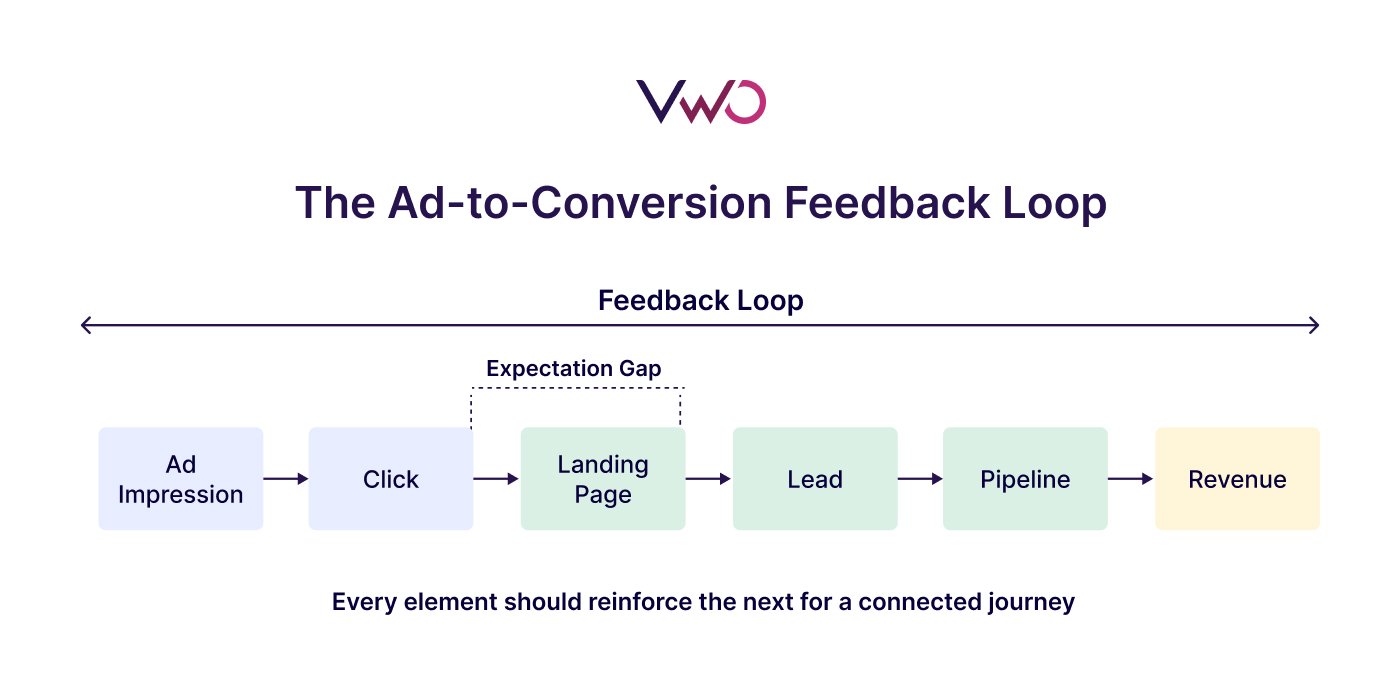
What makes this work is the feedback loop. Media insights reshape how I think about page structure, headlines, and offers. Site behavior, where people hesitate, where they drop, what objections surface, feeds directly back into creative and segmentation decisions. Each side informs the other continuously.
The way I think about it: CRO doesn’t start on the landing page. It starts the moment someone sees the ad. Everything from that first impression to the final conversion is one connected experience, and friction anywhere in that chain costs you at every step downstream.
The goal isn’t to make the ad perform better or make the page convert better in isolation. It’s to build a funnel where each element reinforces the next.
Extending experimentation past the lead
Most CRO strategies stop at the lead. Not because it’s the right call, but because that’s where marketing loses visibility and, honestly, where accountability tends to get fuzzy.
I’ve never bought into that boundary. If the goal is revenue, the funnel doesn’t end at conversion.
One of the clearest examples I’ve seen: the pipeline wasn’t the problem. Lead volume was fine. The issue was that leads weren’t converting into meetings. And when we actually dug into it, the landing page had nothing to do with it. The friction was in response time, the first message, how many touches were being made and through which channel. Fixing that had more impact than any A/B test on the page would have.
The same logic applies to trials. The acquisition isn’t usually the hard part. The hard part is getting users to their first moment of real value before they lose interest. That’s an onboarding problem, not a traffic problem. Simplifying setup, tightening the first-use experience, adjusting the communication sequence. Those changes compound in a way that more spend at the top of the funnel simply doesn’t.
There’s also something most teams aren’t looking at: quality shifts after conversion depending on the source. When you cross channel data with activation rates, show rates, and pipeline progression, patterns emerge fast. Some channels generate volume. Others generate revenue. That distinction should be driving your investment decisions, but it only becomes visible if you’re measuring past the lead.
Stop thinking about post-conversion as sales territory. Start treating it as the second half of the funnel, where experimentation is just as valid and where, in most cases, the highest-leverage opportunities actually live.
B2B testing challenges that rarely get named
B2B testing has a few structural problems that rarely get addressed directly. Most teams work around them without ever naming them, which is part of why the same mistakes keep repeating.
The time mismatch
You can get conversion data fast, but the signal that actually matters — whether that lead became an opportunity or closed as revenue — takes weeks to surface. Teams that optimize on top-of-funnel metrics are essentially making decisions on incomplete information. They move fast, but they drift in the wrong direction without realizing it.
The efficiency trap
CPL improves, CTR goes up, lead volume looks healthy, and there’s a general sense that things are working. Meanwhile, pipeline quality is quietly deteriorating. Without a hard connection between campaign performance and CRM outcomes, it’s entirely possible to spend months scaling something that performs well on a dashboard and does nothing for the business.
The dependency problem
Your test results are partly out of your control. Response time, sales approach, follow-up consistency — these all affect outcomes just as much as the campaign or the landing page. If those variables aren’t standardized, you can’t isolate what’s actually driving the result. Attribution becomes guesswork.
On the opportunity side, the moves that actually change the trajectory are structural, not tactical.
Make the CRM the center of prioritization, not just a reporting tool.
When pipeline progression becomes the optimization target, the entire decision-making process shifts. You stop chasing metrics that feel good and start chasing the ones that compound.
Extend the test scope beyond acquisition
Show rates, initial outreach, activation, onboarding. In most B2B funnels I’ve worked with, the highest-leverage opportunities aren’t at the top. They’re in the conversion steps that nobody’s running experiments on because they fall between team responsibilities.
Treat sales conversations as a research asset
Recurring objections, questions that stall deals, patterns in how prospects talk about their problem. That’s direct evidence of where friction lives. When that information feeds into your experimentation process, you stop guessing at hypotheses and start testing things that are already proven to matter.
When these pieces come together, testing stops being something the marketing team does to improve campaign performance. It becomes the mechanism by which the business makes faster, better-informed decisions about growth.
CPL improves, CTR goes up, lead volume looks healthy, and there’s a general sense that things are working. Meanwhile, pipeline quality is quietly deteriorating. Without a hard connection between campaign performance and CRM outcomes, it’s entirely possible to spend months scaling something that performs well on a dashboard and does nothing for the business.
North star metrics and why the architecture matters more
Every company needs a north star metric, but that’s often where the conversation stops when it should be where it starts.
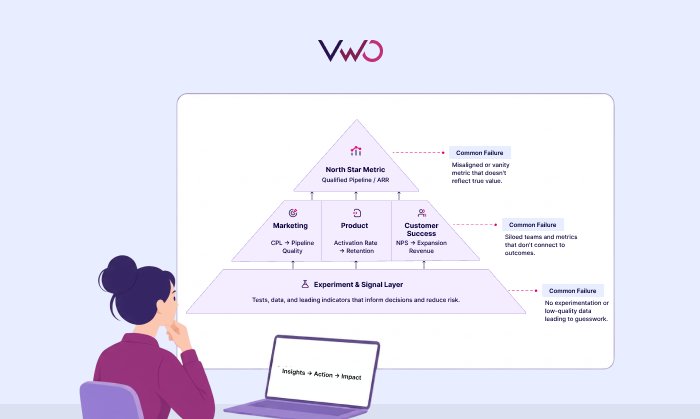
The north star exists to create strategic alignment. It needs to reflect something real about value generation — qualified pipeline, recurring revenue, retention — not a proxy that looks good on a dashboard but drifts from what the business actually needs. Getting that definition right matters more than most teams realize, because everything downstream is calibrated against it.
But a single metric can’t run a company. The mistake I see most often isn’t having too many KPIs. It’s having KPIs that don’t connect to each other. Marketing optimizes CPL without knowing what happens to those leads in the pipeline. Product improves activation rates without understanding which activation patterns predict retention. Customer success tracks NPS without tying it to expansion revenue. Each team is technically performing, but the system isn’t.
The architecture that works is layered. One north star to set direction. Operational metrics per function that are explicitly mapped to that north star, not loosely associated with it. And a shared understanding of how the layers connect, so that a decision made in one area can be evaluated in terms of its downstream effect.
This also needs to evolve as the company scales. Early stage, you want minimal metrics and maximum focus. The cost of fragmented attention is too high. As the business matures and the funnel grows more complex, you need granularity at each stage to identify where the real leverage is. The mistake is keeping an early-stage measurement model on a mid-stage business, or adding metric complexity before the foundation is solid.
When the architecture is right, something shifts in how teams operate. They stop defending their own numbers and start reasoning about the system. That’s when measurement stops being a reporting function and starts being a tool for making better decisions faster.
Signs a company has moved from ad-hoc testing to a repeatable system
The clearest sign of experimentation maturity isn’t a tool or a team structure. It’s whether experimentation is actually driving decisions or just producing activity.
Most companies run tests. Far fewer have built a real experimentation process. The difference shows up in a few specific ways.
How tests get prioritized
Mature teams don’t test what’s convenient or what someone found interesting in a newsletter. They have a clear framework for evaluating potential impact on pipeline and revenue, and that framework is what drives the backlog. When prioritization is rigorous, the quality of what gets tested changes entirely.
Structural consistency
Every experiment starts with a properly formulated hypothesis, defined success metrics, and explicit decision criteria before it runs. Not sometimes. Every time. When the process depends on individual effort or institutional memory, it’s fragile. When it’s embedded in how the team operates, it scales.
Funnel depth
Companies that only measure conversion or lead volume are missing most of the signal. The learnings that actually change strategy come from tracking impact through pipeline, revenue, and retention. That requires tighter CRM integration and a willingness to wait for the right data, but it’s what separates teams that optimize tactics from teams that improve the business.
Documentation is something most teams undervalue until they’ve wasted months retesting things they’ve already learned. A well-maintained experimentation repository — with hypotheses, context, results, and actual learnings — is a compounding asset. It accelerates decision-making and reduces the cost of onboarding new people into the process.
The indicator I weigh most heavily, though, is cross-functional influence. When experimentation is confined to marketing, it has a ceiling. When the learnings start shaping how sales approaches conversations, how product thinks about activation, how leadership frames positioning, that’s when you know the capability has matured into something that moves the whole business.
At that point it’s not a testing program. It’s a decision-making infrastructure.

Centralize scattered test ideas from Slack, docs, and memory into VWO Plan’s structured hypothesis backlog, and prioritize them using clear scoring frameworks (impact, effort, confidence) to move from ad-hoc testing to a repeatable, decision-driven experimentation pipeline.
Experimenting for brand credibility and buyer trust
When conversion rates are already strong, the nature of the problem changes. You’re no longer plugging holes in the funnel. The question becomes how to systematically build the kind of credibility that makes complex, high-stakes decisions easier for the buyer.
In B2B, that’s a fundamentally different challenge. Buying cycles are long, multiple stakeholders are involved, and the decision often stalls not because of a bad landing page but because of unresolved doubt somewhere in the process. That’s where experimentation needs to go.
In practice, this means testing things that rarely show up in a conventional CRO backlog. How the brand signals authority. How it reduces perceived risk at each stage. How it educates before asking for a commitment. Social proof, content depth, value proposition clarity, process transparency, tone. These aren’t soft variables. They’re the levers that move credibility, and credibility is what unlocks the decision.
One of the most underinvested areas at this stage is the gap between promise and experience. Companies that have grown quickly often carry inconsistencies between what they communicate during acquisition and what the buyer actually encounters throughout the journey. That gap erodes trust quietly and creates friction exactly where you can least afford it. Experimentation is one of the most reliable tools for finding and closing it.
The measurement model has to evolve too. Direct conversion metrics become less sensitive at this stage because the impact is upstream. I pay closer attention to content engagement, return visits, time in consideration, and interaction quality. These aren’t vanity metrics. They’re leading indicators of pipeline quality and decision velocity, and they give you signals on whether you’re actually building confidence in the buyer or just generating activity.
Mature experimentation isn’t about winning more tests. It’s about systematically reducing uncertainty in the buyer’s decision process. The teams that do this consistently aren’t just optimizing a funnel. They’re building a perception asset that compounds over time and becomes genuinely difficult for competitors to replicate.
Where AI helps in CRO and where human judgment must hold
AI has genuinely changed how fast I can move, but I’m deliberate about where I let it drive and where I stay in control.
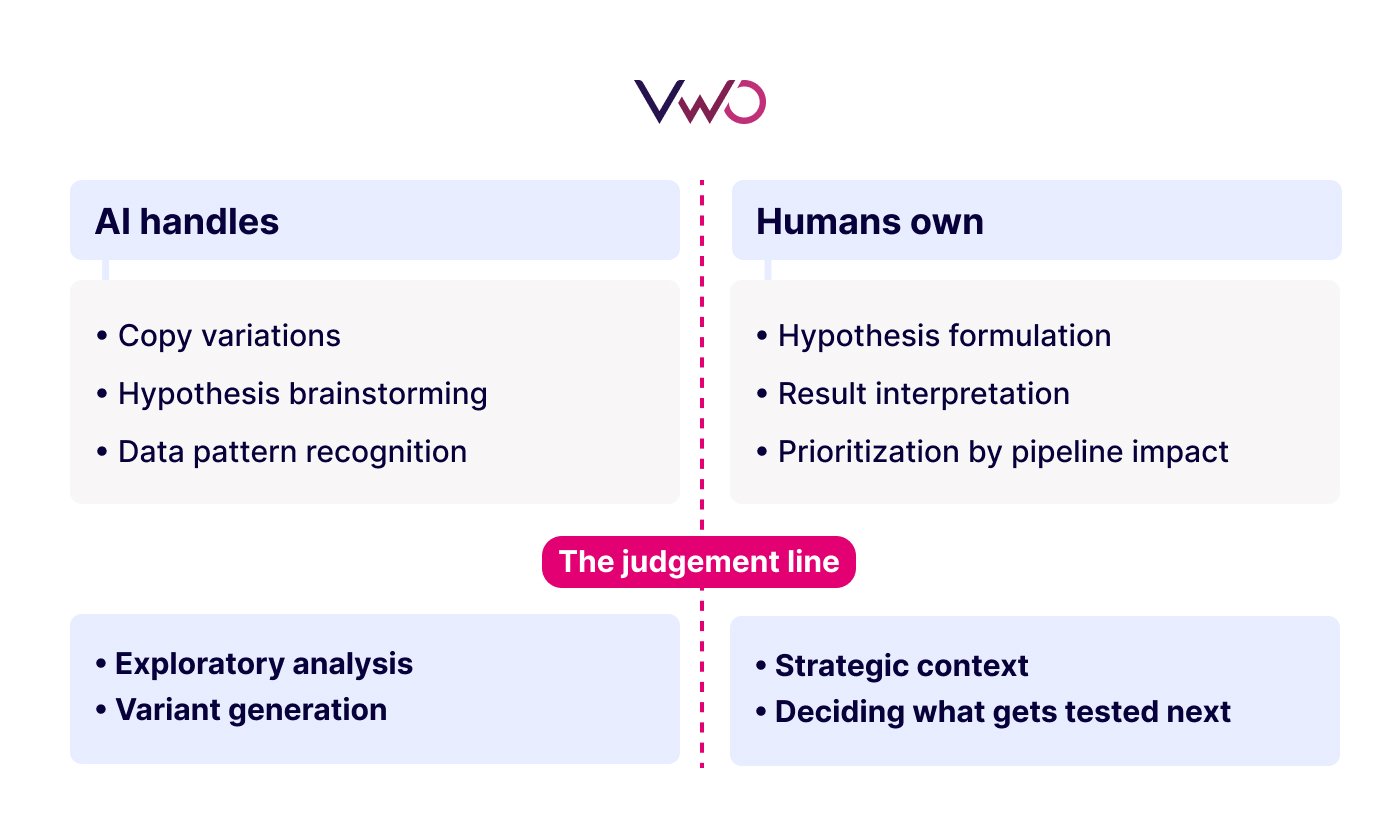
On the execution side, the leverage is real. Copy variations, hypothesis generation, exploratory data analysis, pattern recognition across large datasets. Work that used to take days now takes hours, which means I can run more experiments in the same window and iterate faster on what’s working.
But speed without direction is just noise at scale, and that’s the risk most people underestimate.
AI doesn’t know your ICP at the depth that actually matters. It doesn’t understand why a certain segment behaves differently, what’s driving the friction in a specific sales cycle, or how a result connects to a strategic bet the business is making. It can surface patterns. It can’t tell you which patterns are worth acting on.
The failure mode I see most often is teams that adopt AI and start measuring success by volume. More tests running, more variations in the market, more output overall. But if the hypotheses aren’t sharp, you’re just generating more inconclusive results faster. You’re moving quickly without actually learning anything.
The combination that works is AI handling the parts where speed and scale matter, with human critical thinking filtering what gets tested and what the results actually mean. That’s when the velocity becomes an asset rather than a liability.
The division I’ve landed on is this: AI owns execution velocity, humans own judgment. Hypothesis formulation, result interpretation, prioritization based on pipeline impact, the call on what to test next, those stay with me. Not because AI can’t simulate those steps, but because the reasoning behind them requires business context that the model simply doesn’t have access to.
Conclusion
The through-line in everything Carlos describes is a refusal to let experimentation stop where accountability gets uncomfortable. Most teams optimize what they can see and measure easily: top-of-funnel metrics, click-through rates, landing page conversions. Carlos’s argument is that this is precisely where the real leverage isn’t.
The pipeline gaps that gradually kill B2B growth, leads that don’t convert to meetings, trials that never reach activation, trust that erodes between acquisition message and product reality. These aren’t being tested because they sit between team responsibilities. That gap is where Carlos consistently finds the highest-impact work.
His framework for thinking about AI is about how velocity without judgment is a liability. The teams that will extract real value from AI-assisted CRO are those that use it to sharpen execution while keeping human reasoning firmly in charge of what gets tested and why. The rest will produce more inconclusive results faster and mistake activity for learning.
If there is a single change worth making after reading this conversation, it is to start treating experimentation as the primary mechanism by which your business makes smarter decisions about growth.
To put these ideas into practice, you need an experimentation platform that brings structure, traceability, and intelligence to the full funnel. VWO helps teams run smarter tests, from hypothesis to pipeline impact, with AI-driven insights, automated variation creation, and experiment prioritization. Book your personalized demo today.
Categories: