Uncover hidden visitor insights to improve their website journey
Understand the obstacles visitors encounter, pinpoint their most engaging touch points, and analyze their actions on your website to identify areas for improvement, resulting in enhanced experiences and increased conversions.
Even with sophisticated visitor identification tools, businesses can typically recognize only about 30% of their traffic. That means nearly 70% of visitors remain anonymous, quietly moving through your site while their intent goes unseen.
This creates a massive identification gap. And inside that gap lies your biggest opportunity. Anonymous website visitor tracking helps you understand what this invisible majority is doing, why they leave, and how you can turn hidden traffic into insights that drive better experiences and higher conversions.
What is anonymous visitor tracking?
Anonymous visitor tracking is the process of understanding how people interact with your website without knowing who they are. It monitors and analyzes visitor behavior without collecting or relying on personally identifiable information (PII).
Instead, it distinguishes one visitor from another using non-personal signals, such as device attributes, browser configurations, cookies, or technical identifiers, to track how they navigate, where they click, and how their sessions unfold.
In other words, it’s a privacy-safe way to study the actions, patterns, and motivations of the majority of your traffic: the users who browse your site but never fill a form, sign up, or check out.
Why is it important?
Anonymous visitor tracking is important because it allows businesses to gain critical, actionable insights into the vast majority of their website audience who never identify themselves while simultaneously addressing modern concerns about privacy and data compliance. Tracking such visitors helps in:
Understanding the user journey: It shows how visitors move through your site, which pages draw attention, and where they exit. This makes it easier to spot friction in the conversion path.
Informing content strategy: By seeing which pages attract consistent traffic, whether pricing, product pages, or blogs, you can prioritize content that resonates with your ideal audience.
Improving marketing ROI: Instead of relying on click counts alone, you can compare the engagement quality of visitors coming from various sources such as paid ads, organic search, social media, and other channels.
Supporting A/B testing & personalization: Behavioral patterns such as “viewed multiple product pages in Category X” allow you to tailor CTAs or on-site experiences in real time, without needing personal identifiers.
Respecting user choice: If someone opts out of personal data collection or marketing cookies, anonymous tracking still enables essential, aggregated analytics without violating their preferences.
Reducing regulatory exposure: By minimizing reliance on personally identifiable information (PII) and focusing on aggregated or pseudonymous data, anonymous visitor tracking can help reduce regulatory risk and simplify compliance with privacy laws such as GDPR or CCPA when paired with proper consent and transparency.
Strengthening trust: When a business prioritizes privacy-safe analytics, it signals responsibility and transparency, qualities that build long-term trust with users.
Identifying high-intent prospects (especially in B2B): With techniques like IP intelligence, anonymous visitor tracking helps surface which companies, rather than individuals, are browsing your site. This helps sales teams prioritize outreach to companies that are actively researching their solutions, without knowing the individual’s name.
Linking the journey after conversion: When an anonymous visitor eventually signs up or fills a form, advanced tracking systems can connect their earlier sessions to their new profile. This creates a complete view of their pre-conversion research and path to purchase.
Methods to identify anonymous website visitors
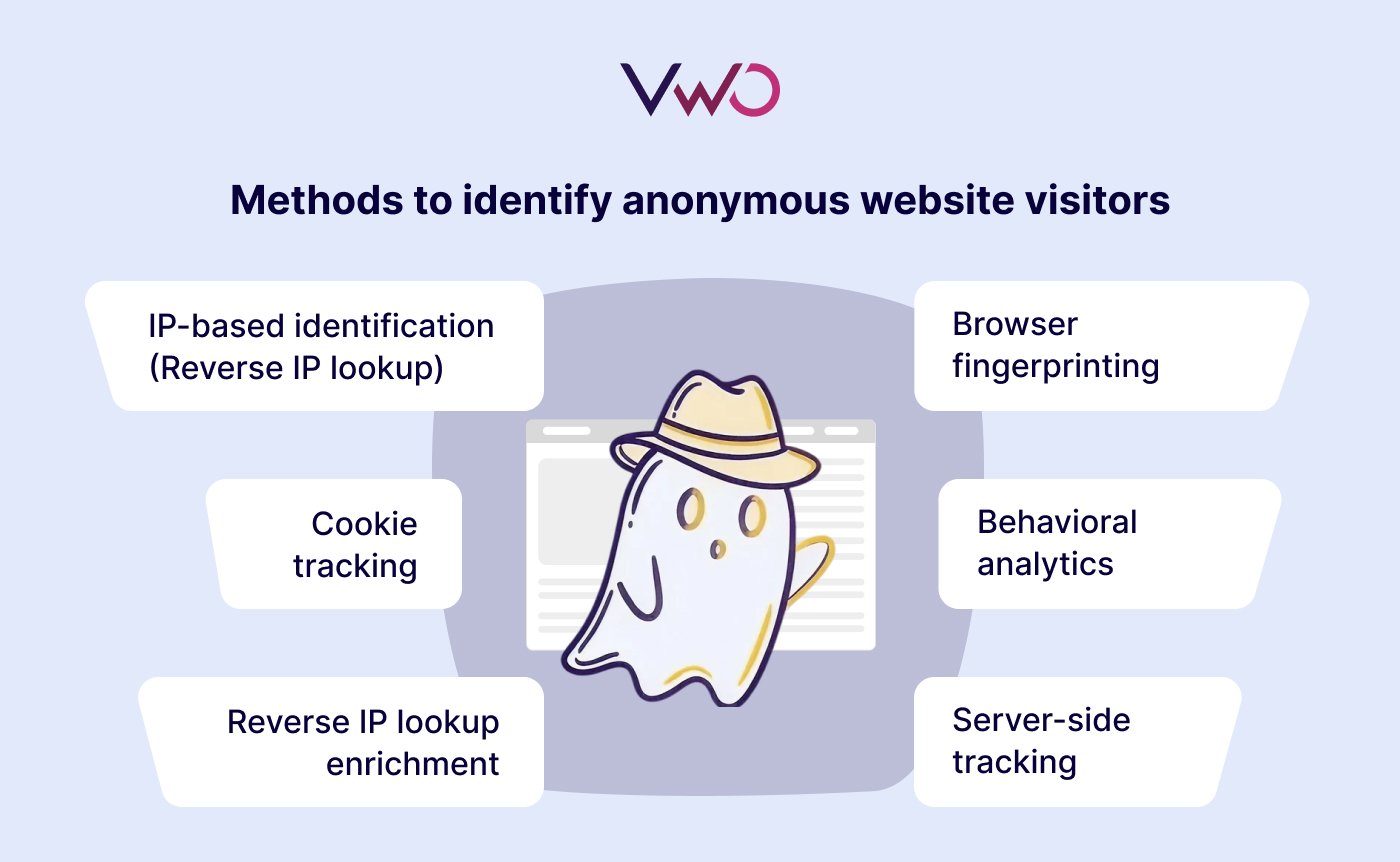
Anonymous visitors leave behind technical, behavioral, and network-level signals that, when combined, help build a privacy-safe understanding of who is browsing your site and how they interact with it. Below are the most common methods used today:
IP-based identification (Reverse IP lookup)
How it works: This process examines a visitor’s IP address (their network location) and matches it against proprietary databases of known corporate and organizational entities.
What it reveals: The identity of the visiting company (organization name, industry, size, and geographic location), making it especially valuable for B2B scenarios.
Value: Excellent for identifying which businesses are actively browsing your website and researching your solutions.
Limitation: Accuracy is reduced for people using remote networks, VPNs, shared Wi-Fi, or mobile connections.
Browser fingerprinting
How it works: A unique digital identifier is generated using a combination of technical parameters, including the visitor’s browser settings, installed fonts, plug-ins, operating system, and screen resolution.
What it reveals: A persistent, unique device-level ID that can track a specific device across sessions with high accuracy (sometimes cited up to 90%).
Value: Highly effective for identifying returning visitors even if they have cleared cookies, making it more resilient than cookie tracking.
Limitation: Faces increasing scrutiny and blockage from privacy-focused browsers.
Cookie tracking
How it works: Small text files (cookies) are placed on the visitor’s browser by the website server to store session data and user preferences.
What it reveals: Enables understanding of visitor behavior over time, session continuity, and retained preferences (e.g., items in a shopping cart).
Value: First-party cookies (set by your domain) are generally considered more privacy-friendly and essential for basic site function.
Limitation: Highly impacted by global privacy regulations (GDPR, CCPA) and browser restrictions, especially concerning third-party cookies.
Behavioral analytics
How it works: It involves the systematic collection and analysis of actions a visitor takes while on the website using tracking IDs generated by a tracking code(from cookies or fingerprinting).
What it reveals: Quantitative data that defines the user experience, including: Pages viewed, time spent per page, navigation flow, downloads, and form interactions.
Value: Provides a comprehensive context needed to calculate user intent and optimize site design (e.g., identifying friction points or high-interest content).
Limitation: The data is only anonymous behavior until successfully linked to a known identity (i.e., when they fill out a form).
Reverse IP lookup enrichment
How it works: Expands upon simple IP-based identification by linking the identified IP address to rich, externally sourced data about the company (e.g., commercial databases).
What it reveals: Detailed firmographic and contact information about the organization, such as: Company name, size, industry, revenue, specific technology stack, and social media profiles.
Value: Transforms a simple company name into a fully qualified sales prospect, enabling targeted outreach and personalized marketing campaigns.
Limitation: The accuracy and depth depend entirely on the quality and freshness of the third-party enrichment databases.
Server-side tracking
How it works: Server-side tracking captures visitor interactions directly from the server instead of relying solely on browser-based scripts. Events such as page requests, form submissions, or API calls are logged on the backend using anonymous identifiers.
What it reveals: A more reliable view of visitor behavior, even when browser restrictions, ad blockers, or cookie limitations prevent client-side tracking from firing.
Value: Improves data accuracy, ensures consistent tracking across devices and browsers, and is especially useful for modern setups like SPAs, headless architectures, and server-rendered applications.
Limitation: Provides less granular front-end interaction detail (such as cursor movement or visual engagement) unless combined with client-side behavioral tools.
Tools and technologies for identifying anonymous website visitors
To put anonymous identification strategies into action, businesses rely on a range of website visitor identification tools, each designed to support a specific stage of the process. Many modern platforms combine multiple techniques to help teams analyze anonymous website traffic, improve user experience, personalize journeys, and drive conversions.
Note: Anonymous website visitor tracking also captures non-human traffic, such as bots or crawlers. Most platforms automatically detect and filter this traffic to ensure analysis focuses on genuine visitor behavior.
IP intelligence and account identification solutions
These tools take IP-based identification a step further by mapping anonymous traffic to real companies, helping you understand who’s showing interest and how deeply they’re engaging.
Leadfeeder
Leadfeeder is a leading sales intelligence platform that instantly turns anonymous website visits into qualified, actionable B2B sales leads by identifying the companies visiting your site and highlighting those showing the strongest buying intent.
It filters out irrelevant traffic, maps visits to real organizations, and allows teams to segment accounts using detailed behavioral and firmographic filters. Leadfeeder also enriches each visit with decision-maker contacts and syncs this intelligence directly into CRM and sales workflows, supported by real-time alerts for timely outreach.
These solutions generate non-PII identifiers to recognize returning visitors across sessions, even when cookies are limited.
Fingerprint
Fingerprint creates a stable, privacy-safe anonymous ID using device, browser, and environment signals, enabling businesses to recognize returning visitors even when cookies are blocked.
Alongside identification, it detects incognito usage, browser tampering, rooted devices, and privacy-focused browsers, providing valuable context about traffic quality. Its Smart Signals, such as high-activity flags and Velocity Signals, help surface suspicious patterns or unusual behavior, making Fingerprint useful for both analytics continuity and security monitoring.
While fingerprinting and IP intelligence hint at who anonymous visitors may be, behavioral analytics tools show how they actually use your website. By analyzing clicks, scrolls, and navigation patterns, these platforms uncover friction and usability issues that influence conversions.
VWO Insights
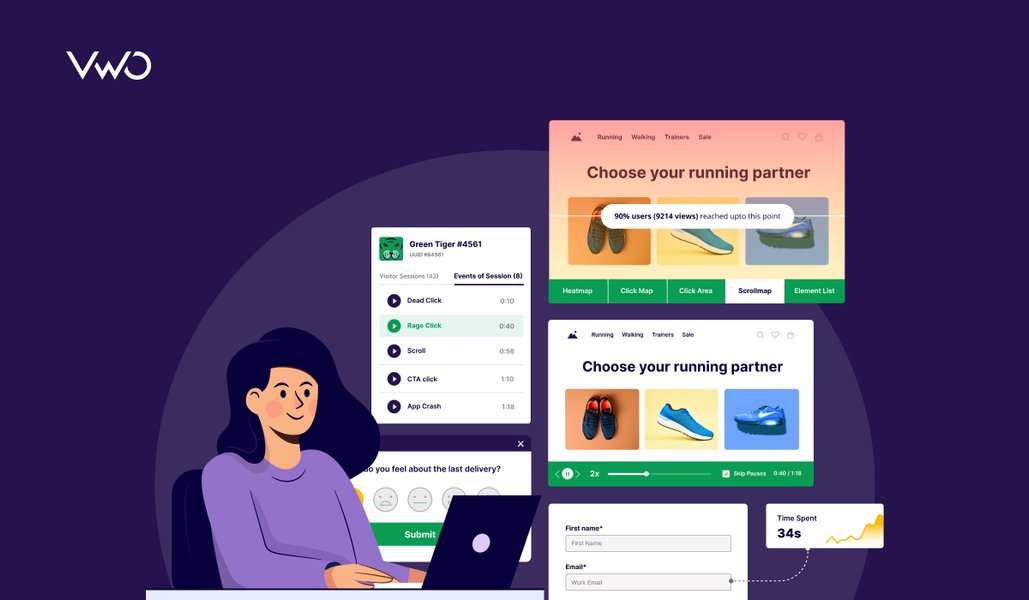
VWO Insights helps teams understand how visitors experience their website by combining visual behavior analysis with AI-powered interpretation. Heatmaps show where users click, scroll, and spend attention, highlighting elements that attract or fail to attract engagement.
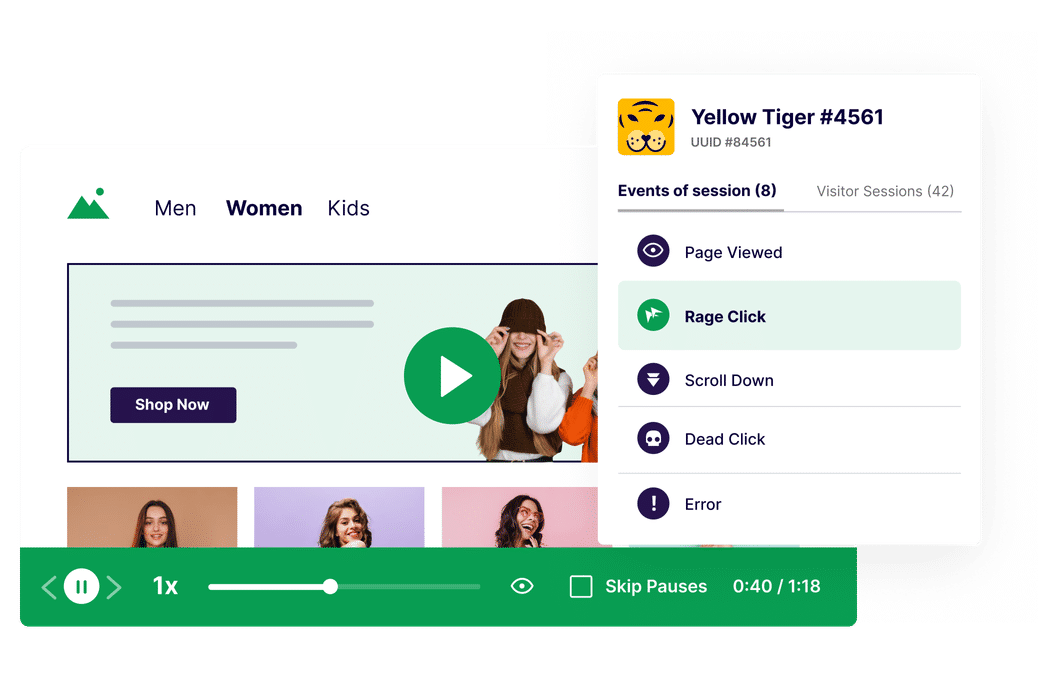
Session recordings provide a replay of real browsing sessions, revealing hesitation, confusion, form abandonment, and other friction points that aren’t visible in traditional analytics.
VWO’s visitor tracking mechanism operates with privacy and protection compliance at its core. It lets you configure what types of visitor data are collected and how they’re stored, including options to anonymize IP addresses and exclude sensitive information before it reaches VWO servers. You can also respect browsers’ Do Not Track settings and control privacy configurations through the VWO Privacy Center to ensure tracking aligns with regulations like GDPR and CCPA. Read on.
Fingerprinting, behavioral analytics, and IP intelligence each capture different parts of the user journey. CDPs unify these signals into a single profile, anonymous or known, so teams can maintain continuity across sessions, build richer behavioral histories, and activate more accurate segments for personalization and marketing.
VWO Data360
VWO Data360 builds on Insights by unifying behavioral data, experiment results, survey responses, and campaign interactions into a single visitor profile. It connects anonymous and known activity across sessions, enabling stronger segmentation and smoother activation in testing and personalization. This helps teams turn scattered data points into a clearer, more usable view of the customer journey.
Identification and insight are only useful if they lead to action. Integration and action platforms ensure that anonymous visitor intelligence flows directly into sales and marketing workflows, so teams can respond quickly, follow up effectively, and move prospects forward.
CRM systems
CRMs act as the central system where identified accounts, enriched company data, and eventual conversions come together. Once an anonymous visitor is identified, their earlier activity can be linked to their profile, providing teams with a comprehensive view of the account journey. Best used for: Automatically creating account records, syncing visitor intelligence, and connecting anonymous behavior to known leads.
These tools monitor website activity and notify sales teams when high-intent companies visit key pages. Alerts are triggered based on predefined criteria such as account type, engagement level, or page visits. Best used for: Prompt, context-aware outreach while potential buyers are still active on the site.
Chat and conversational AI tools utilize company identity and intent signals to tailor conversations in real-time. They can surface personalized messages, qualify visitors, or route high-value accounts directly to sales representatives. Best used for: Engaging anonymous but high-potential visitors instantly and accelerating qualification or meeting bookings.
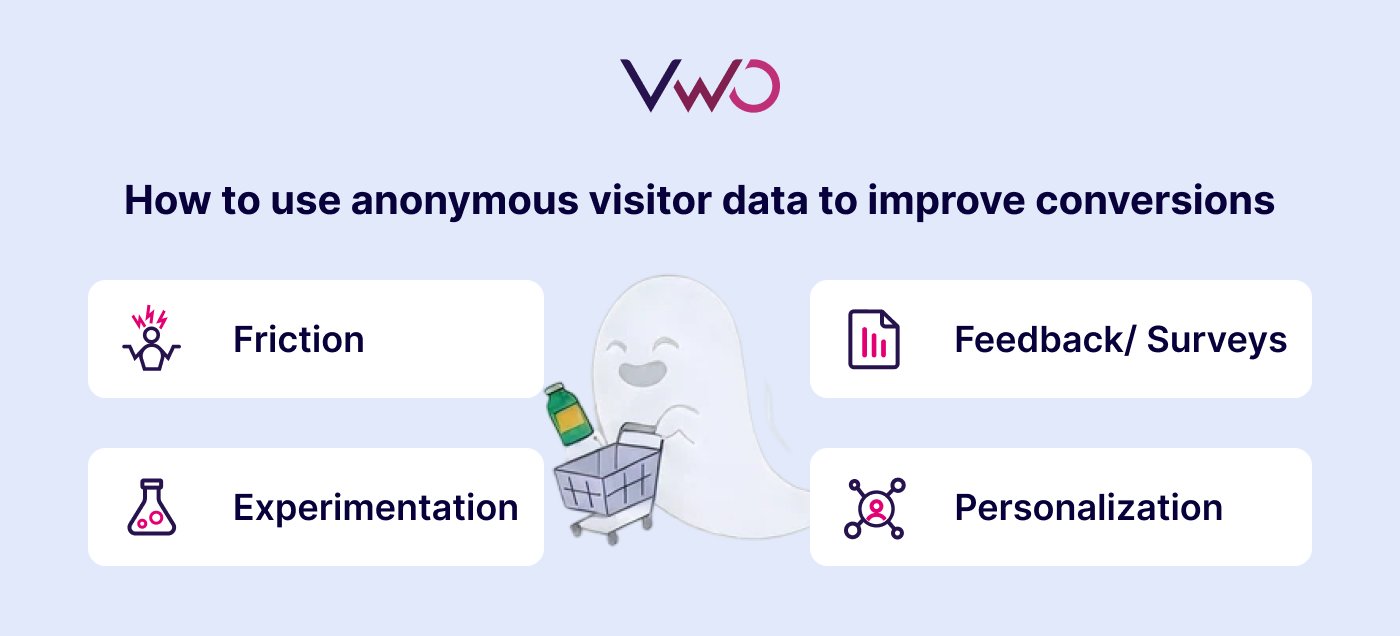
How to use anonymous visitor data to improve conversions
Anonymous visitor tracking isn’t just about observing behavior; it’s about using those insights to take action. When used effectively, it helps teams act on behavioral insights to reduce friction, improve relevance, and increase conversions across the funnel, even before visitors identify themselves.
Here are practical ways teams can use anonymous visitor insights to drive measurable improvement:
Identify friction in the user journey
Behavioral signals reveal where visitors hesitate, struggle, or abandon their journey. By analyzing interaction patterns, teams can uncover issues such as:
Dead or ineffective clicks
Rage clicks and repeated interactions
Abandoned forms
Confusing layouts or unclear navigation
Slow-loading or overlooked sections
These signals help prioritize fixes that remove friction and make key paths easier to complete.
When you do optimization based on research, it is much more successful because you’re not just opening up your box of psychological tricks and best practices, but you really find out what is going on with your customers.
Personalize experiences without collecting personal data
Anonymous signals, such as scroll depth, repeat visits, or specific page interactions, can be used to tailor experiences in real time. Common applications include:
CTAs triggered by engagement level
Offers based on browsing or cart behavior
Content variations driven by intent signals
Layout changes for new vs. returning visitors
VWO Personalize helps teams deliver relevant experiences using behavioral data collected through VWO Insights. These signals are used to build audience segments and trigger contextual experiences across the funnel, without relying on personal identifiers.
Identify companies showing repeated or deep engagement
Trigger timely, personalized follow-ups
Support account-based marketing efforts
Create content tailored to specific industries or segments
This ensures high-intent accounts don’t go unnoticed simply because no form was filled out.
Validate changes through experimentation
Behavioral insights should lead to testing, not assumptions. A/B testing helps confirm whether proposed changes actually improve outcomes, such as:
Clearer copy reduces friction
Cleaner layouts improve engagement
Visibility changes increase interaction
Offers resonating better with high-intent segments
VWO Testing enables teams to run controlled experiments on personalized elements like banners, CTAs, recommendations, layouts, and targeted offers. It supports A/B testing, multivariate testing, and split URL testing, as well as mobile and server-side experiments. By validating ideas before rolling them out widely, experimentation turns observations into evidence-backed decisions that reliably improve discovery and conversions.
VWO is designed to handle visitor data responsibly. It provides controls to prevent the collection of sensitive information, anonymizes IP addresses by default, and applies defined data-retention policies. Data associated with deleted or expired accounts is automatically removed within standard retention windows (typically 45–90 days), with priority deletion available when required. This enables teams to run experiments while maintaining robust privacy standards.
Pro Tip!
Use VWO Copilot to auto-generate image variations from existing assets using simple prompts, reducing dependency on design team bandwidth. Teams can guide Copilot with instructions such as refining copy or modifying image context to prepare test-ready visuals quickly.
Use surveys to understand the “why” behind behavior
Visitors may remain anonymous during their session, but they still experience friction worth understanding. Well-timed on-page surveys help uncover:
Missing or unclear information
Pricing or value concerns
Trust gaps
UX frustrations
These qualitative insights often explain why certain behaviors occur and directly inform both optimization and personalization efforts.
VWO Surveys lets teams ask targeted questions at the right moments using smart triggers like time on page, scroll depth, or exit intent. AI-powered survey creation generates relevant questions aligned to specific survey goals, reducing setup time and improving question quality.
Once responses start coming in, AI-generated summaries enable faster analysis without manually reviewing every response.
Further, survey responses can also be filtered by context, such as page, device, traffic source, or visitor segment, so feedback is reviewed where it occurred and more easily translated into actionable improvements.
Request a demo to discover how teams use VWO to understand anonymous visitors and optimize experiences.
Is anonymous visitor tracking legal?
Yes, anonymous visitor tracking is legal, provided it’s implemented responsibly and in line with applicable privacy regulations. The key distinction lies in what data is collected and how it’s used.
Most privacy laws focus on protecting personally identifiable information (PII). Anonymous visitor tracking, by design, avoids collecting direct identifiers such as names, email addresses, phone numbers, or exact identities. That said, legality depends on a few important principles.
Understanding the difference between anonymous and personal data
Anonymous tracking relies on non-PII signals like behavioral patterns, device attributes, or company-level information. As long as this data cannot reasonably be used to identify an individual, it generally falls outside the strictest regulatory requirements.
Once data can be linked to a specific person, however, it becomes subject to additional obligations.
Alignment with global privacy regulations
Regulations such as GDPR, CCPA/CPRA, and similar global privacy laws primarily govern the collection and use of personal data. Truly anonymous data typically falls outside their strictest requirements, while pseudonymous data may still be subject to regulatory obligations depending on context. In practice, compliant data collection generally requires that:
No direct personal identifiers are collected
Data is used for legitimate purposes like analytics or optimization
Appropriate consent mechanisms are in place where required
Users are informed through a clear privacy policy
Transparency and meaningful user control
Even when tracking anonymously, transparency matters. Best practices include:
Clearly explaining what data is collected and why
Disclosing the use of analytics, personalization, or experimentation tools
Providing easy ways for users to manage or withdraw consent
Respecting browser-level privacy signals where applicable
Responsible implementation of advanced tracking techniques
Techniques like fingerprinting or IP-based identification require extra care. While they can be legal, they should be:
Used proportionately and purposefully
Configured to avoid individual identification
Implemented with regional legal requirements in mind
Organizations should always assess their use of such techniques against local laws and internal privacy standards.
VWO is built with security and privacy in mind. It follows industry-standard practices and helps teams stay aligned with global privacy regulations such as GDPR and CCPA. With certifications like ISO 27001 and SOC 2 Type II, and additional compliance options available based on how the product is used, VWO gives teams the confidence to run experiments and analyze user behavior responsibly.
FAQs
Q1. Can you track website visitors?
Yes. You can track how visitors interact with your site, what they view, click, or abandon, without identifying them personally, as long as tracking remains privacy-safe and compliant.
Q2. How to track anonymous visitors on a website?
Anonymous visitors are tracked using first-party cookies, behavioral analytics, fingerprinting, IP intelligence, and server-side event tracking, often combined within analytics and optimization platforms.
Q3. Is identifying anonymous website visitors legal?
Yes. Identifying anonymous visitors is legal when it avoids collecting personally identifiable information (PII), follows applicable privacy laws, and respects user consent requirements.
Q4. What types of data can I collect about anonymous visitors?
You can collect non-PII data such as browsing behavior, page interactions, device or browser attributes, traffic source, approximate location, and at a company level, industry or organization details.
Q5. How accurate are anonymous visitor identification methods?
Accuracy varies by method. Cookie-based tracking works well for session continuity, fingerprinting improves recognition when cookies are limited, and IP-based identification is effective at the company level, especially in B2B, but less precise for individuals.
Hi, I’m Pratyusha Guha, manager - content marketing at VWO. For the past 6 years, I’ve written B2B content for various brands, but my journey into the world of experimentation began with writing about eCommerce optimization. Since then, I’ve dived deep into A/B testing and conversion rate optimization, translating complex concepts into content that’s clear, actionable, and human. At VWO, I now write extensively about building a culture of experimentation, using data to drive UX decisions, and optimizing digital experiences across industries like SaaS, travel, and e-learning.
Uncover hidden visitor insights to improve their website journey
One of our representatives will get in touch with you shortly.
Awesome! Your meeting is confirmed for at
Thank you, for sharing your details.
, you're all set to experience the VWO demo.
I can't wait to meet you on at
Account Executive
, thank you for sharing the details. Your dedicated VWO representative, will be in touch shortly to set up a time for this demo.
We're satisfied and glad we picked VWO. We're getting the ROI from our experiments.
Christoffer Kjellberg
CRO Manager
VWO has been so helpful in our optimization efforts. Testing opportunities are endless and it has allowed us to easily identify, set up, and run multiple tests at a time.
Elizabeth Levitan
Digital Optimization Specialist
As the project manager for our experimentation process, I love how the functionality of VWO allows us to get up and going quickly but also gives us the flexibility to be more complex with our testing.
Tara Rowe
Marketing Technology Manager
You don't need a website development background to make VWO work for you. The VWO support team is amazing
Elizabeth Romanski
Consumer Marketing & Analytics Manager

 DE
DE
 BR
BR




 ChatGPT
 Perplexity
 Gemini
 Claude
 Grok
Grok











![10 Best Enterprise Analytics Platforms [2026]: Expert Picks with Reviews and Comparisons](https://static.wingify.com/gcp/uploads/sites/3/2025/08/Feature-image-10-Best-Enterprise-Analytics-Platforms_-In-Depth-Reviews-and-Comparisons.jpg?tr=h-600)