Every element on your website or app, from headlines to buttons, shapes user experience and influences conversions.
But how do you know which combination works best?
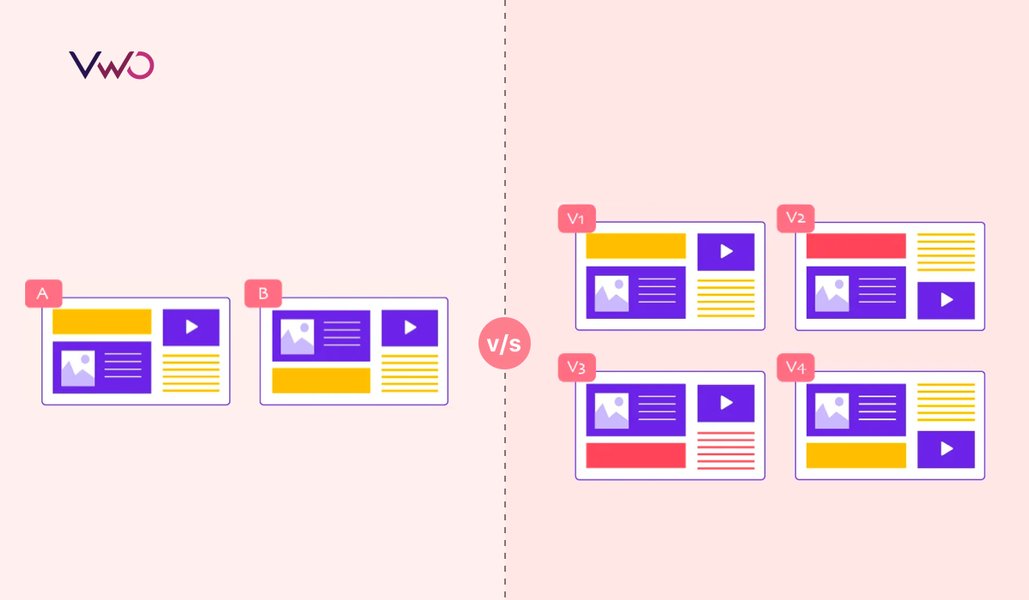
There are different testing methods to explore, depending on what you want to test. A/B testing is great for refining individual elements, while Split URL testing is ideal for comparing entirely different page designs.
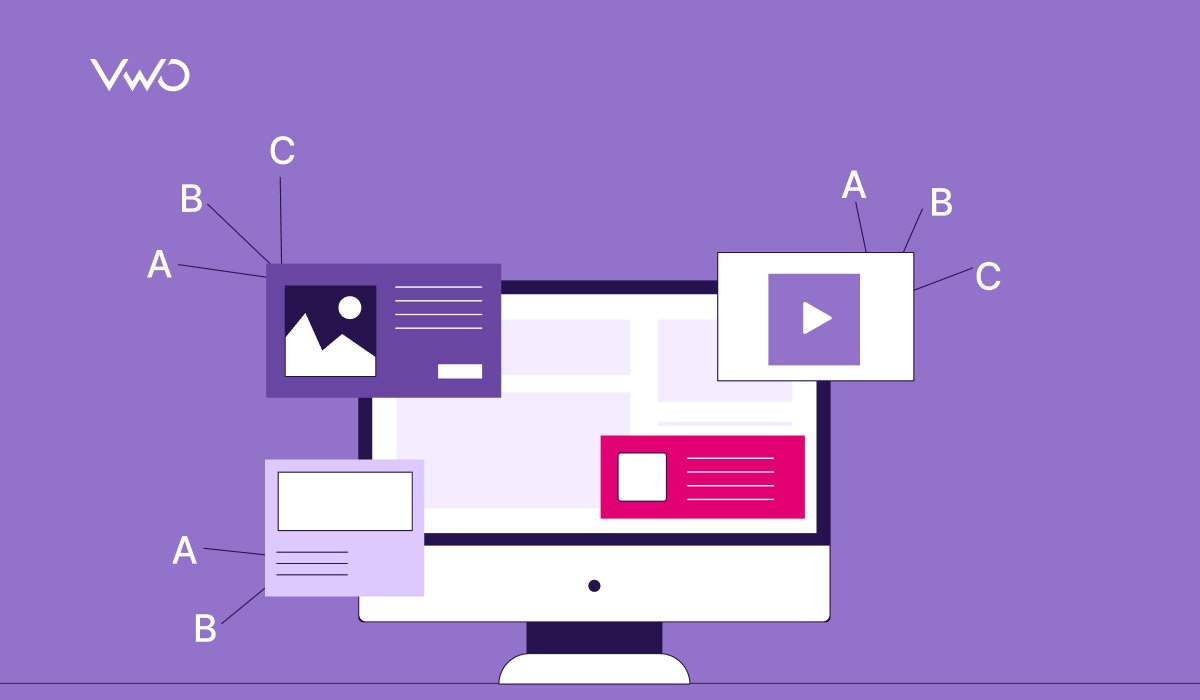
However, when you need to analyze how multiple elements—like headlines, images, and buttons—work together and which combination best uplifts your conversions, multivariate testing (MVT) is the way to go.
In this guide, we’ll explore the best multivariate testing tools and why VWO is the top choice for smarter experimentation, faster optimization, and better results.
What is a multivariate testing tool?
A multivariate testing (MVT) tool is a software solution that allows businesses to test multiple elements on a webpage or digital experience simultaneously to determine the best-performing combination.
MVT analyzes how different variations of multiple elements—such as headlines, images, CTAs, and layouts—interact to influence user behavior.
For instance, a hospital website aimed to increase specialist appointment bookings by running a multivariate test with these variations:
Headlines: “Expert Care, Anytime” vs. “Book a Specialist Consultation”
Hero Image: Doctor-patient interaction vs. Modern hospital facility
CTA Button Text: “Schedule an Appointment” vs. “Consult a Doctor Now”
Form Placement: Embedded on the homepage vs. Pop-up after 10 seconds
With 16 possible combinations, the test revealed that: “Book a Specialist Consultation” + Doctor-patient image + “Schedule an Appointment” CTA + Embedded form placement led to the highest conversion rate.
By optimizing its website based on these insights, the hospital increased online appointment bookings and reduced drop-offs from the scheduling page.
Used by marketers, UX designers, and CRO teams, MVT tools help identify the most effective design and content variations, leading to better engagement and higher conversions.
A/B Testing vs Multivariate Testing Tools
A/B Testing Tools
Multivariate Testing Tools
Definition
Compare two versions of a single page element
Test multiple elements and their combinations at once
Setup Ease
Simple setup with 2-3 variations of one element
Complex setups and combinations of several elements are tested
Best Use Case
Testing individual changes, sites with limited traffic
Understanding element interactions, high traffic websites, and complex testing scenarios
Note: Most experimentation platforms offer both A/B testing and multivariate testing capabilities, allowing you to choose the right method based on your testing goals and traffic volume.
Top 7 multivariate testing tools (free & paid): Detailed overview
1. VWO
VWO is an experience optimization platform that enables businesses to optimize their websites through A/B testing, multivariate testing (MVT), and in-depth behavioral analytics tools. It provides a user-friendly interface for running experiments, creating test variations, and analyzing performance through its robust dashboard.
Multivariate testing with VWO
VWO’s multivariate testing (MVT) capabilities allow you to experiment with multiple elements on a page simultaneously, helping you find the best-performing combination. Instead of testing changes one at a time, MVT lets you test hundreds of variations at once, ensuring data-driven decision-making for conversion rate optimization.
Key features:
Create and test multiple combinations automatically
Visual editor: Effortlessly create and modify hero images, buttons, headlines, and other key elements – no coding required.
Auto combinations: Automatically generates and tests all possible variations to identify the highest-converting combination.
Advanced reporting & performance analysis
Visualize test results to understand which element combinations drive the best engagement.
The Conversion Rate Report in MVT helps analyze each combination’s success.
Combination Performance Tracking allows you to compare results for different goals and combinations.
Multivariate testing in action: Provident Hotels & Resorts increased CTR by 9.1%
Challenge: Provident Hotels & Resorts aimed to increase click-through rates (CTR) on its CTA buttons to drive more reservations. To achieve this, they partnered with Sabre Hospitality Solutions Digital Marketing, leveraging VWO’s multivariate testing (MVT) feature for website optimization.
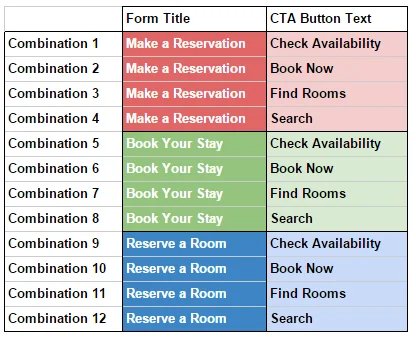
Approach: Sabre conducted an MVT to determine the best-performing combination of form title and CTA button text. The test included 3 variations of the form title (“Make a Reservation,” “Book Your Stay,” “Reserve a Room”) and 4 variations of the CTA text (“Check Availability,” “Book Now,” “Find Rooms,” “Search”), generating 12 total combinations.
The 12 Combinations
Results: The test ran for one month across 27,500 visitors, with traffic equally split among the variations. The most effective combination led to a 9.1% increase in CTR, helping Provident drive more users to check room availability and rates.
To help you get started, here’s a detailed webinar that walks you through how to set up a multivariate campaign in VWO.
In our client’s words:
VWO’s multivariate testing feature supports testing on a larger scale, along with understanding consumer behaviors and shopping habits. It is really useful for eCommerce clients as we can identify the highest converting combination of CTAs and messages from easily digestible data.
Mercedesz Molnar Senior SEO Executive & Outreach Lead at Digital NRG
2. Webtrends Optimize
Webtrends Optimize is an enterprise-grade experimentation platform offering a robust suite of website optimization tools. It’s full, and fractional factorial multivariate testing allows businesses to experiment with multiple elements simultaneously, pinpointing the most effective combinations for enhanced user experiences.
Best features:
Split Testing
Personalization
Targeting
Baseline Analysis
Onsite Surveys
Funnel Optimization
Pros & cons
Pros
Cons
The reporting dashboard offers easy segmentation and customization for seamless test monitoring.
Occasional flickering can be a drawback when using Webtrends Optimize.
Its user-friendly interface and seamless A/B testing simplify experiment setup by eliminating unnecessary complexities.
The documentation could be improved, as finding answers isn’t always easy, though customer support helps mitigate this.
Pricing:
Free trial: 30 days for all features.
Free account: For growing websites with less than 10,000 sessions/month.
Paid: Pricing available on request.
A customer experience as per G2 reviews:
Our experience with WebTrends Optimize has been outstanding. From day one, their team has provided knowledgeable, responsive support that feels genuinely invested in our growth. The platform itself is powerful yet easy to navigate, allowing us full visibility of A/B tests and optimising key areas of our website. For a growing business like ours, it’s been invaluable to have enterprise-level tools that are accessible and flexible, backed by a team that treats you like a partner. We’ve already seen measurable improvements in user engagement and conversion, and we’re excited to keep scaling with their support.
David W. Chief Operating Officer
3. Adobe Target
Adobe Target empowers businesses to optimize and personalize digital experiences, driving real results, retention, and revenue.
Its multivariate testing (MVT) feature allows teams to experiment with multiple elements simultaneously, identifying the most effective combinations for different audiences. Full factorial testing ensures every variation is tested equally, while thetraffic estimatorpredicts the required sample size for meaningful results. The element contribution report provides clear insights into which elements have the greatest impact.
Best features:
A/B/n Testing
Multi-armed Bandit Testing
Mobile Optimization
Personalization
Automation
Targeting
Segmentation
Pros & cons
Pros
Cons
Integration with Adobe Analytics delivers powerful real-time insights for optimizing campaigns.
Integrating with non-Adobe products can require extra steps, and the pricing may be high for smaller businesses.
Adobe Target makes it easy to create and run A/B and multivariate tests across channels without requiring deep technical expertise.
Effectively using Adobe Target requires advanced knowledge of web analytics and optimization, and integration with CMS can be challenging.
Pricing:
Pricing is available on request.
A customer experience as per G2 reviews:
One of the best aspects of Adobe Target is its ability to easily create and run A/B and multivariate tests across various channels. The platform’s robust targeting and segmentation options allow us to personalize user experiences based on detailed data, which improves conversion rates significantly. Additionally, the integration with Adobe Analytics provides powerful insights that help optimize campaigns in real time. The ease of setting up experiments without needing deep technical expertise is also a big plus.
AB Tasty is an experimentation platform that helps product marketers optimize user experiences and drive conversions through data-driven testing. With A/B, split, multivariate, and multi-page testing, teams can seamlessly experiment across websites, mobile apps, and connected devices.
Powered by a Bayesian statistics engine, AB Tasty provides gain probability and median value insights, helping marketers assess ROI, minimize false positives, and accelerate decision-making for better experiment outcomes.
Best features:
No-code Visual Editor
Emotions AI
Full-stack Experimentation
Audience Builder
Performance Center
Reports & Dashboards
Custom Widgets
Dynamic Allocation
Cross-Account Sharing
Pros & cons
Pros
Cons
Offers excellent flexibility to various testing needs.
Advanced coding knowledge may be needed for complex tests.
Responsive and reliable customer assistance.
Editor performance can lag, making it cumbersome, depending on the site’s technical structure.
Extensive tracking options with AI-driven insights for better decision-making.
Pricing:
Prices are not available on the website.
A customer experience as per G2 reviews:
It has a simple and very organized interface that allows multiple profiles from the same team to work coordinately on the same tests. The functionalities and the level of customization for conducting segmented tests are very powerful, allowing you to integrate with your data layer to impact the users you need to impact.
Kameleoon is a unified experimentation and personalization platform that helps businesses optimize and enhance digital experiences. With unlimited web experimentation, including multivariate testing, teams can experiment with copy, design, and product features across all devices without impacting performance.
Kameleoon Hybrid allows teams to track and manage experiments independently from developers’ release cycles for greater agility.
Best features:
Multi-Stat Engine
AI Copilot
Audience Segmentation
Mobile App Testing
Smart Graphic Editor
Code Editor
Simulation Tool
Dynamic Traffic Allocation
AI Predictive Targeting
Pros & cons
Pros
Cons
User-friendly interface, easy to navigate and implement.
It is priced higher than similar tools.
Pre-built bridges make third-party integrations quick and hassle-free.
Some technical expertise may be required to modify significant landing page changes.
Pricing:
Pricing is available on request.
A customer experience as per G2 reviews:
Kameleoon is an optimization solution that allows me to be completely autonomous in setting up and launching A/B tests/customizations to improve site navigation, notably thanks to PBX. In just a few minutes, simply by talking with the AI, I can turn ideas into tests. It is a real time saver and very easy to use. The results of the first tests launched via PBX are convincing.
SiteSpect helps businesses validate ideas, optimize user experience, and drive revenue across platforms and devices with powerful A/B and multivariate testing. Whether refining content, page elements, or site performance, SiteSpect ensures data-driven decisions that enhance SEO rankings and conversions.
From visual changes to backend feature rollouts, SiteSpect ensures precise optimization without compromising site performance.
Best features:
No Flicker
Deep Segmentation
Dashboards
Enhanced Analytics
Real User Monitoring
Alerts
Visual Editor
Find & Replace
Personalization
Product Recommendations
Pros & cons
Pros
Cons
The platform offers powerful targeting tools to test specific users or pages effectively.
The platform only provides general audience statistics without access to specific user data.
Multivariate testing campaigns help measure the impact of content changes before implementation.
Navigating all features may require a learning curve for new users.
Pricing:
No pricing information is available on the website.
A customer experience as per G2 reviews:
We’ve been working with SiteSpect for many years now and remain highly satisfied. It’s a powerful and versatile CRO tool that fits our needs perfectly. What truly sets SiteSpect apart is not only its robust functionality but also the exceptional support they provide. Unlike many other A/B testing tools, we don’t experience any flickering or loading delays on our webpages when using SiteSpect — a major advantage for both the user experience and the reliability of our test results. The server-side approach enables lightning-fast and seamless experiments, even in complex implementations. In short, SiteSpect is our ideal solution for conversion rate optimization: reliable, fast, and backed by a support team that’s always ready to help.
Convert helps businesses enhance user experiences and boost conversions through its advanced experimentation capabilities. It allows setting up every kind of experiment possible—from A/B testing to multivariate testing (MVT), where multiple page elements are modified in each version to determine the most effective combination.
Its A/B Testing Engine offers 40+ audience filters, API integrations, and customizable stats engines, enabling precise, data-driven decision-making. With targeting options, post-segmentation, and collision prevention, Convert ensures that users see the most relevant variations, allowing businesses to optimize performance with confidence.
Best features:
Full Stack Experimentation
Advanced Targeting
Guided Onboarding
QA Wizard
Multipage Testing
Sequential Testing
Code Editor
Pros & cons
Pros
Cons
The platform supports full-stack experimentation, allowing almost all types of A/B testing.
Requires multiple code snippets for SPA compatibility.
Its flicker-free, lightweight script ensures smooth performance with an intuitive UI.
Helpful support documentation, but it could be more comprehensive.
Pricing:
Free trial: 15 days for the Growth and Pro plans.
Paid: Starts from $299/month.
A customer experience as per G2 reviews:
Convert Experiences has been a reliable partner in helping us execute experimentation for multiple ecommerce clients. The interface is intuitive, which allowed our CRO team to adapt quickly. Setting up experiments is straightforward, and the learning curve was minimal, even for junior team members. It’s a tool that enables us to focus on what matters: running impactful tests and learning fast.
While A/B testing has its place, multivariate testing provides deeper insights into element interactions, helping you identify winning combinations that deliver measurable results.
The tools we’ve explored each offer unique capabilities, from visual editors and auto-combination generation to advanced statistical engines and cross-device testing.
Running successful multivariate tests requires more than just software. You need a platform that combines ease of use with statistical rigor, provides actionable insights without overwhelming complexity, and integrates seamlessly with your broader optimization strategy.
VWO stands out by offering a complete optimization ecosystem that goes beyond just running tests. It connects MVT with behavior analytics, integrated heatmaps, and session recordings, which help you understand why certain combinations perform better, not just what wins.
Ready to discover which element combinations drive your best results? Request a demo or experience firsthand with a 30-day free trial that includes full access to all features.
FAQs
Q1. What are multivariate testing tools?
Multivariate testing tools are software solutions that facilitate the process of creating, running, and analyzing MVT experiments. They help businesses optimize digital experiences by testing multiple variations and providing insights into the most effective element combinations.
Q2. What is a multivariate tool?
A multivariate tool is software that facilitates MVT experiments, evaluates user interactions, and identifies the most impactful variation combinations to optimize digital experiences.
Q3. How is multivariate testing conducted?
Multivariate testing (MVT) involves testing multiple elements on a webpage simultaneously to identify the best-performing combination. It requires selecting elements (e.g., headlines, images, CTAs) and generating all possible variations to determine which combination boosts conversions the most.
Q4. What key features should I look for in multivariate testing tools?
Look for automated combination generation, real-time reporting, audience segmentation, statistical accuracy (Frequentist or Bayesian methods), and cross-device compatibility to ensure efficient and accurate testing.
Q5. What types of tests can I run with multivariate testing tools?
You can run tests on landing pages, product pages, CTAs, forms, navigation menus, pricing structures, and ad creatives, allowing for deep optimization across different elements.
Q6. What is an example of a multivariate test?
Example of a Multivariate Test:
An eCommerce website wants to improve product page conversions. It tests: Product Image: Lifestyle shot vs. plain background CTA Button Color: Blue vs. Green CTA Text: “Add to Cart” vs. “Buy Now”
With 2 variations for each element, the test generates 2 × 2 × 2 = 8 total combinations. The results reveal which combination drives the most purchases, helping the business optimize its product pages for higher conversions.
Q7. How do you measure multivariate tests?
MVT results are measured by evaluating conversion rates, click-through rates, and engagement metrics to identify the most effective element combination. Statistical significance tests, such as Frequentist or Bayesian analysis, ensure accuracy, helping businesses make data-driven optimization decisions.
Q8. What is the difference between A/B testing and multivariate testing?
A/B testing compares two versions of a single element, while MVT tests multiple elements simultaneously, identifying the best combination rather than just a single change.
Q9. What are the statistical tools used in multivariate analysis?
Some key statistical tools used in multivariate analysis include multiple regression, factor analysis, cluster analysis, discriminant analysis, principal component analysis, canonical correlation analysis, correspondence analysis, multidimensional scaling, structural equation modeling, and ANOVA (Analysis of Variance).
I'm a branding enthusiast, marketer, and B2B content professional with over 20 years of experience. I'm also a certified native advertising expert and trained in strategic thinking. Author of 'Managing Modern Brands: Cult Theory and Psychology', and three other books in diverse genres. I generally write on marketing trends, optimization, brand strategy, consumer psychology, CRO, cult theory, data, personalization, and content strategy. With a strong expertise in building and leading teams and cross-functional collaboration, I have driven demand through content creation, data, digital media, content marketing, and technology.
Uncover hidden visitor insights to improve their website journey
One of our representatives will get in touch with you shortly.
Awesome! Your meeting is confirmed for at
Thank you, for sharing your details.
, you're all set to experience the VWO demo.
I can't wait to meet you on at
Account Executive
, thank you for sharing the details. Your dedicated VWO representative, will be in touch shortly to set up a time for this demo.
We're satisfied and glad we picked VWO. We're getting the ROI from our experiments.
Christoffer Kjellberg
CRO Manager
VWO has been so helpful in our optimization efforts. Testing opportunities are endless and it has allowed us to easily identify, set up, and run multiple tests at a time.
Elizabeth Levitan
Digital Optimization Specialist
As the project manager for our experimentation process, I love how the functionality of VWO allows us to get up and going quickly but also gives us the flexibility to be more complex with our testing.
Tara Rowe
Marketing Technology Manager
You don't need a website development background to make VWO work for you. The VWO support team is amazing
Elizabeth Romanski
Consumer Marketing & Analytics Manager

 DE
DE
 BR
BR





 ChatGPT
 Perplexity
 Gemini
 Claude
 Grok
Grok