
 DE
DE
 BR
BR





 ChatGPT
 Perplexity
 Gemini
 Claude
 Grok
Grok
How Elite Product Teams Turn CSAT Into a Real Growth Lever
Most B2B SaaS teams monitor Customer Satisfaction Score, but very few translate those numbers into meaningful change. Tracking CSAT is easy. Acting on it consistently, at speed, and with confidence is where most teams fall short.
Top-performing product and customer experience teams treat CSAT as more than a reporting metric. They operationalize it. They build systems that connect customer sentiment directly to product decisions, experimentation priorities, and retention strategies.
Over time, this turns feedback into a compounding advantage rather than a passive dashboard number.
This guide breaks down how modern product and customer success teams use CSAT as an execution tool, not just a signal, and how they close the gap between listening to customers and improving outcomes.

Why leading teams choose CSAT over NPS for product development
For years, Net Promoter Score dominated executive conversations. But when it comes to day-to-day product decisions, many teams are discovering its limitations.
Product leaders increasingly favor CSAT because it reflects satisfaction with a specific experience, at a specific moment. That granularity makes it far easier to diagnose issues, validate improvements, and prioritize work that actually changes customer behavior.
Why NPS falls short for product teams
Research from the user research community, including work led by Judd Antin during his time building research practices at companies like Facebook and Airbnb, highlights a consistent pattern. Simple satisfaction measures tied to real interactions tend to be more stable, more precise, and more closely linked to actual user behavior than recommendation-based scores.
The core issue with NPS is not intent, but design. Asking users to predict whether they would recommend a product introduces bias, external influences, and factors product teams cannot control. Despite these limitations, NPS persists largely because of legacy adoption and industry inertia, not because it is the best tool for product decision-making.
As Antin notes, the survey science community has reached consensus that NPS makes fundamental methodological mistakes. The real problem? An entire industry of consultants and software providers has a vested interest in maintaining NPS as the standard, despite its limitations.
Why high-performing teams prefer CSAT
Contextual accuracy
CSAT captures sentiment immediately after a real interaction, using the product, completing onboarding, or resolving a support issue. This proximity to the experience makes the feedback clearer and easier to act on.
Decision-level precision
Unlike broad loyalty metrics, CSAT reflects how well a specific experience performed. That makes it far more useful when teams need to decide what to fix, improve, or double down on.
Faster learning cycles
Product value only matters if users can realize it easily. CSAT surfaces friction early, often before usage drops or churn signals appear.
Clear benchmarks
In B2B SaaS, strong teams typically aim for CSAT scores above 80%, with category leaders pushing beyond 85%. These thresholds make it easier to track progress and align teams around shared goals.
The VWO Pulse framework: Turning CSAT into a growth engine
VWO Pulse, formerly Blitzllama, is designed for teams that want to move from collecting feedback to acting on it continuously. Instead of treating CSAT as a periodic check-in, it enables teams to run feedback as an always-on intelligence layer inside their product workflow.
The 3-layer approach to CSAT
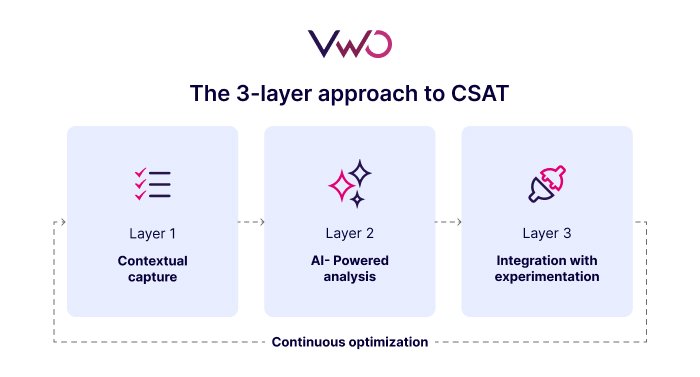
Layer 1: Capture feedback in context
Surveys are triggered at meaningful moments, after feature use, milestone completion, or friction events, when users are most likely to give accurate feedback.
Layer 2: Turn responses into insight automatically
AI-driven analysis surfaces patterns, recurring themes, and emerging risks without requiring manual review of every response.
Layer 3: Connect insight directly to experimentation
CSAT signals feed straight into testing and rollout decisions, allowing teams to validate fixes, test alternatives, and measure impact quickly.
Real-world application
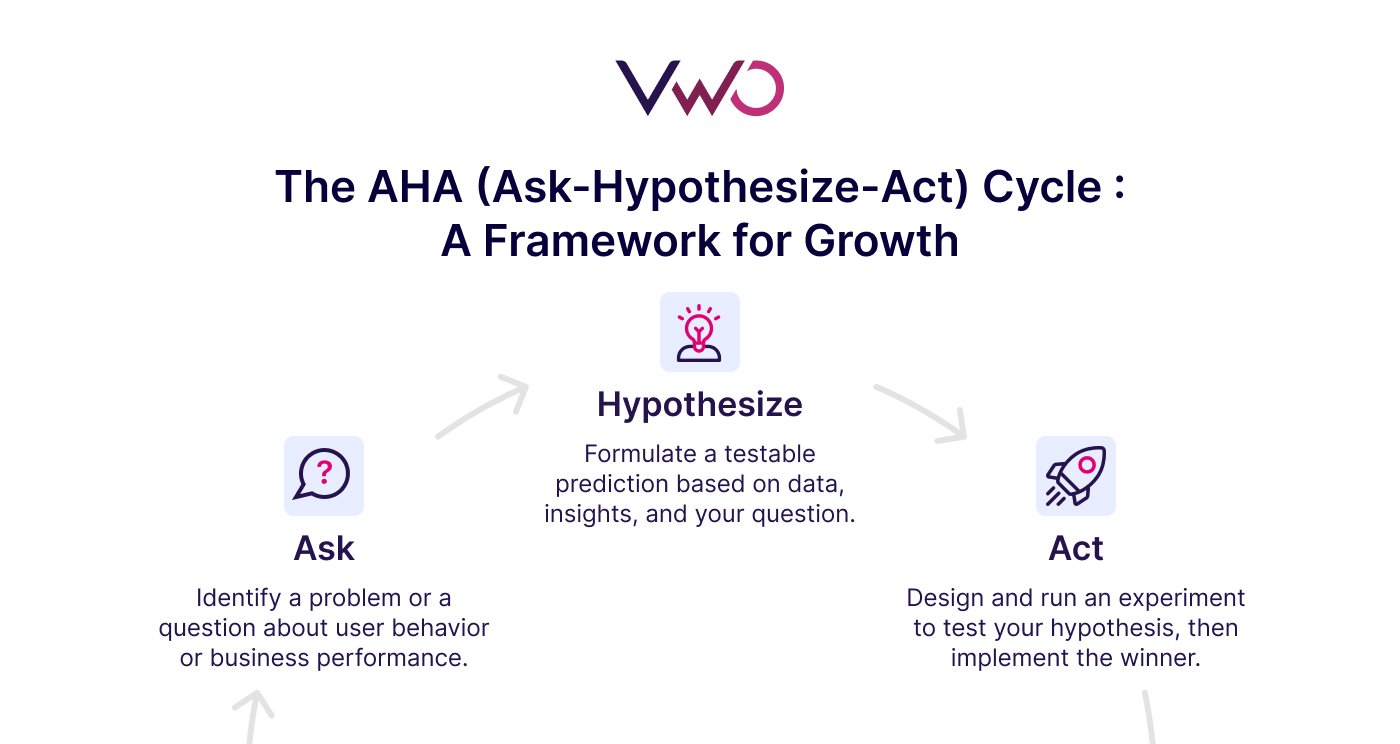
Imagine a SaaS team sees a sudden drop in checkout completion. Instead of guessing at causes or launching broad experiments, they start by asking the right users one focused question at the moment of abandonment.
The feedback makes the issue obvious; password requirements are confusing and slowing users down. With that clarity, the team runs targeted experiments, simplifying flows, adjusting copy, or introducing alternative login options.
The difference is not speed alone, but certainty. Every experiment now starts with evidence, not assumptions.
Ask: Trigger a hyper-targeted survey to users who abandon checkout: “What’s stopping you from completing your purchase?”
Hypothesize: AI-summarized feedback reveals that users are confused by password requirements. Instead of guessing, you now have direct evidence.
Act: Launch a VWO A/B Test to simplify password creation, deploy a personalization campaign with clearer instructions, or roll out a feature experiment with social login options.
This cycle moves teams from guessing to knowing, ensuring every experiment is backed by direct user evidence. The result? Higher experiment win rates, faster iteration cycles, and more confident product decisions.
Strategic CSAT implementation: Lessons from high-growth companies
When to deploy CSAT surveys
High-performing teams are strategic about survey timing. Here are the critical touchpoints where CSAT delivers maximum value:
Post-onboarding completion
First impressions matter enormously in SaaS. Measuring CSAT immediately after users complete primary onboarding reveals whether you’re setting users up for success or frustration. Low scores here are leading indicators of early churn.
After the first feature use
The “aha moment” when users first experience the core value should be followed by a CSAT check. This tells you whether your core value proposition is landing as intended.
Following support interactions
Supporting CSAT is one of the strongest predictors of account health. In B2B contexts, consistent low scores from decision-makers or influential users are among the strongest predictors of churn.
Post-feature launch
Rolling out new features without measuring satisfaction is like flying blind. CSAT surveys triggered 3-7 days after users first interact with a new feature reveal whether you’re adding complexity or genuine value.
At renewal milestones
30-60 days before renewal, CSAT provides crucial intelligence about account health. This gives your customer success team time to intervene if scores are low.
After product updates
Major updates can introduce friction even when adding capabilities. Post-update CSAT helps you understand whether changes enhance or hinder the user experience.
Segmentation: The secret weapon of elite teams
Average teams track overall CSAT. Elite teams ruthlessly segment to uncover insights that matter:
By user role: Product managers, end users, and administrators often have vastly different satisfaction levels with the same product. Track CSAT by role to ensure you’re not optimizing for one persona at another’s expense.
By customer tier: Enterprise customers may tolerate complexity that frustrates SMB users. Your $100K annual contract holders might have different expectations than your $1K customers.
By product area: CSAT for your core product might be strong, while a new feature module scores poorly. Segment by product area to pinpoint exactly where to focus improvement efforts.
By customer journey stage: New customers (0-90 days), growing customers (91-365 days), and mature customers (365+ days) have different needs. Track satisfaction across these stages to identify when and why engagement drops.
By acquisition channel: Users from product-led growth motions often have different expectations than those from sales-led deals. Segment CSAT by acquisition source to tailor experiences appropriately.
The power of combined metrics
While CSAT is powerful, elite teams combine it with complementary metrics for deeper insights:
CSAT + NPS quadrant analysis
Combining these metrics reveals four distinct customer segments:
- High CSAT, High NPS: Brand advocates … your happiest customers
- High CSAT, Low NPS: Satisfied but not enthusiastic … at risk of switching
- Low CSAT, High NPS: Loyal despite recent frustrations … address their issues urgently
- Low CSAT, Low NPS: At-risk customers requiring immediate intervention
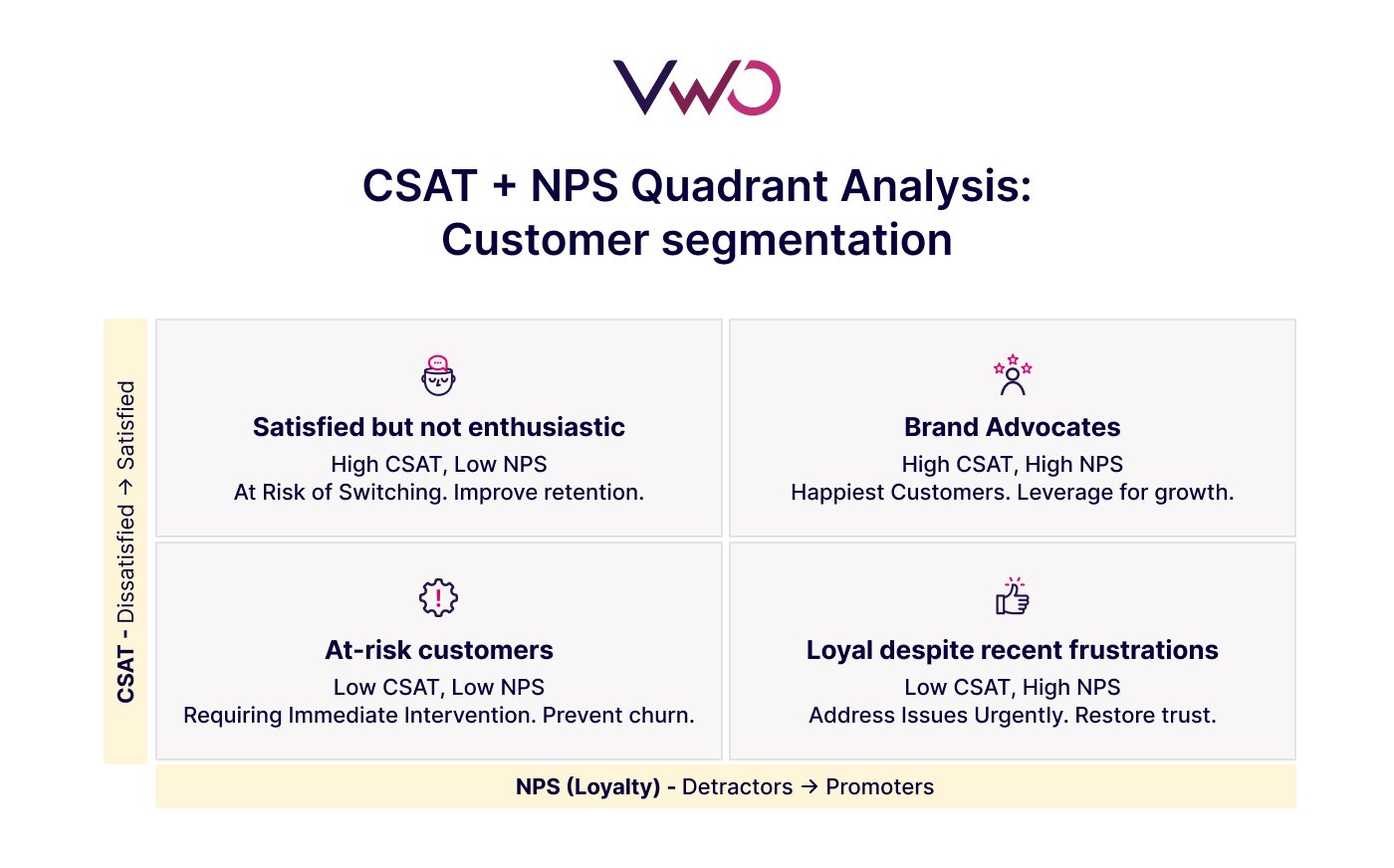
This segmentation helps identify patterns such as customers who love certain features but aren’t happy with the overall product or service (low risk of churn), versus loyal customers who were satisfied but recent experiences have made them unhappy (high risk of churn, but haven’t left due to high opportunity costs).
CSAT + CES (Customer Effort Score)
If CSAT is high but CES is also high, you have satisfied customers who struggled to achieve their goals. This points to UX friction that needs addressing even when outcomes are positive.
CSAT + Product Analytics
Correlating CSAT scores with actual product usage reveals whether satisfaction translates to engagement. Low CSAT with high usage might indicate a lack of alternatives; high CSAT with low usage suggests you’re delighting a niche but haven’t achieved broad adoption.
Building high-response CSAT programs
Response rates make or break CSAT programs. High-performing teams achieve 20-40% response rates (compared to 5-10% for poorly implemented surveys) by following these principles:
Design for immediacy
Trigger instantly: Send CSAT surveys within seconds or minutes of the interaction, not hours or days later. VWO Pulse’s event-based triggering ensures surveys appear at exactly the right moment.
Keep it short: One rating question plus one optional open-ended follow-up is the gold standard. Every additional question dramatically decreases completion rates.
Mobile-optimize everything: With mobile accounting for an increasing SaaS usage, surveys must render perfectly and be complete in under 10 seconds on small screens.
Personalize the ask
Generic surveys get generic response rates. High-performing teams personalize:
- Use the customer’s name and reference the specific interaction
- Customize the question to the exact experience (e.g., “How satisfied were you with the new dashboard?” not “How satisfied are you with our product?”)
- Adjust language based on user segment and journey stage
Close the loop visibly
Customers who see their feedback lead to changes are 3x more likely to respond to future surveys. Make your feedback loop visible:
- Send personal responses to low scores within 24-48 hours
- Publish monthly “You spoke, we listened” updates highlighting changes driven by feedback
- Tag product updates in-app with “Requested by users like you.”
From data to action: The closed-loop system
Collecting CSAT data is meaningless without systematic action. Here’s how elite teams close the loop:
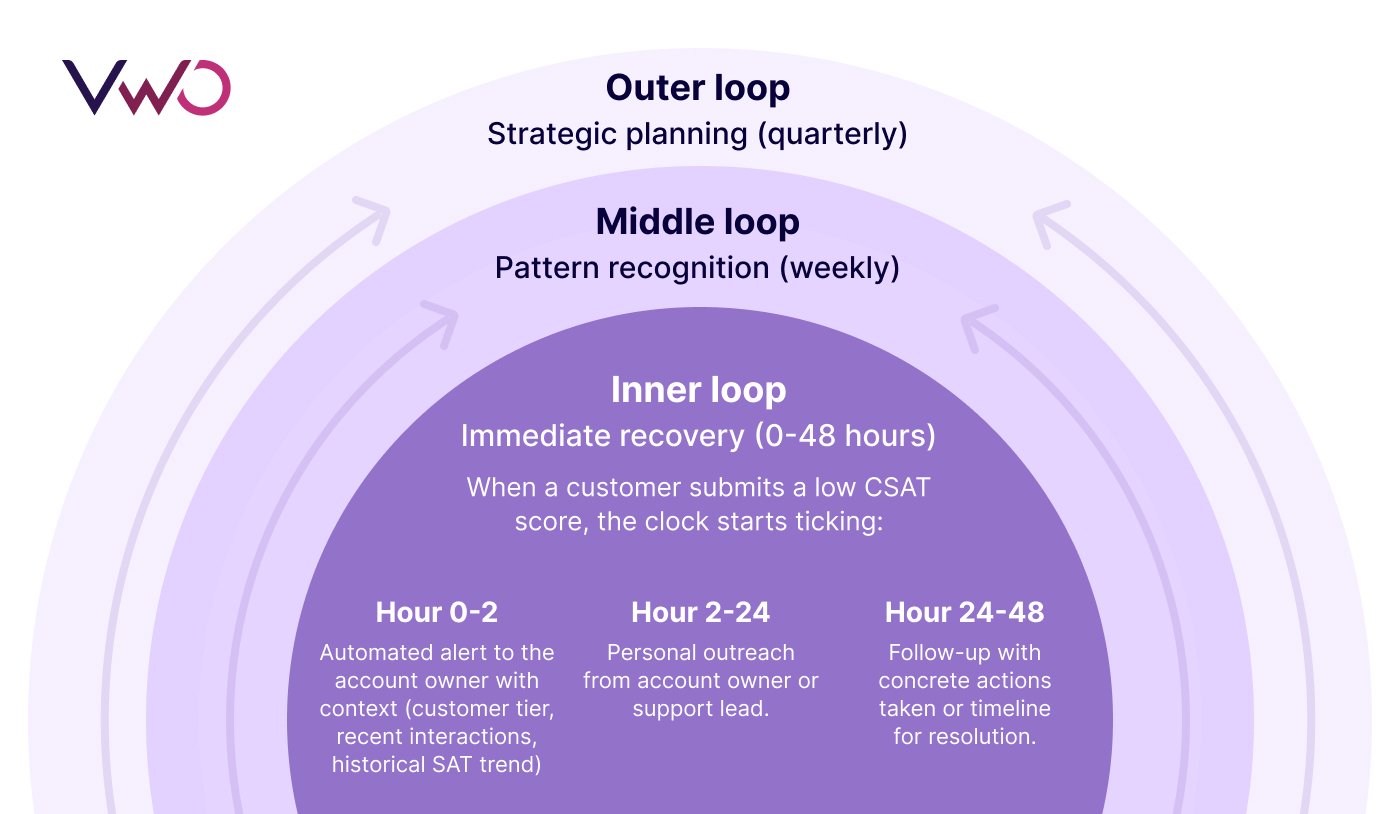
Inner loop: Immediate recovery (0-48 hours)
When a customer submits a low CSAT score, the clock starts ticking.
Middle loop: Pattern recognition (weekly)
Every week, product and customer success leaders review:
- CSAT trends by segment, feature, and journey stage
- Common themes in open-ended responses (surfaced by AI analysis)
- Correlation between CSAT drops and specific product changes or external events
- Comparison to benchmark scores and historical performance
This weekly rhythm ensures that emerging issues are caught before they become systemic problems.
Outer loop: Strategic planning (quarterly)
Quarterly planning should be heavily informed by CSAT insights:
- Which features or experiences consistently drive satisfaction?
- What friction points appear repeatedly across segments?
- Where are the biggest gaps between customer expectations and delivery?
- How has CSAT evolved in relation to product changes?
High-performing teams dedicate entire sprint cycles to “CSAT debt”… addressing the accumulated friction points that prevent customers from being fully satisfied.
Advanced tactics: Maximizing CSAT intelligence
Predictive churn modeling
Sustained low scores from decision-makers or influential users are one of the strongest predictors of churn. Elite teams build predictive models that combine CSAT trends with usage data, support ticket volume, and payment issues to forecast churn 60-90 days out.
The model might weigh factors like:
- CSAT trajectory (improving vs. declining)
- Absolute CSAT level
- Response consistency (engaged feedback vs. survey fatigue)
- Sentiment in open-ended responses
- Support ticket sentiment and volume
This early warning system enables proactive intervention before customers reach the decision point.
A/B testing survey design
Why guess at optimal survey design? High-performing teams A/B test:
- Question phrasing (e.g., “How satisfied were you?” vs. “How would you rate your experience?”)
- Scale types (1-5 vs. 1-7 vs. emoji vs. thumbs)
- Survey timing (immediate vs. 1-hour delay vs. next session)
- Follow-up question wording
Small design changes can increase response rates by 20-30% or improve the quality of open-ended feedback.
Incentivizing thoughtful feedback
Some teams worry that incentives bias responses. The research shows otherwise: thoughtful incentives increase response rates without materially affecting scores:
- Entry into monthly drawings for gift cards (doesn’t reward specific scores)
- Charitable donations for completed surveys
- Early access to new features for engaged feedback providers
- Public recognition in the “Customer Advisory Board” for consistent, high-quality feedback
The key is rewarding participation, not specific scores.
Multi-channel feedback aggregation
VWO Pulse’s unified feedback analysis consolidates CSAT data with:
- Support ticket sentiment
- App store and review site ratings
- Social media mentions
- Sales call feedback
- Customer advisory board insights
This 360-degree view prevents you from optimizing for one feedback channel while missing critical signals from others.
Measuring CSAT program success
High-performing teams track these meta-metrics to evaluate their CSAT program:
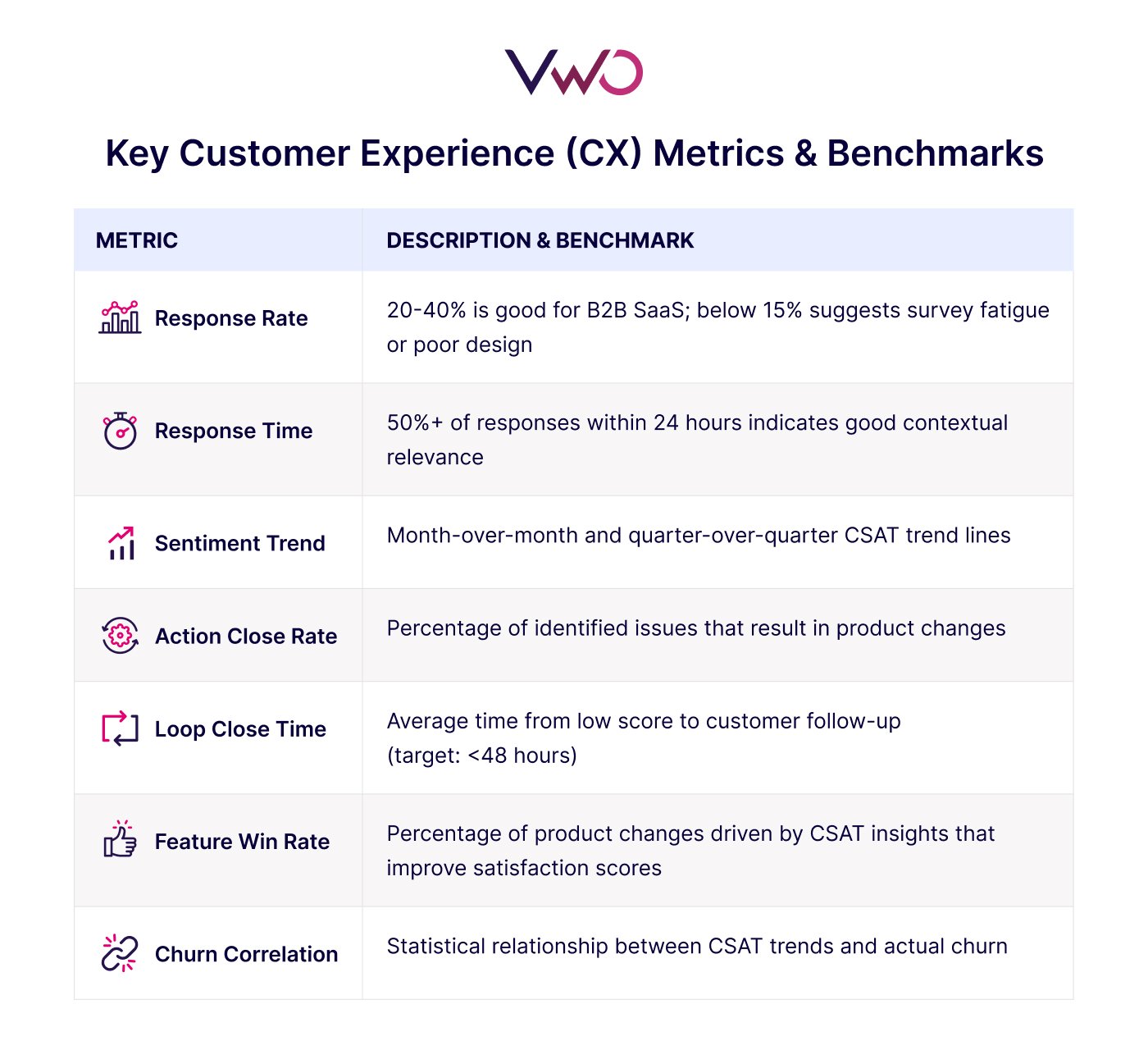
Common pitfalls and how to avoid them
Survey fatigue
The problem: Bombarding users with surveys at every interaction destroys response rates and annoys customers.
The solution: Implement frequency caps (maximum one survey per user per 30 days) and smart triggering that prioritizes high-value touchpoints. VWO Pulse’s targeting capabilities ensure you’re strategic, not spammy.
Analysis paralysis
The problem: Collecting mountains of CSAT data but taking months to act on insights.
The solution: Establish clear decision triggers (e.g., “Any feature with CSAT <70% gets immediate product team attention”). Use AI summarization to surface themes in minutes, not weeks. Bias toward action over perfect analysis.
Cherry-picking feedback
The problem: Teams highlight positive feedback while dismissing negative scores as outliers.
The solution: Make all feedback visible to product and leadership teams. Celebrate both high scores and rapid responses to low scores. Create psychological safety for discussing bad news.
Ignoring non-respondents
The problem: Given that NPS response rate averages 20-40%, at least 60% of customers are non-respondents, and based on case studies, non-respondents churn the most, even more than detractors.
The solution: Track engagement patterns of non-respondents. Use product analytics to identify friction points they’re experiencing. Consider alternative feedback mechanisms (in-app behavior signals, usage patterns, support interactions).
Measuring without context
The problem: Comparing CSAT scores across dissimilar touchpoints or customer segments without accounting for context.
The solution: Establish separate benchmarks for different survey types (post-support should target 85%+, post-feature-launch might target 75%+ initially). Always segment before concluding.
Building a CSAT-driven culture
Technology enables CSAT programs, but culture determines their impact. High-performing teams cultivate these cultural elements:
Make feedback visible
Product team standups
Start with CSAT highlights, both wins and urgent issues
Shared Slack channels
Post real-time CSAT feedback (with customer names redacted if needed)
Executive dashboards
Ensure leadership sees CSAT trends alongside revenue and growth metrics
Celebrate feedback champions
Recognize team members who:
- Rapidly respond to low CSAT scores
- Identify patterns that lead to product improvements
- Close the loop thoughtfully with customers
- Drive CSAT improvements in their product area
Democratize access
Every team member, from engineering to sales, should have access to relevant CSAT data. Transparency builds shared accountability for customer satisfaction.
Link to outcomes
Pilot, a $1.2-billion company, prioritizes customer satisfaction as a key component of their growth strategy, with their cofounder stating they never jeopardize CSAT, even when under pressure to hit numbers.
Make CSAT a first-class metric in your planning, equal in importance to revenue and user growth targets.
The future of CSAT: AI-powered, always-on intelligence
The next generation of CSAT programs, exemplified by VWO Pulse, is moving beyond periodic surveys toward continuous intelligence:
Predictive CSAT: AI models that predict satisfaction before asking, using behavioral signals, support interactions, and usage patterns
Automated insights: Systems that not only identify patterns but suggest specific product changes to address them
Real-time personalization: Experiences that adapt based on predicted satisfaction levels, preventing dissatisfaction before it occurs
Unified action workflows: Seamless handoffs from CSAT insight to experimentation platform to deployment, closing the loop in days instead of months
Your 30-day CSAT acceleration plan
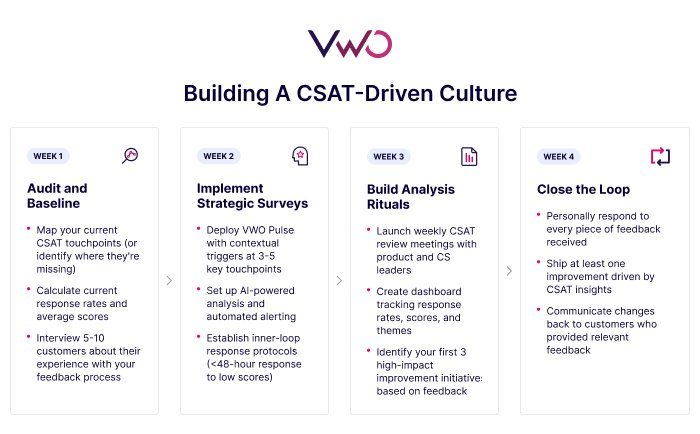
Week 1 – Audit and baseline
- Map your current CSAT touchpoints (or identify where they’re missing).
- Calculate current response rates and average scores
- Interview 5–10 customers about their experience with your feedback process
Week 2 – Implement strategic surveys
- Deploy VWO Pulse with contextual triggers at 3–5 key touchpoints
- Set up AI-powered analysis and automated alerting
- Establish inner-loop response protocols (e.g., <48-hour response to low scores).
Week 3 – Build analysis rituals
- Launch weekly CSAT review meetings with product and CS leaders
- Create dashboards tracking response rates, scores, and themes
- Identify your first three high-impact improvement initiatives based on feedback
Week 4 – Close the loop
- Personally respond to every piece of negative feedback received
- Ship at least one improvement driven by CSAT insights
- Communicate changes back to customers who provided relevant feedback
Conclusion: CSAT as a competitive advantage
As product differentiation shifts from features to experience, customer satisfaction has become a competitive variable, not a vanity metric.
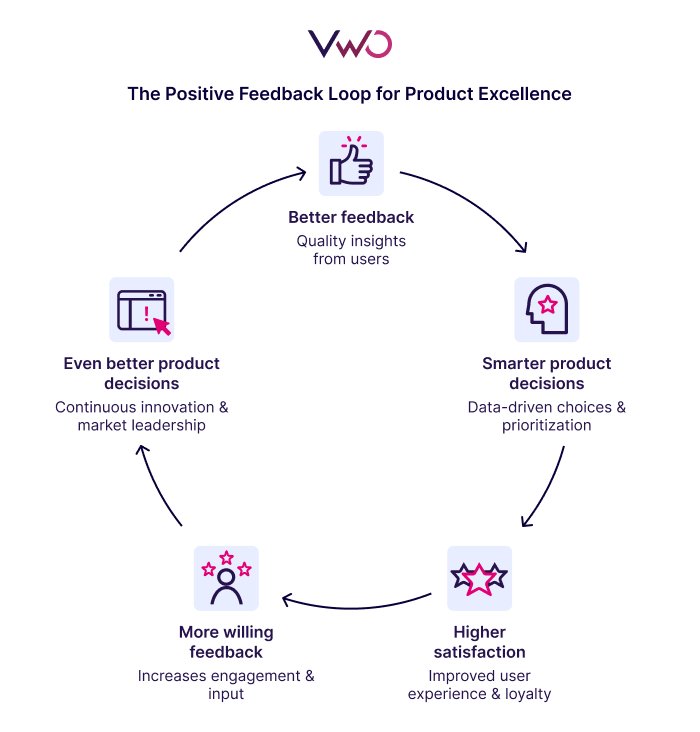
Teams that win with CSAT don’t just measure sentiment. They build systems that respond to it quickly, consistently, and visibly. Over time, this creates a feedback loop where better decisions lead to better experiences, which in turn fuel growth.
VWO Pulse is built for teams that need this loop to run fast. By combining in-context feedback collection, AI-driven insight, and direct links to experimentation and rollout workflows, it helps teams move from insight to impact without delay.
The real question isn’t whether you’re collecting CSAT. It’s whether your organization is structured to act on it before the opportunity passes.
Elite teams recognize that systematic, contextual CSAT measurement combined with rapid action creates a flywheel:
VWO Pulse represents the latest evolution in Voice of Customer, purpose-built for teams who need to move at the speed of modern product development. By combining contextual survey triggering, AI-powered analysis, and direct integration with experimentation tools, it enables teams to close the gap between customer insight and product action.
The question isn’t whether to measure CSAT; it’s whether you’re using it to its full potential. The teams that master this discipline don’t just build better products; they build sustainable competitive advantages that compound over time.
Ready to transform how your team uses CSAT? VWO Pulse makes it easy to capture contextual feedback across mobile apps, websites, and shareable links, analyze it with AI, and connect insights directly to your experimentation workflow. Learn more about how VWO Pulse helps product teams move from feedback to action in hours, not weeks.
Categories:








![What Is Net Promoter Score (NPS)? How to Measure and Use It [Complete Guide]](https://static.wingify.com/gcp/uploads/sites/3/2025/11/Feature-image-What-Is-Net-Promoter-Score-NPS_-How-to-Measure-and-Use-It-Complete-Guide-1.jpg?tr=h-600)