
 ChatGPT
 Perplexity
 Gemini
 Claude
 Grok
Grok
Digital journeys are rarely linear.
A visitor may land on your site from an email, browse anonymously, compare products across tabs, leave, return through search, and then show interest in a completely different category. Traditional personalization tools often struggle with this behavior because they rely on fixed segments, historical data, or known customer profiles.
That creates a major gap.
Most visitors do not arrive logged in or fully identified. Yet from the first click, they provide valuable behavioral signals: what they view, where they hesitate, how they scroll, what they ignore, and which products or categories attract their attention.
AdaptiveCX helps brands act on those signals in real time.
Instead of waiting for a visitor to become known, AdaptiveCX uses in-session behavior to predict intent and adapt the experience while the visitor is still engaged. The result is a more relevant journey for both anonymous and known visitors, powered by transparent AI and activated directly on-site.
This guide explains why real-time personalization matters, how AdaptiveCX works, where it can be applied, and how teams can use it to improve conversion, revenue per visitor, retention, and customer experience.
Why real-time personalization matters
Most eCommerce brands know less about their visitors than they think.
Analytics tools show conversion rates, bounce rates, traffic sources, and session duration. But they often do not provide a complete understanding of who the visitor is or what they want in the moment.
For many mid-market and enterprise eCommerce businesses, a large share of traffic is anonymous. These visitors are not logged in, may be browsing in private mode, or may be visiting for the first time. Traditional personalization systems, which depend on customer profiles, CRM data, or previous purchases, are often built for the known minority.
That means a significant portion of traffic receives a generic experience.
The limits of static personalization
Many personalization strategies are based on rules:
- If a visitor is in a certain location, show a location-specific banner.
- If a visitor browsed shoes last month, show shoe-related content.
- If a customer belongs to a loyalty segment, show a VIP offer.
These rules can be helpful, but they are also rigid. They assume past behavior or broad attributes are enough to predict what someone wants now.
But intent changes quickly.
A visitor in New York may be shopping for a gift in Florida. Someone who viewed winter coats last week may now be looking for swimwear. A first-time visitor may show strong buying intent within seconds, even without any profile history.
When personalization cannot respond to live behavior, the experience can feel generic, mistimed, or irrelevant. That friction affects engagement, conversion, and ultimately revenue.
The opportunity: personalize based on current intent
AdaptiveCX shifts the focus from identity-based personalization to intent-based personalization.
Rather than waiting for a login or historical profile, it interprets live behavioral signals such as:
- Scroll depth
- Click patterns
- Mouse movement
- Time on page
- Product interactions
- Search behavior
- Exit intent
- Hesitation around key actions
These signals help indicate whether a visitor is browsing, comparing, ready to buy, price-sensitive, frustrated, or likely to abandon.
By acting on these signals during the session, brands can personalize experiences for visitors who would otherwise receive a default journey. AdaptiveCX helps unlock value from anonymous traffic by predicting intent in real time and adapting the experience accordingly.
The business value of AdaptiveCX
AdaptiveCX is designed to improve both business performance and customer experience.
For the business, the goal is to increase conversion, revenue per visitor, repeat engagement, and campaign efficiency. For the visitor, the goal is a smoother journey that feels relevant from the first interaction.
Key performance benefits
Typical outcomes associated with AdaptiveCX include:
- Conversion rate lift of around 10% by showing more relevant content and reducing friction.
- Revenue per visitor growth of around 15% by using intent predictions to personalize recommendations, upsells, and incentives.
- Retention improvements of up to 2.5x when visitors have a more relevant first experience and are more likely to return.
A better experience for every visitor
For customers, personalization should not feel like a campaign. It should feel like the site is helping them find what they need faster.
AdaptiveCX can support that by:
- Reordering content based on current interest
- Surfacing relevant categories or products sooner
- Adjusting search recommendations before a query is typed
- Offering alternatives when a product is unavailable
- Triggering incentives only when they are likely to influence behavior
- Reducing dead ends in the journey
This is especially valuable for first-time or anonymous visitors. Instead of waiting for a profile to develop, AdaptiveCX creates relevance from the current session itself.
How AdaptiveCX works
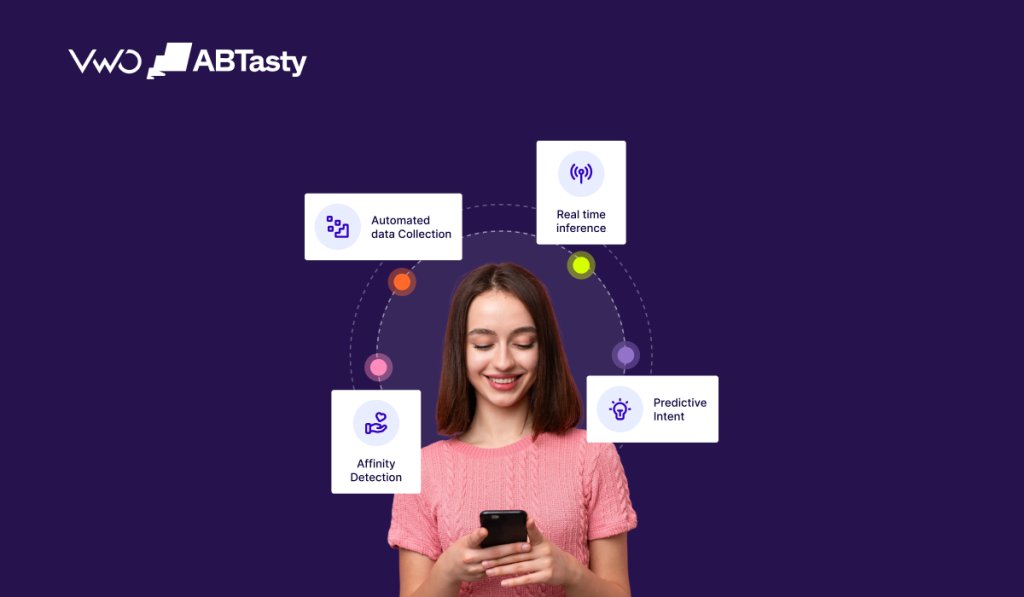
AdaptiveCX uses a continuous cycle of signal capture, intent prediction, and experience activation.
This process happens repeatedly throughout a session, allowing the experience to adapt as visitor behavior changes.
Step 1: Capture live behavioral signals
AdaptiveCX collects non-PII (Personally Identifiable Information) behavioral data as visitors interact with the site.
Examples include:
- Scroll activity
- Mouse movement
- Active time on page
- Click sequences
- Product interactions
- Search engagement
- Browsing patterns
- Interaction with forms, carousels, or calls to action
These signals help build a real-time understanding of what the visitor may be trying to do.
Step 2: Predict intent in real time
AdaptiveCX uses machine learning models to infer visitor intent based on live behavior.
These models can generate predictions such as:
- Purchase probability
- Churn or abandonment risk
- Category affinity
- Product interest
- Price sensitivity
- Likelihood to return
- Likelihood to engage with a campaign
Because the system relies on in-session behavior, it can make useful predictions even when a visitor has no previous history.
Step 3: Activate the right experience
Once intent is predicted, AdaptiveCX can trigger the most relevant experience in milliseconds.
Examples include:
- Reordering homepage carousel items
- Updating product recommendations
- Showing or suppressing a discount
- Promoting alternative products
- Changing search suggestions
- Adjusting content blocks
- Triggering campaign banners for high-value visitors
The goal is to adapt while the visitor is still engaged, not after the opportunity has passed.
Transparent AI decisioning
One of AdaptiveCX’s key differentiators is transparency.
Rather than functioning as a black box, AdaptiveCX is designed to show teams which signals influenced a prediction and why a visitor was scored in a particular way. Marketers and optimization teams can understand the logic behind the activation and remain in control of the experience strategy.
The AI provides the intelligence, but the business defines the parameters.
SaaS, no-code, and privacy-conscious
AdaptiveCX is delivered as a SaaS solution and is designed for no-code deployment. Most teams can deploy it through a single tag and begin launching adaptive experiences in days rather than months.
It is also built around a privacy-conscious model. AdaptiveCX focuses on first-party, in-session behavioral signals and does not require personally identifiable information or third-party tracking to make predictions.
High-impact use cases
AdaptiveCX can be applied across the customer journey, from homepage discovery to search, product pages, incentives, and retention campaigns.
Use case 1: Adaptive homepage carousels
The challenge
Homepage carousels often contain several campaigns, products, or categories. But most visitors only see the first few slides. If the most relevant item is buried in position seven, many visitors will never discover it.
The AdaptiveCX approach
AdaptiveCX can reorder carousel content based on live intent signals.
If a visitor shows interest in swimwear, seasonal products, or a specific category, the carousel can prioritize the most relevant content in the first position. Less relevant content moves further back.
The outcome
This helps brands increase exposure for campaigns and categories most likely to matter to each visitor.
For example, Colony Brands used AdaptiveCX to move from static displays to adaptive prediction, achieving:
- +44% exposure to sales
- +60% exposure to new arrivals
By dynamically prioritizing relevant campaigns, the brand improved visibility for key merchandise and created more personalized experiences.
Use case 2: Out-of-stock recovery
The challenge
A visitor lands on a product page, finds the item they want, and then discovers that their size, color, or preferred version is unavailable.
In many eCommerce journeys, this becomes a dead end. The visitor may leave and continue shopping with a competitor.
The AdaptiveCX approach
AdaptiveCX can detect the out-of-stock moment and combine it with the visitor’s current intent signals.
Instead of showing a generic message, the site can immediately recommend relevant alternatives based on:
- Product style
- Price range
- Category interest
- Brand affinity
- Size or variant needs
- Browsing behavior
The outcome
This turns a frustrating experience into a continuation of the journey. According to typical AdaptiveCX outcomes, users exposed to adaptive recovery experiences can generate 1.5–2x follow-up orders.
Use case 3: Intelligent incentives
The challenge
Many brands use broad promotions, such as a 10% discount for all new visitors.
That approach can create two problems:
- High-intent shoppers receive discounts they did not need.
- Hesitant shoppers may not receive the right nudge at the right moment.
In both cases, the brand risks either giving away margin or missing conversions.
The AdaptiveCX approach
AdaptiveCX can estimate purchase probability in real time and trigger incentives selectively.
For example:
- A high-intent visitor actively adding products to cart may not need a discount.
- A hesitant visitor checking return policies or moving toward exit may benefit from a targeted offer.
- A convenience-driven visitor may respond better to free shipping than a percentage discount.
The outcome
This allows teams to protect margin while still using incentives where they are most likely to change behavior.
Abercrombie & Fitch used AdaptiveCX to identify high-quality visitors most likely to return and spend, rather than promoting an app download campaign to all traffic. The result was:
- +3x visits per visitor after downloading
- +2x improvement in follow-up orders
Use case 4: Adaptive search recommendations
The challenge
Search is one of the highest-intent areas of an eCommerce site. Yet many search experiences begin with generic recommendations or bestsellers.
That misses an opportunity.
Before a visitor types a query, they may have already shown clear interest through their browsing behavior.
The AdaptiveCX approach
AdaptiveCX can personalize the empty search state using in-session signals.
If a visitor has spent time exploring leather handbags, the search area can suggest relevant categories such as leather totes, crossbody bags, or related products before the visitor enters a search term.
The outcome
This creates a faster path to relevant products and can improve search-led conversion. Making search adaptive typically drives a 10–15% conversion lift after search.
Setup and time to value
Personalization programs often slow down because implementation requires heavy technical resources. AdaptiveCX is designed to reduce that barrier.
Fast deployment
A typical implementation includes:
- Adding a single JavaScript tag to the site header.
- Validating that data is flowing correctly.
- Auto-mapping key site sections and events.
- Launching an initial adaptive experience within days.
No-code configuration
Because AdaptiveCX is SaaS-based and configurable through a no-code interface, marketing and optimization teams can manage many experiences without waiting for long development cycles.
This helps teams move quickly from idea to execution, whether they are testing a new incentive, adapting search logic, prioritizing seasonal categories, or launching an out-of-stock recovery experience.
Built to scale
AdaptiveCX is designed to scale across traffic levels, from normal daily traffic to major seasonal peaks. It does not require brands to manage additional infrastructure or server maintenance.
Measuring success
Adaptive personalization should be evaluated through business outcomes, not just clicks.
VWO AB Tasty customers can use experimentation and control groups to measure the incremental impact of AdaptiveCX experiences.
Core KPIs to track
Conversion rate: Measures whether adaptive experiences help more visitors complete the desired action, such as purchasing, signing up, or adding to cart.
Typical benchmark: around +10% lift for adaptive audiences.
Revenue per visitor: Combines conversion rate and average order value, making it a strong metric for evaluating profitable growth.
Typical benchmark: around +15% RPV growth.
Retention and repeat visits: Measures whether a more relevant first experience makes visitors more likely to return.
Typical benchmark: up to 2.5x increase for adaptive users.
Engagement: Metrics such as pageviews per session and time on site help evaluate whether visitors are discovering more relevant products or content.
Typical benchmark: +40–60% pageviews for targeted categories.
Margin saved: For incentive use cases, brands should measure the value of discounts not shown to high-intent visitors.
This is important because a campaign may increase conversion while unnecessarily reducing margin. AdaptiveCX helps teams avoid over-discounting by reserving offers for visitors who are predicted to need them.
Final thoughts
Most eCommerce sites still rely on static assumptions.
They show the same homepage to visitors with different goals. They offer broad discounts to shoppers with different levels of intent. They treat anonymous traffic as if it cannot be understood until a profile exists.
AdaptiveCX offers a different approach.
By interpreting live behavioral signals, predicting intent in real time, and activating relevant experiences immediately, brands can make personalization available to every visitor, not only those who are logged in or already known.
That shift can help teams reduce friction, improve conversion, protect margin, recover potentially lost journeys, and create more relevant experiences from the first click.
For VWO AB Tasty customers, AdaptiveCX can become a natural extension of an experimentation and optimization strategy: test adaptive experiences, measure incremental lift, learn from visitor behavior, and continuously improve the journey.
The opportunity is not just to personalize more.
It is to personalize at the right moment, for the right visitor, based on what they are showing you now.
Request a demo to see how AdaptiveCX transforms live visitor behavior into personalized experiences that drive better business results.
Frequently asked questions (FAQs)
No. AdaptiveCX is especially valuable for anonymous visitors because it uses in-session behavioral signals rather than relying only on historical profiles or login data.
AdaptiveCX uses non-PII behavioral signals such as scroll depth, click patterns, mouse activity, time on page, browsing sequences, product interactions, and search engagement.
Yes. AdaptiveCX is designed around transparent AI decisioning, allowing teams to understand which signals influenced predictions and activations.
Most teams can deploy AdaptiveCX with a single tag and begin launching initial adaptive experiences in days rather than months.
No. AdaptiveCX is designed to work with first-party, in-session behavioral data and does not need third-party tracking to predict intent.
Categories: