
 DE
DE
 BR
BR





 ChatGPT
 Perplexity
 Gemini
 Claude
 Grok
Grok
Release Management 101: How Modern Teams Ship, Test, and Scale Features Safely
Let’s be honest: most product teams don’t fall apart because they’re chasing the wrong ideas. The real headache shows up when it’s time to actually ship those features.
You know the drill. It’s late on a Friday, someone pushes a new release, and everything just blows up. Slack’s on fire. Engineers are scrambling. Marketing halts their campaigns. Support drowns in tickets. Suddenly, everyone’s asking, “How did this even get out?”
That’s the moment release management steps in.
Release management once followed a predictable pattern. Teams built features, tested them, released them, and reacted when issues surfaced.
However, that doesn’t suffice anymore, especially when you’re in SaaS, eCommerce, or any other digital business where releases have a direct impact on revenue, customer trust, and growth. In this environment, release management is no longer about coordinating deployments, but about controlling exposure and validating impact. Teams are shipping features faster with AI-generated code, making strong guardrails through release management and feature flags essential.
Today’s teams ship continuously, and users expect you to get it right. When you’re shipping nonstop, guessing turns into a costly mistake.
This guide breaks down release management in plain English: what it is, why you should care, and how product and engineering teams actually use it to keep things moving (keeping everyone sane!).
What is release management?
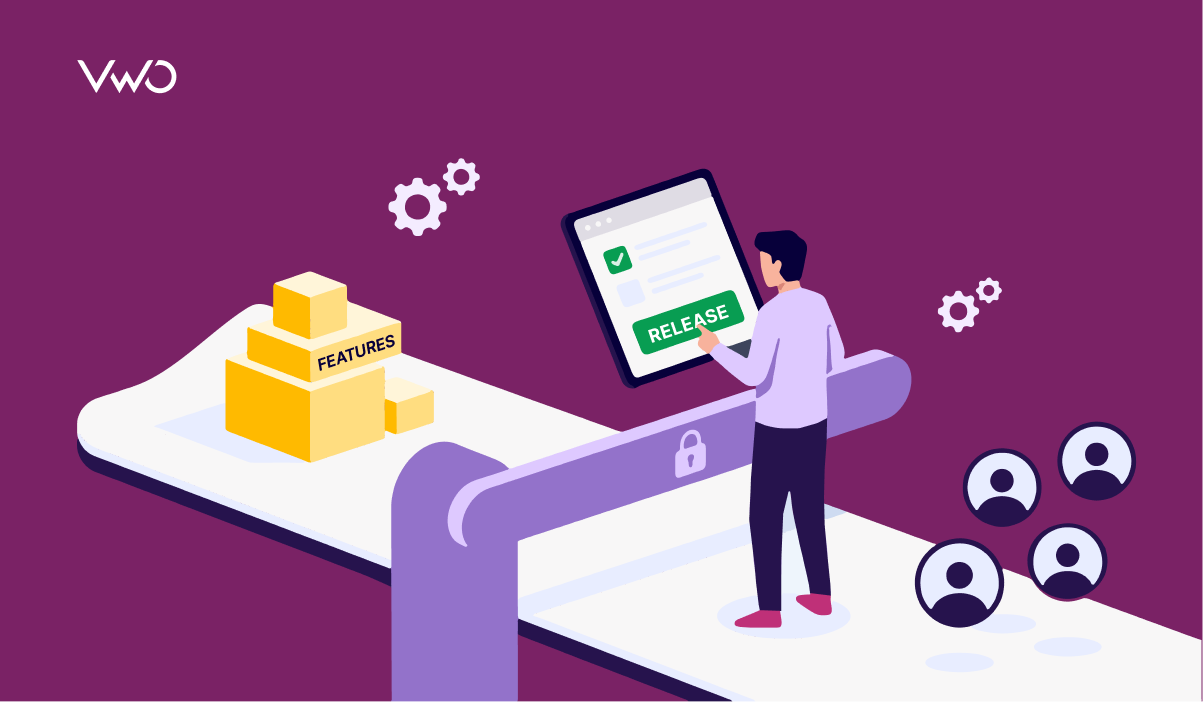
Release management is the discipline of deploying software while intentionally controlling how and when features reach users, using gradual rollouts, targeted exposure, experimentation, and instant rollbacks to reduce risk and scale proven outcomes.
These changes span new feature launches and iterations, backend and infrastructure updates, UI and UX improvements, and experiments across web, mobile, and server-side experiences.
The most important evolution in release management is that deployment, release, and learning are now treated as distinct steps. This allows teams to deploy code safely, control exposure, and validate impact through real user behavior before scaling.
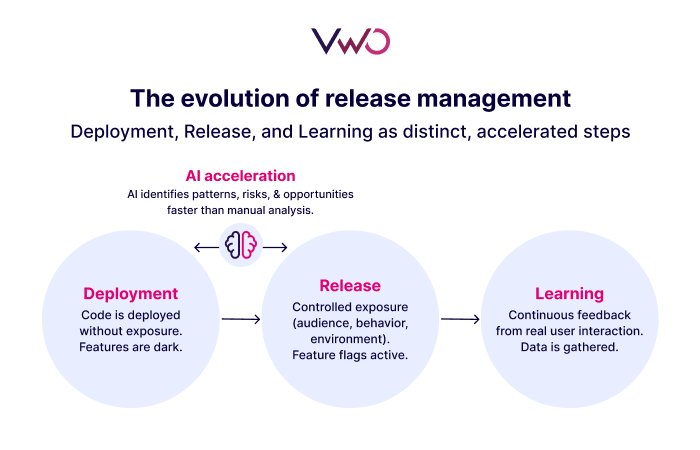
This image shows that code can be deployed without being exposed, and exposure can be controlled by audience, behavior, or environment. Learning happens continuously as real users interact with features. In addition, AI accelerates this loop by helping teams identify patterns, risks, and opportunities faster than manual analysis ever could.
In other words, just because the code is live doesn’t mean every user gets it. Teams roll out features gradually, test different versions, measure what works, and then decide what sticks.
As Jeff Bezos, Founder of Amazon, says,
If you double the number of experiments you do per year, you’re going to double your inventiveness.
And AI-driven release management makes that level of experimentation sustainable.
Picture a B2B SaaS company trying to bump up trial-to-paid conversions. Instead of launching a new pricing page to everyone, they show it to a small group, test a couple of versions, track conversions, and then roll it out to the wider audience with the winner.
The best setups make rollbacks so easy you barely think about them. If something tanks, turn it off. If it works, roll it out wider. That kind of safety enables teams to run experiments at scale confidently.
Now, consider an eCommerce brand introducing a new checkout experience. A full rollout without validation risks immediate revenue loss. A controlled rollout allows the team to detect friction early, measure conversion impact, and scale only what performs.
The best teams use systems that help them decide what to release, who should see it, and when to scale, with confidence.
Effective release management enables teams to:
- Ship high-impact features faster without unnecessary risk
- Limit the impact of change through gradual and controlled rollouts
- Detect issues early through real usage signals
- Align releases with measurable business outcomes
So, more than a tooling decision, effective release management is a competitive advantage.
Automation layer of modern releases
Continuous Integration & Continuous Delivery (CI/CD) pipelines provide the automation layer that makes modern release management possible. Together, they form the foundation of successful release management cycles.
With Continuous Integration, developers merge changes frequently, triggering automated builds and tests that maintain code quality.
Continuous Delivery, on the other hand, ensures applications are always in a releasable state, while humans retain control over exposure.
Continuous Deployment automates deployment entirely once checks pass.
A standard pipeline flows through commit, build, test, security checks, and deploy. If a stage fails, the pipeline stops and alerts the team.
CI/CD delivers speed and consistency. What it does not deliver on its own is intelligence, and that is where AI-powered feature management and experimentation come in.
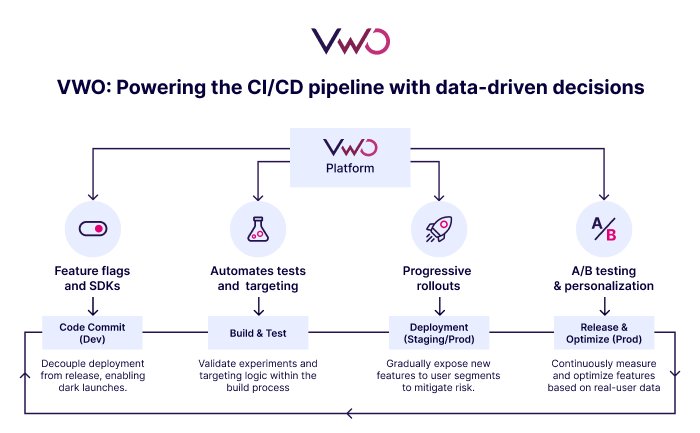
Control layer of modern releases
Feature flags are the control layer of modern releases. They separate deployment from exposure by allowing engineering teams to deploy code once and decide later who sees it.
This enables:
- Internal rollouts before external exposure
- Gradual expansion to defined user segments
- Immediate rollback without redeployment
For example, a SaaS company launching a new reporting module might enable it for internal teams, expand to beta users, and only then roll it out broadly. Performance and adoption data guide every step.
Feature flags remove uncertainty from releases. When combined with experimentation and AI, they also guide which features deserve to scale.
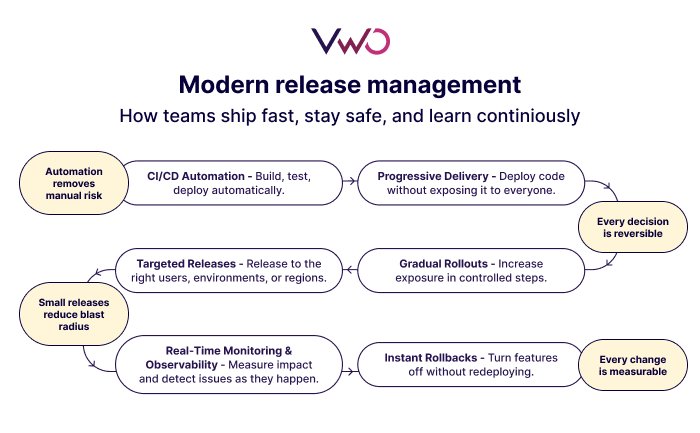
At its core, modern release management is about controlling how change reaches users. Instead of releasing features to everyone at once, teams now use progressive delivery, gradual rollouts, targeted releases, and automated controls to ship safely. CI/CD automation handles speed, real-time monitoring provides visibility, and rollbacks ensure recovery when things don’t go as planned.
Think of it as a connected system, not a checklist. Each part supports the next. Every step feeds the next. Together, they turn releases into controlled, measurable, and repeatable motions.
| CI/CD Automation | Progressive Delivery | Gradual Rollouts | Targeted Releases | Real-Time Monitoring | Rollbacks | Takeaway | |
| Product Managers | Your production line features are built and validated automatically. | A soft launch instead of a big reveal. | Start small, prove impact, then scale. | Different users see different experiences based on readiness. | Live feedback on adoption, conversion, and engagement. | A safety net, if a feature underperforms. | Releases become data-backed product decisions. |
| Developers & DevOps | Pipelines handle build, test, and deploy consistently across environments. | Code reaches production without immediate user exposure. | Increase traffic in controlled increments to manage load and risk. | Enable features by service, environment, region, or user segment. | Track errors, latency, throughput, and system health as changes roll out. | Disable features instantly without redeploying or rolling back binaries. | Releases become predictable, observable, and reversible by default. |
Role of AI
AI elevates release management from reactive control to proactive decision-making. It helps teams identify risky releases earlier, surface performance anomalies faster, understand feature impact across segments, and prioritize what to scale and what to stop.
Instead of manually analyzing dashboards, teams can focus on decisions. AI highlights where attention is needed, while experimentation confirms what works.
This is especially critical for high-velocity teams shipping across web, mobile, and server-side environments simultaneously.
Avoid the most common release management failures
The most common release management failures are rarely caused by bad code. They usually come from process gaps, missing controls, and a lack of learning loops. Below are the failures that show up repeatedly across SaaS, eCommerce, and enterprise product teams, explained plainly and without fluff.
| S. No. | Common Mistakes | Belief | Why this fails | What works better |
| 1 | Treating deployment and release as the same thing | Many teams still assume that once code is deployed, it must be exposed to everyone. | – A defect immediately affects all users – Rollbacks require redeployments under pressure – Teams lose the ability to test in real production conditions safely | They deploy code independently and control exposure using feature flags, progressive rollouts, and experimentation. |
| 2 | Releasing too many changes at once | Large, bundled releases make it difficult to understand what caused an issue or success. | – Root cause analysis becomes slow and inaccurate – Rollbacks affect unrelated functionality – Learning is diluted across multiple changes | Smaller, isolated releases with clear ownership and measurable outcomes. |
| 3 | No clear rollback or kill-switch strategy | Some teams assume rollbacks are rare and can be handled later. | – Recovery takes longer than expected – Teams scramble to fix production issues – Customer impact increases with every minute of delay | Feature-level kill switches that allow instant rollback without redeploying code. |
| 4 | Shipping without measuring real user impact | Releases are often judged as “successful” because they shipped, not because they delivered value. | – Teams don’t know if features improve or hurt key metrics – Poor-performing features stay live too long – Decision-making relies on opinions instead of evidence | Treat every release as a hypothesis and measure impact through experimentation and post-release analysis. |
| 5 | Weak coordination across teams, or a lack of ownership and accountability | Release decisions are often made in engineering silos without visibility for product, marketing, or support. | – Support teams are unprepared for user questions – Marketing launches features that are not fully stable – Conflicting priorities delay response during incidents | Shared release visibility and accountability, clear communication, and ownership across all stakeholders – product, engineering, and DevOps. |
| 6 | Overreliance on manual checks | Manual testing and approvals do not scale with release frequency. | – Human error increases under time pressure – Releases slow down as teams grow – Inconsistent standards creep in | Automated CI/CD pipelines combined with controlled release mechanisms and monitoring. |
| 7 | Ignoring risk signals after release | Some teams stop paying attention once a release is live. | – Early warning signs go unnoticed – Small regressions become major incidents – Teams react only after customer complaints | Real-time monitoring, alerts, and AI-assisted anomaly detection tied directly to releases. |
| 8 | Treating experimentation as optional | Experimentation is often seen as something to do later or only for major changes. | – Teams ship based on assumptions – Risk increases with every unvalidated release – Learning slows over time | Embedding experimentation directly into the release process so learning happens by default. |
| 10 | Optimizing for speed instead of outcomes | Some teams measure success by how fast they ship. | – Fast releases without validation increase risk – Teams ship more but learn less – Technical debt accumulates silently | Optimizing for speed with confidence, shipping fast while continuously measuring outcomes. |
All of these failures share a common root cause: lack of control and lack of learning.
Modern release management succeeds when deployment is decoupled from exposure, every feature is flagged, every release is measured, and every risk has a control mechanism.
This is why feature management and experimentation platforms like VWO Feature Experimentation have become central to how modern teams release features. VWO’s AI-supported release management makes these practices easier to sustain at scale.
Use cases in the real world
Retail & eCommerce: Rolling out new checkout flows, launching seasonal campaigns, testing prices, and release management keep things smooth even when traffic spikes.
SaaS & B2B: Shipping features without interrupting customers, running phased rollouts for big clients, juggling multi-tenant setups.
Financial services: Staying compliant, limiting the fallout from changes, and keeping systems up during releases.
Media & publishing: Updating content platforms, experimenting with layouts, shipping updates often without tanking performance.
Selecting the right tool
Tools help, but they aren’t the whole story. Most teams use GitHub or GitLab for source control, Jenkins or GitHub Actions for CI/CD, feature flag tools for safer rollouts, and monitoring for visibility after launch. The point isn’t more tools, but a smoother flow.
Release management is evolving toward systems that are experiment-led, AI-assisted, data-driven, and omnichannel by default. It’s getting more automated. AI will spot risky releases before they hit users. Feature flags will be everywhere. Releases will get smaller, safer, and just part of the daily routine.
Winning teams aren’t the ones shipping the most code, but the ones who ship confidently.
And as per the product experimentation maxim,
Every feature is a hypothesis until users prove otherwise.
VWO Feature Experimentation
VWO Feature Experimentation is designed for modern, high-velocity teams that manage releases consistently and move fast without sacrificing control.
It is a feature management and experimentation solution that empowers teams to:
- Ship high-impact features faster without the risk
- Deploy once and release gradually
- Run experiments across the entire stack with omnichannel testing
- Measure real user impact for every feature
VWO is easy to implement and hassle-free to use, with SDKs that speak your language and support multiple environments. It is built to serve diverse use cases at scale, from simple rollouts to complex, AI-informed experimentation programs.
VWO Feature Experimentation works in-sync with developers’ favourite stack. Its strong MCP server support offers:
- AI-native feature flag control: Manage and operate feature flags directly from your AI-powered IDE, without breaking your development flow.
- End-to-end flag lifecycle, in one place: Create, view, update, toggle, and remove feature flags across all environments, instantly from your IDE.
- Instant SDK bootstrapping: Auto-configure Cursor rules and generate language-specific SDK code samples with a single command.
- Intelligent flag hygiene: Scan your codebase to detect stale or unused feature flags and keep your system clean and maintainable.
- Zero-friction installation: Install via npx using your VWO credentials and get started immediately, no complex setup or configuration needed.
For engineers and DevOps, it means release management fits naturally into everyday workflows: you can work with feature flags directly from your IDE and validate flag behaviour automatically in CI/CD, so shipping and safeguarding features feels like part of coding, not an extra process. This reduces context switching, catches issues earlier, and lets developers move fast without losing control over how code reaches production.
For product and marketing teams, it means decisions backed by evidence, not intuition.
Get started with VWO Feature Experimentation
Speed alone isn’t enough. You need to know which features should scale and which ones shouldn’t leave beta. VWO lets dev teams release code safely, measure real user impact, and make decisions backed by data.
With AI, experimentation, and feature management working together, releases become safer, smarter, and more impactful.
Take a 30-day free trial or book a demo to see how VWO Feature Experimentation can make your releases easier, safer, and way more effective. Ship with confidence. Learn faster. Scale what works.
Categories: